Many of us are fortunate to have the legacy guns of our fathers, grandfathers, and great grandfathers tucked safely away. These guns testify to a different time, and for some, to a heritage that we will be passing on to our succeeding generations.
by Paul G Markel
Back in the good old days, before the Internet or even cable TV and the 24-hour news cycle, folks sought entertainment through travel and outdoor activities. Growing up in Detroit in the 1970s, many of our grandparents had what we referred to as “a cabin up north.”
If you know anything about Michigan geography, just about every part of the Wolverine State, or the “Big Mitten,” is north of Detroit. During the economic boom of the post-WWII era, it was quite common for those who made their living in the greater metropolitan area of the Motor City to purchase a couple acres with a rustic cabin either near Saginaw Bay or adjacent to one of the thousands of lakes spread across the lower peninsula.
The Cabin Up North
It was at Grandpa’s cabin up north that I fell in love with shooting — first with a lever-action Daisy BB gun. No, it was not a Red Ryder model. If memory serves (and it usually does), the lever-action Daisy that my maternal grandfather showed me how to shoot was the Model 155. I suppose I was ten or eleven years old when Grandpa let me loose to wander the countryside around Saginaw Bay with my “blued-steel beauty.” Believe it or not, the few neighbors in the area did not witness the sight of a young man with a “gun” and call out the SWAT team.
While I was considered a bit too young for “real guns” at that time, I recall that Grandpa would pull out his .22 pistols occasionally for some target shooting. Both my maternal and paternal grandparents had cabins up north, and while I would not describe them as part of the “gun culture,” they were the American Culture and all of them had .22 LR rifles and handguns. I recall my dad relating stories of his mother shooting chipmunks up north with a single-shot .22 rifle loaded with “22 Shorts.” Back before the era of the suppressor, if you wanted to shoot quietly, you loaded up the subsonic .22 Short rimfire in a bolt-action single-shot rifle. The neighbors were not at all bothered.
Guns of Our Fathers
Now I am a grandfather, and my father and my grandfathers have completed their journeys here on earth. In addition to the memories of all those weekends and summer vacations spent at the cabins up north, like many of you, I inherited some firearms from them.
You will not be surprised to learn that .22-caliber revolvers were some of the most common firearms owned by our parents and grandparents in the 1950s, ’60s and ’70s. The firearms that I inherited are akin to living memories. Each time I take them out and shoot, I am reminded of my family, my father, grandfathers, and all they shared with me as I was growing up.
Let’s take a closer look at some of these classic revolvers from a bygone era.
Harrington & Richardson Model 900 DA/SA
Harrington & Richardson has seen its ups and down over the last 150 years. One of many gun companies to originate in Massachusetts (the irony…), H&R produced firearms for WWII to include the Reising .45 ACP submachine gun, as well as post-WWII M1 Garands, M14s, and M16s.
In 2000, H&R was purchased by Marlin Firearms, and then during the GWoT gunmaker boom, when all the Wall Street investors sought to profit from the firearms business, H&R was purchased by the Remington Arms/Freedom Group conglomerate. Not surprisingly, when GWoT ended disastrously, the investors scrambled to dump gunmaker stocks and the Freedom Group was broken up and all its brands sold in what you might describe as a fire sale. The investment group that owns Palmetto State Armory now owns the Harrington & Richardson IP.
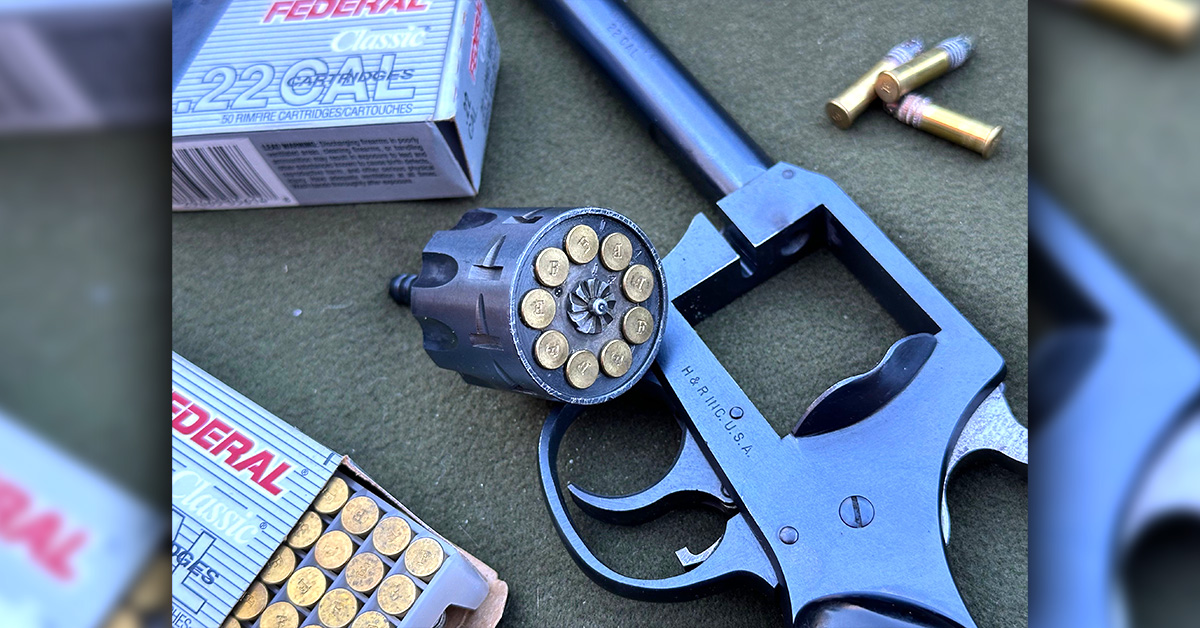
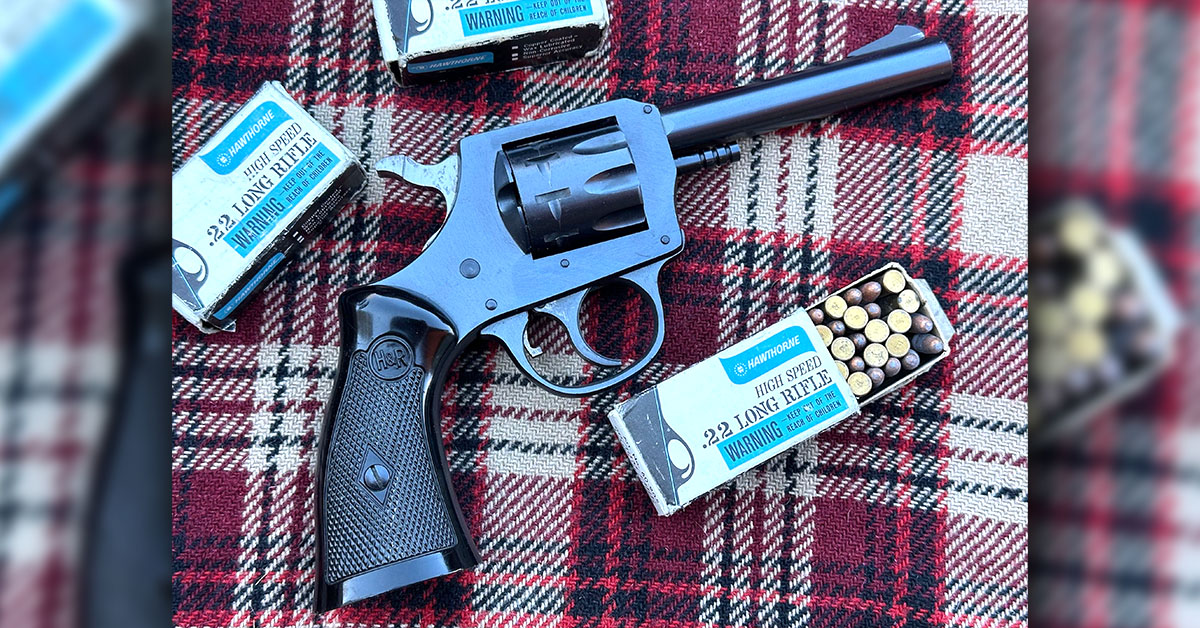
The particular H&R firearm featured here is the Model 900 — a .22-caliber rimfire DA/SA revolver that holds nine rounds of ammunition in its cylinder. Being a price point firearm, the Model 900 has a “pop-out” cylinder versus the swing-out style most of you are used to. To load the HR 900, you pull out on the cylinder pin and pop the cylinder out of the gun. Load it up and reinstall it. Spent cases are knocked out with a star and ejector rod. The grips are checkered black plastic.
According to the company history that I could access, the H&R Model 900 was available with either a 2.5-, 4-, or 6-inch barrel. This version has a 4-inch barrel. Also, records indicate that H&R made the Model 900 handguns from 1964 to 1976. Using the serial number on the gun, I was able to determine that this particular revolver was likely made around 1965.
Ruger Bearcat Single-Action
Like many American gunmakers, Ruger has a habit of releasing a gun, discontinuing it, and then coming out with a “new” model a decade or two later. The Ruger Bearcat .22 LR single-action revolver seen here has the original design with an engraved cylinder featuring a bear and a mountain lion along with the words “Ruger Bearcat.”
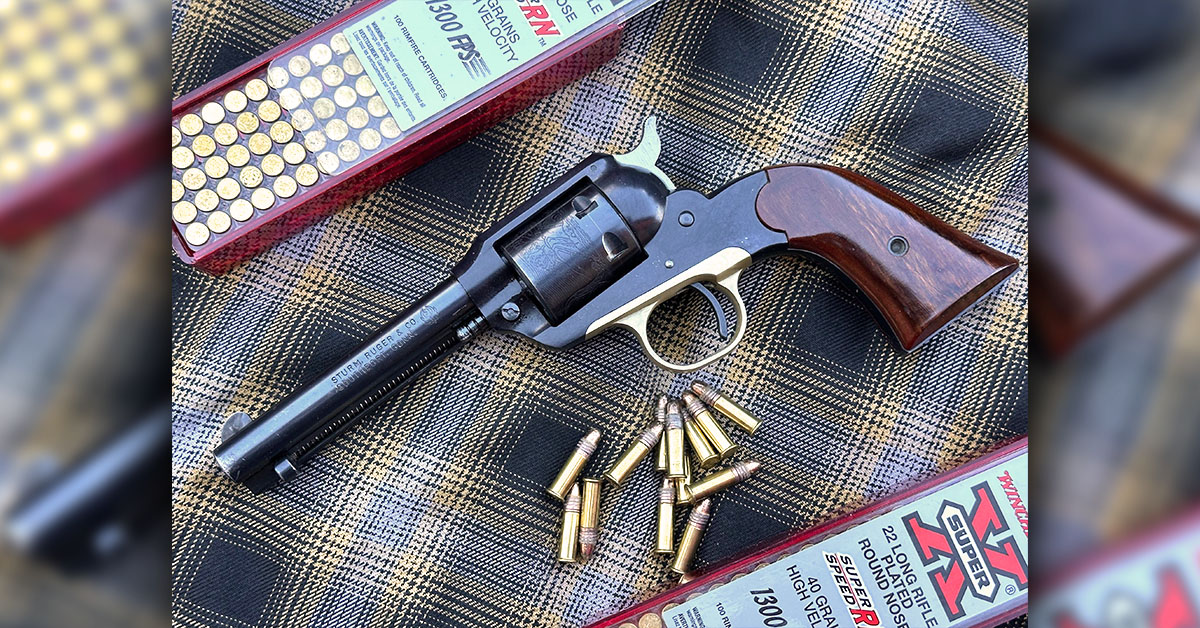
This handgun is Ruger’s single-action design with a six-shot cylinder and loading gate on the right side. Sights are old-school — a channel on top of the frame and a wide half-moon front sight over the muzzle. Spent cases are knocked out manually with the traditional spring-loaded ejector rod that rides under the 4-inch barrel. The trigger guard is brass, and the rest of the revolver is blued steel with hardwood grips.
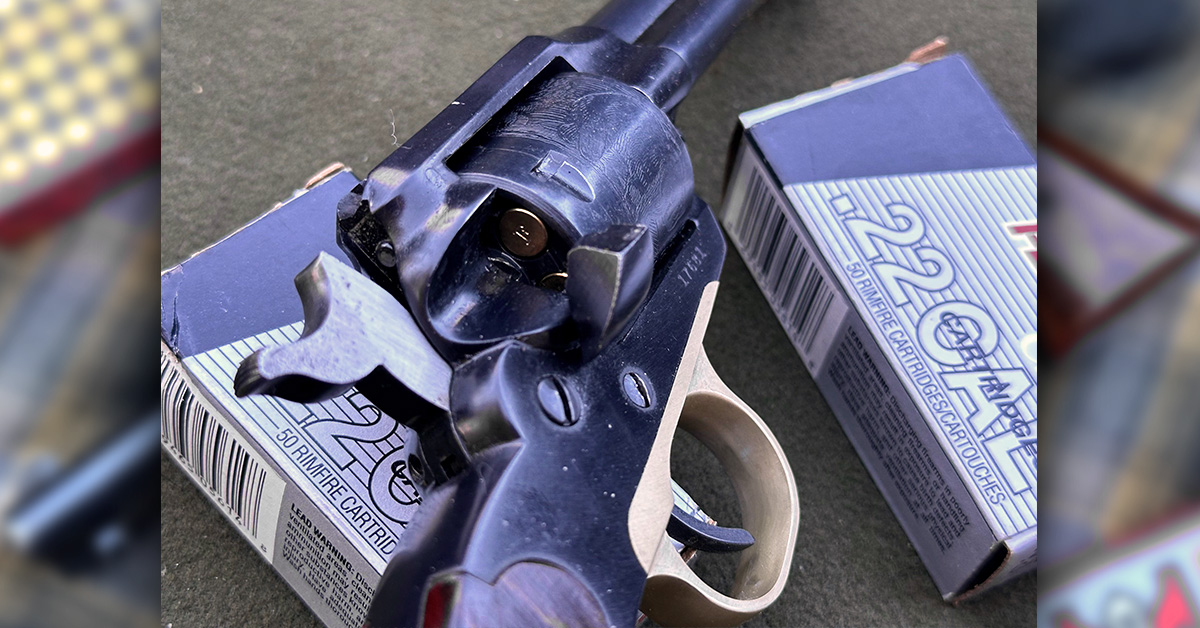
As I did with the H&R gun, I used the serial number on the Bearcat to determine that it was produced in the early 1960s. Despite its age, the action was smooth as butter and the trigger crisp and precise. Not unexpectedly, the sights were set up for a six o’clock hold. That is, you hold the front sight underneath the target to get center hits. That was very common back in the old days.
Once more, according to records, Ruger made the original Bearcat revolvers from 1958 to 1974. Then they waited a while and released the “new Bearcat” models in 1993. The new versions are still available and listed on their website.
Smith & Wesson Model 34-1 “Kit Gun”
Lastly, let’s consider the Smith & Wesson Model 34-1, also known as the “Kit Gun.” This blued steel “J-frame” double-action .22 LR revolver was marketed as the perfect companion for hiking, fishing, and backpacking; hence the moniker “kit gun.” Per the available records, Smith & Wesson made the Model 34-1 revolvers from 1960 to 1988. The serial number tracking for the gun shown here indicated an early 1960s production.
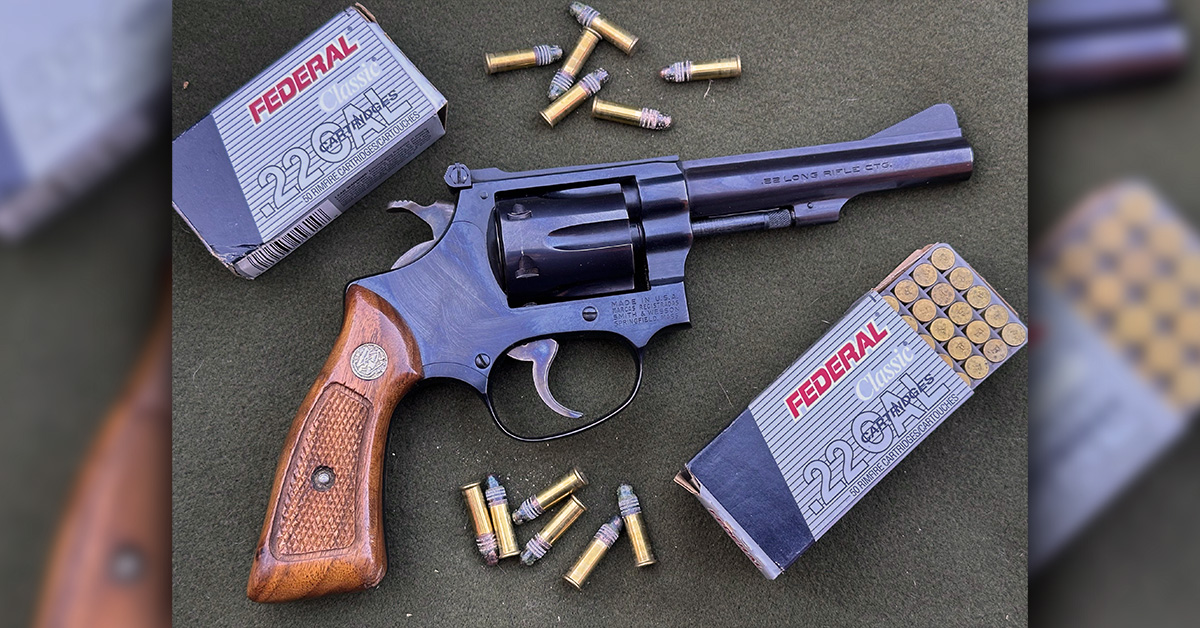
This 4-inch barrel DA revolver has the traditional swing-out cylinder made famous by the S&W Model 10. Six shots of .22 rimfire ammunition are held in it. For this gun, S&W put an adjustable “target” rear sight on it to align the ramped front sight. The hardwood grips are checkered and in the traditional J-frame style with the S&W logo. Like the original Model 10, the ejector rod is exposed or non-shrouded and the cylinder is fluted as you would see on the larger centerfire revolvers.
As I was coming of age in the gun culture, I can recall reading stories in gun magazines about the “S&W Kit Gun” and listening to my elders discuss them with reverence. When it came to .22 revolvers, it seemed that the S&W Model 34 was the benchmark.
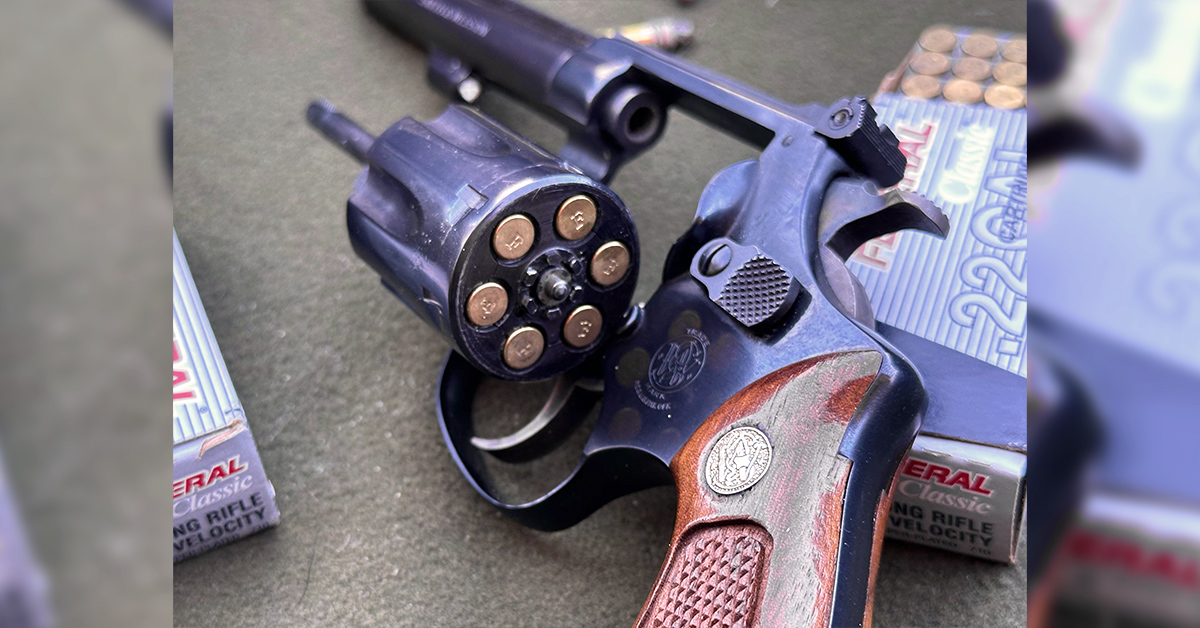
While the sought-after Model 34 is no longer in production, Smith & Wesson does still have a rimfire wheelgun listed as a “Kit Gun” on their website. The Model 317 is a fancy stainless-steel handgun with rubber grips and fiber-optic sights holding eight rounds in the cylinder.
Parting Thoughts
In addition to the inherited firearms, I also received numerous full and partial boxes of .22 LR, .22 Long, and .22 Short rimfire ammunition. Some were from classic makers such as the old yellow box Winchester “Super X” and some were more rare, such as the “Hawthorne” ammunition made exclusively for Montgomery Ward stores.
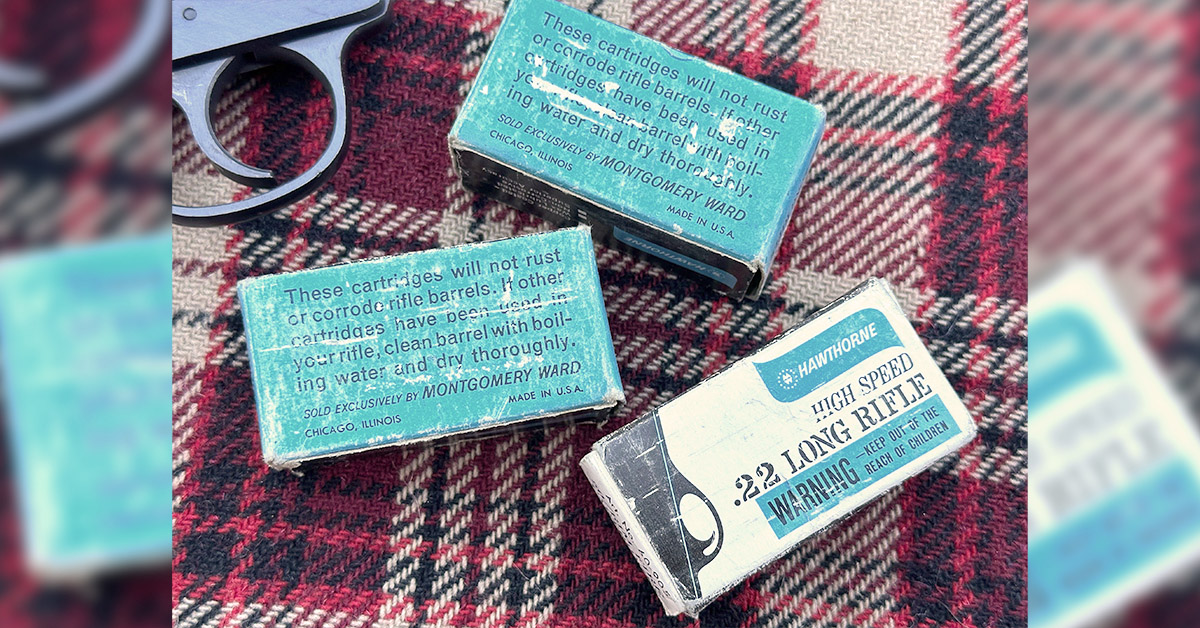
Yes, kids, your grandpas and great grandpas used to be able to go into a Sears & Roebuck or Montgomery Ward department store and walk out with a handgun, rifle, or shotgun along with the ammunition to feed it. If they were hungry, they could stop at the famous Montgomery Ward lunch counter for a hamburger and a Coke and likely spend around $2 for both. If you weren’t that hungry, you could get a coffee and a muffin for 55¢.
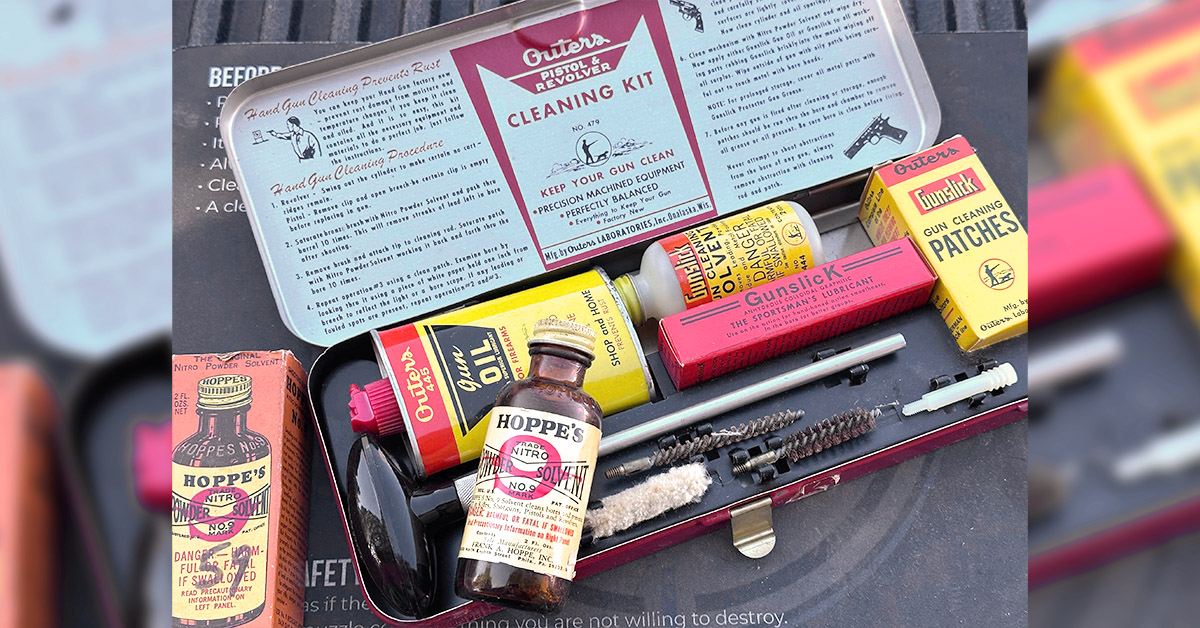
Of course, no hand-me-down gun collection would be complete without a cleaning kit. Our fathers and grandfathers swore by Outers and the classic Hoppes #9 solvent. The kit featured here came in the old-school tin box, not plastic.
At risk of sounding like an “old guy,” in my humble opinion, it was a better time. At least, life had a slower pace with fewer distractions. It is my hope that many of you have cherished family firearms to pass down to your grandkids.