The lightweight leader of Benelli’s pack, the Lupo Alpha blends ergonomic refinement and platform strength with factory accuracy worth boasting about
by Mike Dickerson
Modernista. Futurista.
These Italian words translate to modernist and futuristic, and they apply to Benelli’s new Lupo Alpha special edition rifle.
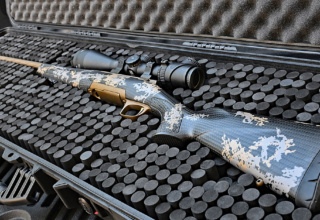
Even at a glance, it’s obvious that the Lupo Alpha departs radically from traditional bolt-action rifle design and appearance. That’s due to the rifle’s unique 3D-printed stock, which has modern lines and a dozen sculpted holes. This design isn’t just about being Euro-stylish. There’s a practical reason for it. The stock is engineered under the principles of biomimicry to imitate the porous, hollow, and truss-filled structure of bird bones. The result isn’t just a futuristic-looking stock. It’s a lighter and stronger stock with enhanced structural integrity.
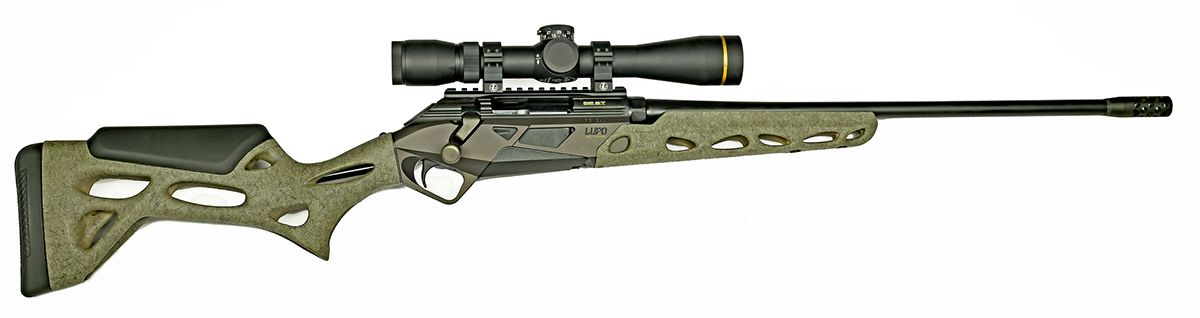
With this stock, the rifle weighs just 5.73 lbs., and that, combined with a special weatherproof finish, makes the Alpha a true go-anywhere gun. Initial production is limited to rifles chambered in 308 Win with 20-inch barrels and 300 Win Mag with 22-inch barrels. Some reviewers have stated that only 1,000 rifles in 308 Win will be made, but that is not accurate. That is simply the annual production limit of the machines used to 3D-print the stock, and there is no long-term production cap, according to Benelli representatives.
The Lupo Alpha is well-named. Lupo means wolf in Italian, and “alpha” is a widely used metaphor for the leader of a pack. Pricewise, the Alpha has the same steep $3,199 price tag as the Lupo HPR rifle, but they are very different guns. The HPR weighs a hefty 9.4-10.4 lbs. Benelli calls it a “hybrid” design, combining a chassis with a heavier adjustable stock, making it at home as a varminter or a big game rifle in open country. The ultralight Alpha, in contrast, was created to hunt anywhere under any conditions.
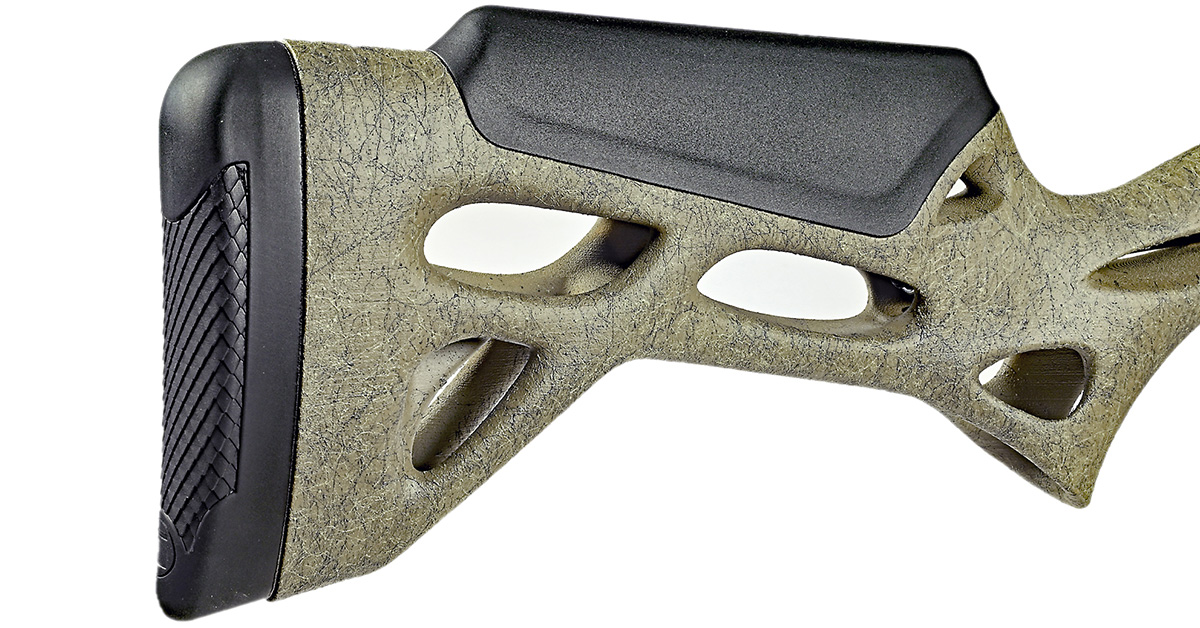
The stock does not have the same degree of adjustability as the HPR stocks, but the Alpha ships with shims that can be inserted between the buttstock and the action to adjust drop and cast. Similarly, the Alpha does not have the Progressive Comfort recoil system of other Lupo models, but neither does it have their weight. Recoil in this lightweight rifle is mitigated by use of a soft CombTech cheek pad, substantial recoil pad, and radial muzzle brake.
Interestingly, the Alpha’s stock does not come with sling swivel studs in place. Instead, they are provided as part of an included accessory kit. Before you can screw them into molded stud holes, which accept standard sling swivel studs, you must pop out rubber plugs in the bottom of the stock.
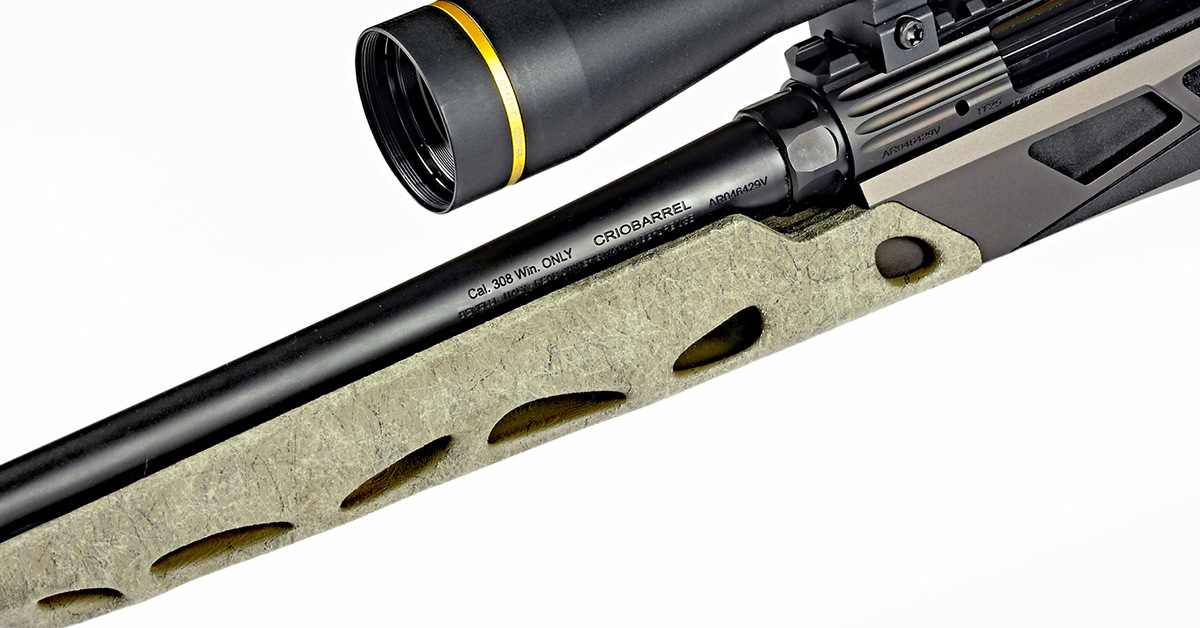
The Alpha’s barrels differ substantially from most factory-produced rifle barrels, and that likely accounts for the rifle’s excellent accuracy in my testing. A simplified explanation is that Benelli finalizes manufacturing of the barrels in a three-stage process that the company says locks in precision by controlling stress and preserving straightness.
The first stage is a vacuum heat treatment that eliminates stress at a molecular level. This creates a barrel that resists deformation. The second stage is electrochemical rifling, versus traditional rifling. Benelli says this process produces uniform lands and grooves, and preserves bore straightness. In the final stage, barrels are subjected to a minus 300-degree cryogenic treatment. This relieves any remaining micro stress, boosting accuracy and durability.
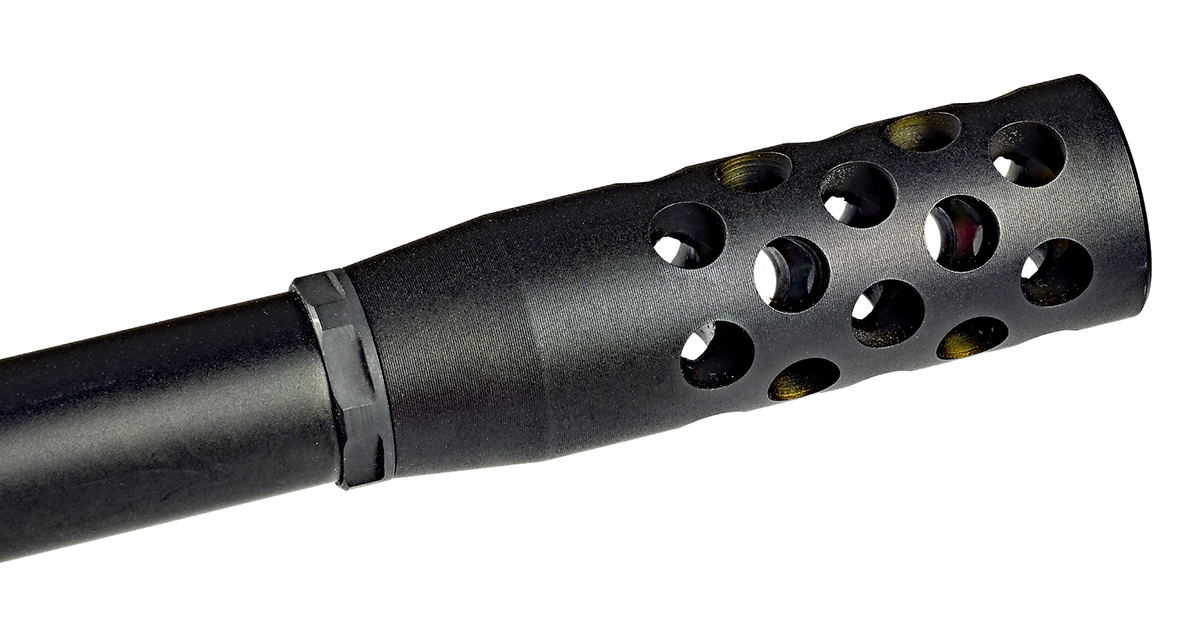
Notably, barrels are threaded 3/4×24 and topped with a radial muzzle brake, which can easily be replaced with a suppressor of your choice. Rate of twist for both current chamberings is 1:10.
Barrels and actions are protected with a BE.S.T (Benelli Surface Treatment) finish. This proprietary matte-black finish is actually a combination of plasma-enhanced chemical vapor deposition and physical vapor deposition technologies. This makes exposed metal about as impervious to the elements as you can make it. The matte-back finish contrasts nicely with the charred timber color of the stock, which is essentially a gray-with-black-splatter pattern.
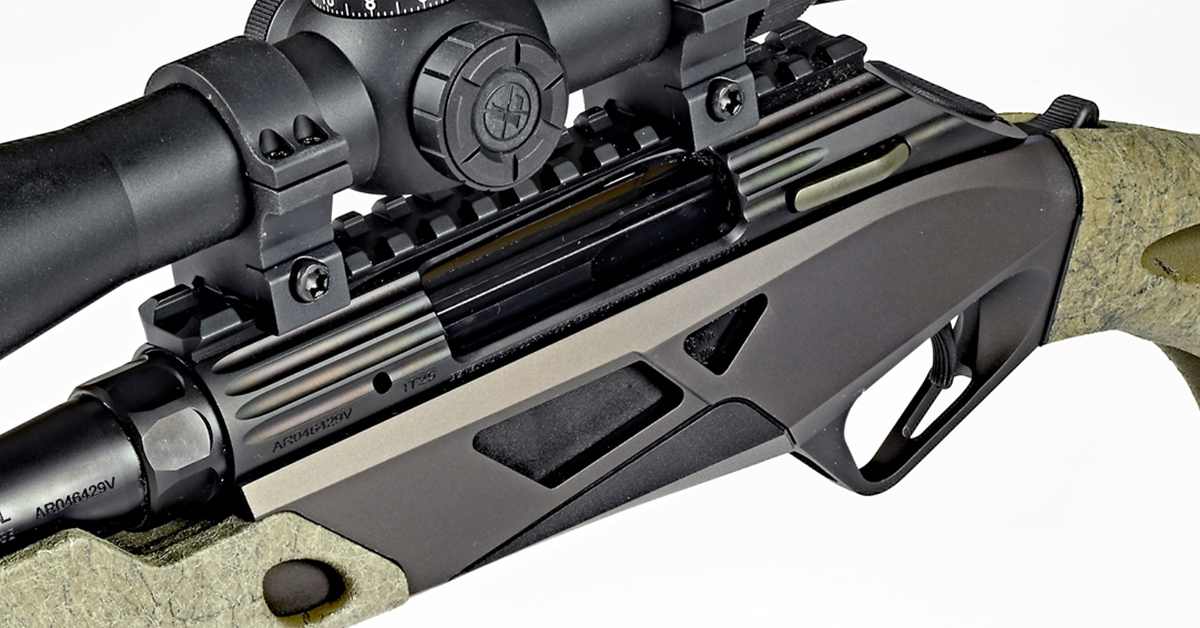
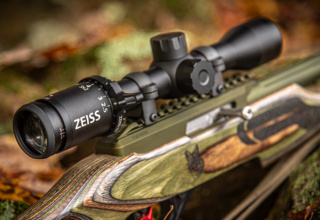
The Alpha’s action is pretty much the standard Lupo action, which is to say it’s not a standard action at all. It’s a chassis-type design in which the free-floated barrel attaches to a steel block within an alloy receiver, but the Alpha’s receiver has a few lightening cuts in it to reduce weight. The action is instantly recognizable thanks to the sharply angled and sculpted bolt handle, which has a short, 60-degree throw.
This has a couple of real benefits.
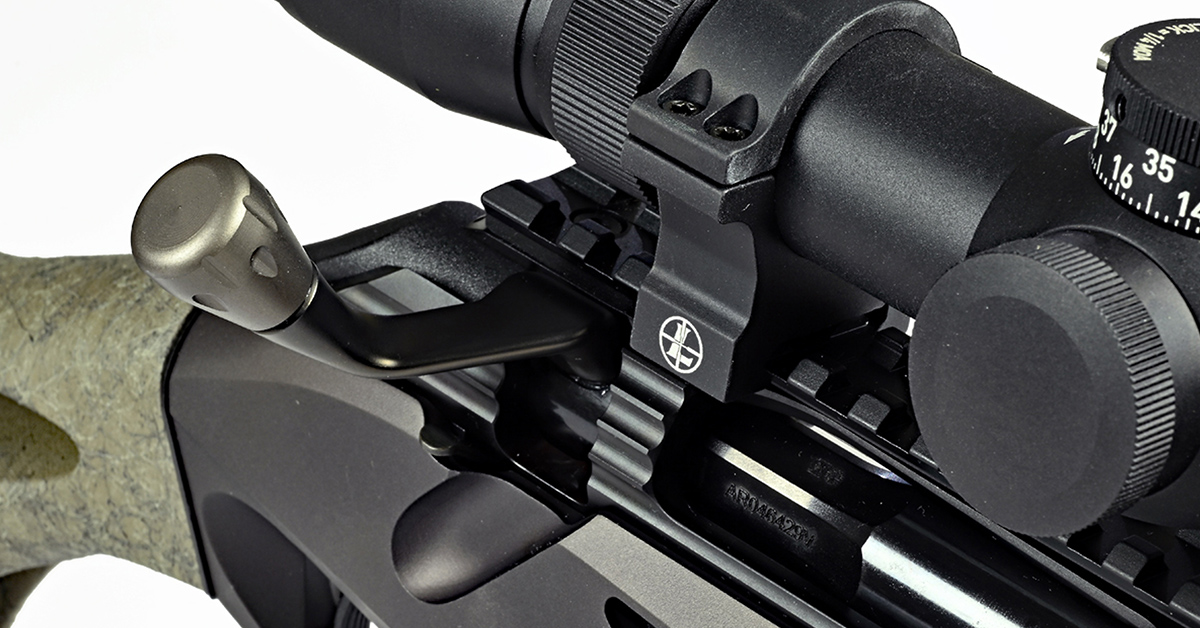
First, it helps you run the gun faster for quick follow-up shots. It also allows ample clearance to mount scopes, and you should be able to use low mounts on the factory pre-installed Picatinny rail that rides atop the receiver. The bolt is a partially fluted, three-lug design that cycles with exceptional smoothness. It uses a standard plunger-style ejector and a strong claw-style extractor.
I will freely admit that I am a bit of a snob when it comes to rifle triggers. I simply cannot abide a creepy or mushy trigger with an unnecessarily heavy trigger pull. Such triggers destroy accuracy. That’s especially true with very light rifles like the Alpha. Even a slight amount of finger pressure on an ultralight rifle will likely transmit some wobble to the scope’s crosshairs.
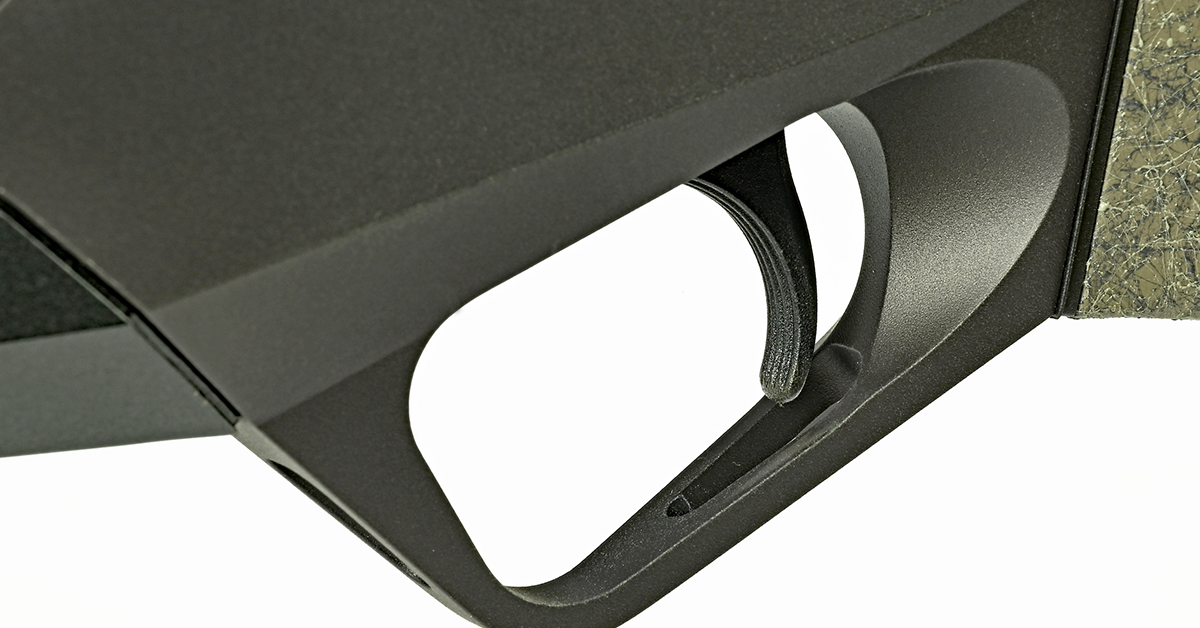
Happily, that is not the case with the Alpha, which is equipped with an excellent trigger. The trigger on my test rifle, chambered in 308 Win, broke crisply and consistently at a pull weight of 2 lbs., 1 oz. That’s about as light as I care to go with a hunting rifle, so I saw no need to adjust the trigger.
If you do want to adjust it, you can do so without having to pull the barreled action from the receiver. You simply pull the detachable magazine from the rifle, locate the trigger housing inside the magazine well, and use the supplied Allen wrench to adjust trigger pull weight.
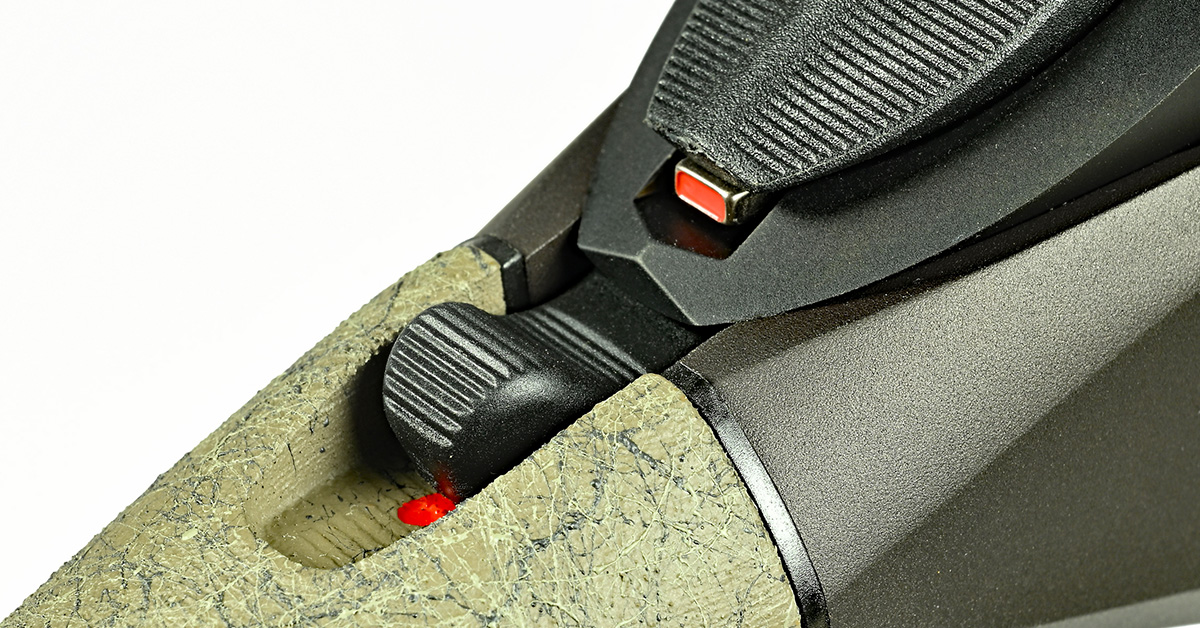
The trigger is mated to a two-position, tang-mounted safety that locks down the bolt when the safety is engaged. I prefer that arrangement because it precludes the possibility of brush snagging on the bolt handle and inadvertently opening the bolt at an inopportune moment. The safety requires just enough pressure to operate that it is very unlikely to be accidentally pushed to the engaged or disengaged position.
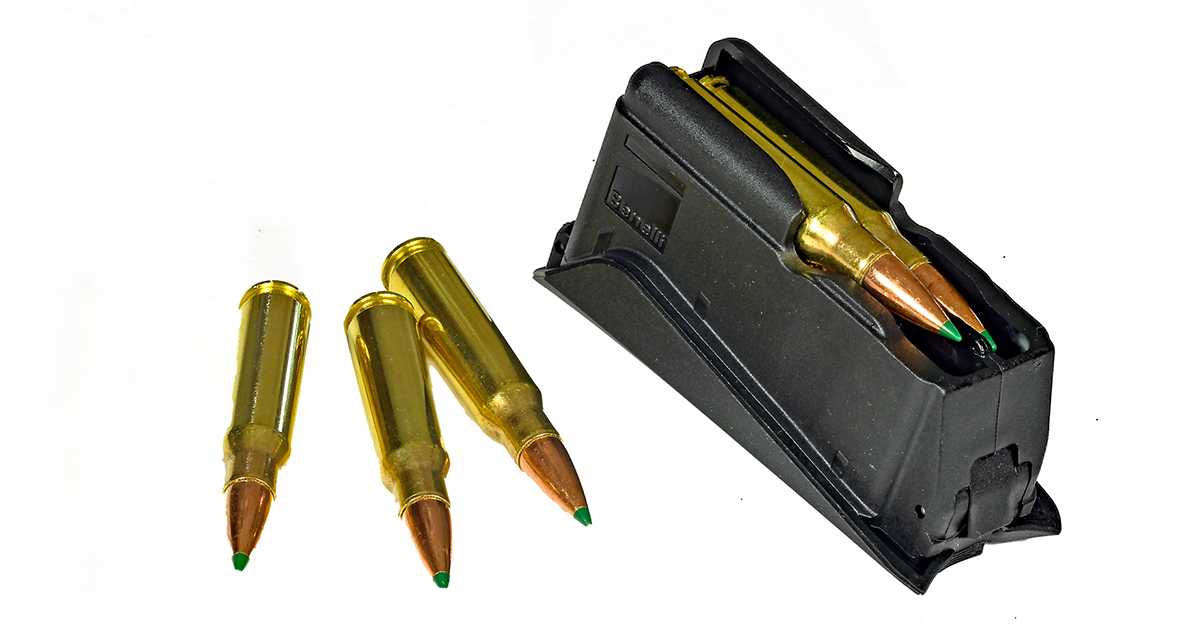
The Alpha uses a proprietary detachable polymer magazine. Capacity is five rounds in 308 Win and four rounds in 300 Win Mag. I found it easy to stuff rounds into the magazine, which had no issues feeding rounds reliably into the action. The magazine was a little sticky when inserting or removing it from the action, but that also makes it much less likely to be dropped by accident when maneuvering through heavy brush. Despite its five-round capacity, the magazine sits flush with the bottom of the magazine, so there’s little on this gun to snag.
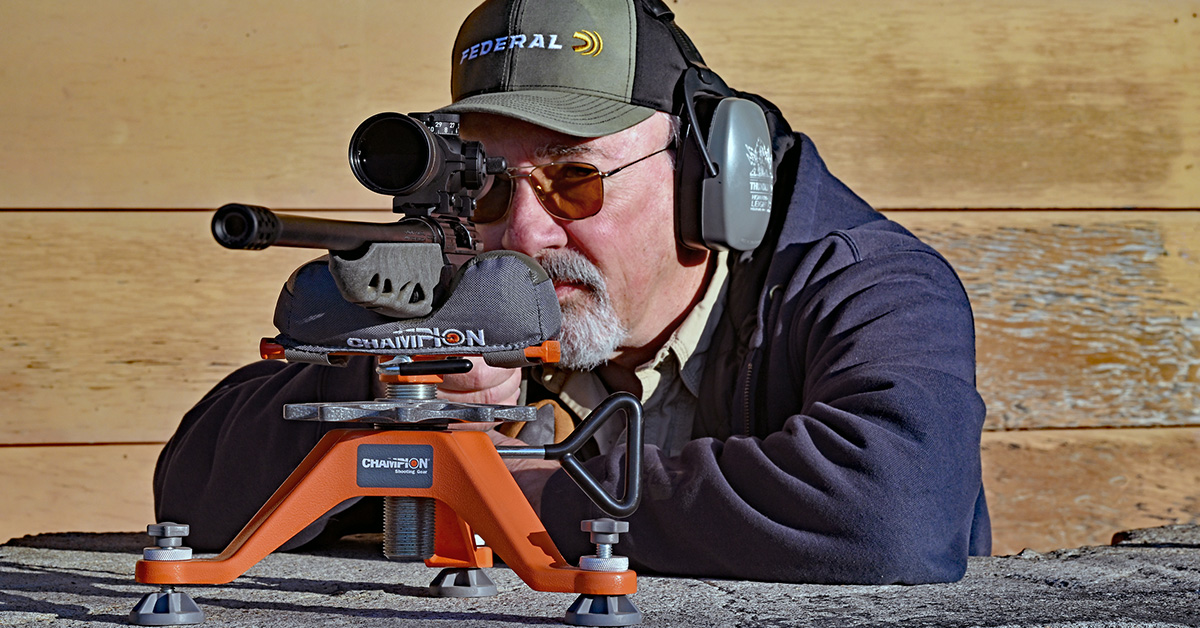
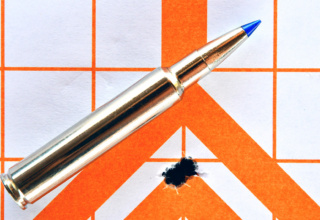
I was eager to test the Alpha at the range to see if it would live up to Benelli’s claims for the gun. Benelli says they test every Lupo before shipment to verify sub-MOA accuracy, and the rifles ship with proof. Mine arrived with a printed target group showing that the gun shot a 0.68-in. group with Federal’s Gold Medal 168-grain 308 Win load. I tested that same match load and did even better with a 0.48-inch best group. The same load produced 0.80-inch average groups, but that was not even the best load tested. The top dog in terms of accuracy was Nosler’s 150-gr. Ballistic Tip load, which printed average groups measuring 0.41 inches and a best group of just 0.38 inches, or a single ragged hole. Hornady’s 150-gr. American Whitetail load also turned in sub-MOA performance.
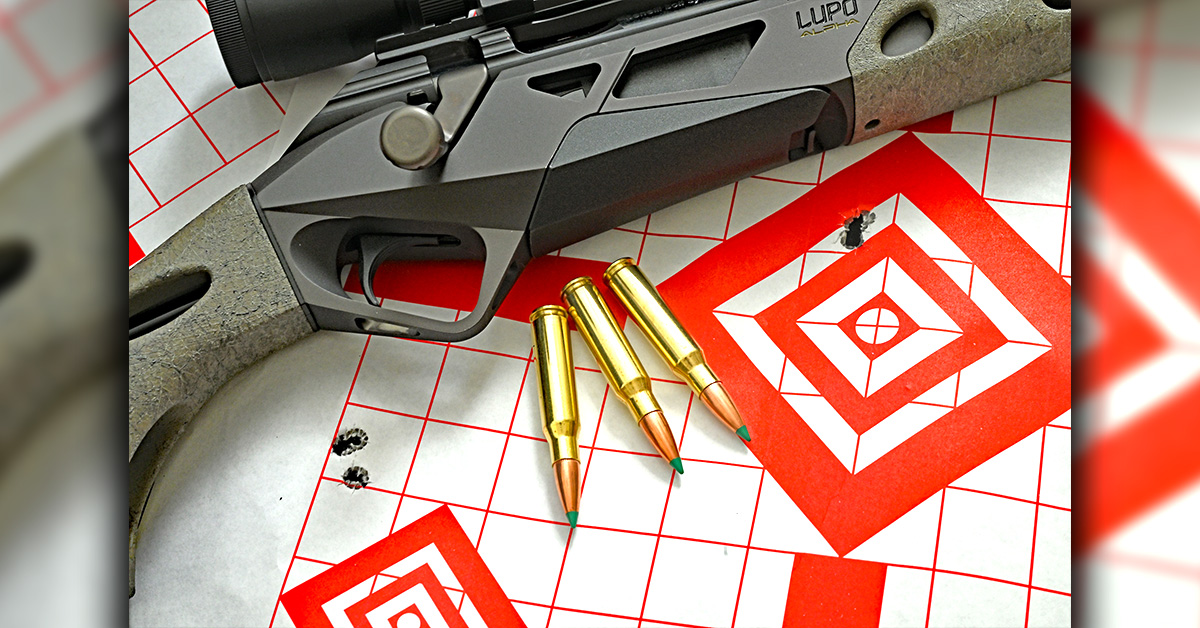
Two other tested loads turned in sub-MOA best groups, but their average groups measured just slightly over one MOA. These included Remington’s 165-gr. Core-Lokt load and Hornady’s 178-gr. Precision Hunter load.
Clearly, in the hands of a shooter experienced in shooting ultralight rifles, the Alpha is superbly accurate. That’s especially true with ammo the rifle likes, but with these results, I wouldn’t hesitate to hunt with any of the four tested hunting loads.
Velocities, as measured with my Garmin Xero C1 Pro chrono, were slightly slower than factory-advertised velocities out of the rifle’s shorter 20-inch barrel. That was to be expected, and it honestly wouldn’t make much difference in the field. In trading away a slight amount of velocity, you gain a shorter, handier rifle, especially when you remove the muzzle brake and attach a suppressor.
Increasingly, that’s the type of lightweight package backcountry or mountain hunters want, and manufacturers like Benelli are listening. While the styling and price of the Lupo Alpha may not be for everyone, the rifle’s performance certainly is. Beauty, as they say, is truly in the eyes of the beholder.
Benelli Lupo Alpha Specifications
- Caliber: 308 Win, as tested
- Action Type: bolt action
- Barrel: 20-inch free-floating
- Threading: 3/4×24, muzzle brake attached
- Rate of Twist: 1:10
- Finish: matte black BE.S.T.
- Receiver: aluminum alloy with steel block
- Stock: 3D-printed synthetic
- Magazine/Capacity: detachable, 5+1
- Sights: none, Picatinny rail for optics
- Overall Length: 40.08 inches
- Weight: 5.73 pounds
- MSRP: $3,199

- In Defense of Three-Shot Groups and Other Fuddisms - August 10, 2026
- ACCURACY PROVEN! Benelli’s Lupo Alpha Bolt-Action Rifle - July 13, 2026
- TESTED: Riton 5 Primal 3-18×50 Riflescope - December 24, 2025