Looking back, I consider myself fortunate to have had so many dedicated, professional instructors when I went through the police academy back in 1992. Numerous lessons were learned and stuck with me. A couple of them are applicable to any person who carries a firearm, law enforcement or not.
During this review, we will examine some of the realities of the world that are often misunderstood or forgotten by those who have decided to exercise their rights to be armed citizens. Unfortunately, much of what we call “firearms training” conducted on the square range either does not translate to real world fighting or fails to reinforce certain realities.
There is Always a Gun Present
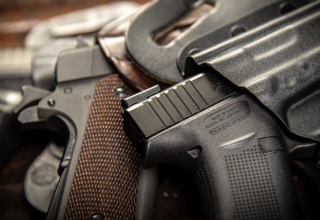
One of the Police Academy lessons was explained by an instructor like this, “If dispatch tells you there are ‘no guns on scene’, you can ignore that because there will always be at least one gun on scene when you get there. You are bringing it with you.”
The point of that lesson was to remind us young cadets that, even if the suspects happened to be unarmed when we engaged them, there was always a risk of them going for our gun. Some of us like to joke that there is no such thing as a “gun free zone” as long as we are there. That much is true, there is always at least one gun on scene.
One of the lessons that my dear departed friend, James Yeager, used to teach his students was this. “Gun culture people will think or say, ‘If I had my gun’ I would do such and such. Criminals think ‘If I had a gun I would’…fill in the blank.” The point of that lesson was that we, the good guys, focus on our favored blaster. All a criminal thinks about is getting their hands on a gun. If that means taking your gun off of you, then that is what they will attempt to do.
Keeping the above in mind. That leads us to our next topic, that of keeping your gun out of their hands.
They Will Kill You With It
Another sobering and serious lesson we cadets were taught was this. “If you get attacked and they take your gun, the first thing they are going to do is try and kill you with it.” One of our instructors put it this way, “He’s not taking your gun so he can go home and shoot squirrels. He’s taking it so that he can kill you and get away.”
These lessons were given to us before we engaged in our defensive tactics training where we practiced defending our guns in the holster. Back then we had what we called the “Red Man Suits”, special protection that allowed us to essentially go full-force against attackers in training.
One of the defensive tactics techniques was called “trapping the gun”. If an attacker reached out and grabbed our handgun in an attempt to pull it out of the holster, our immediate response was to use our dominant hand to trap the pistol in the holster by pinning our hand on top of their hand. This required the non-dominant hand to do the fighting.
With our non-dominant hand, we were taught to strike the face/throat area and keep doing so until the attacker let go of our handgun. Such strikes can work if the two subjects are evenly matched size and strength-wise. However, if the attacker is larger and stronger, it will be difficult for a smaller/weaker defender to muster enough power in close quarters to strike hard enough to get them to let go. Keep in mind, if the attacker is larger/stronger, you may have only a few seconds before they power the gun out of your holster and kill you with it.
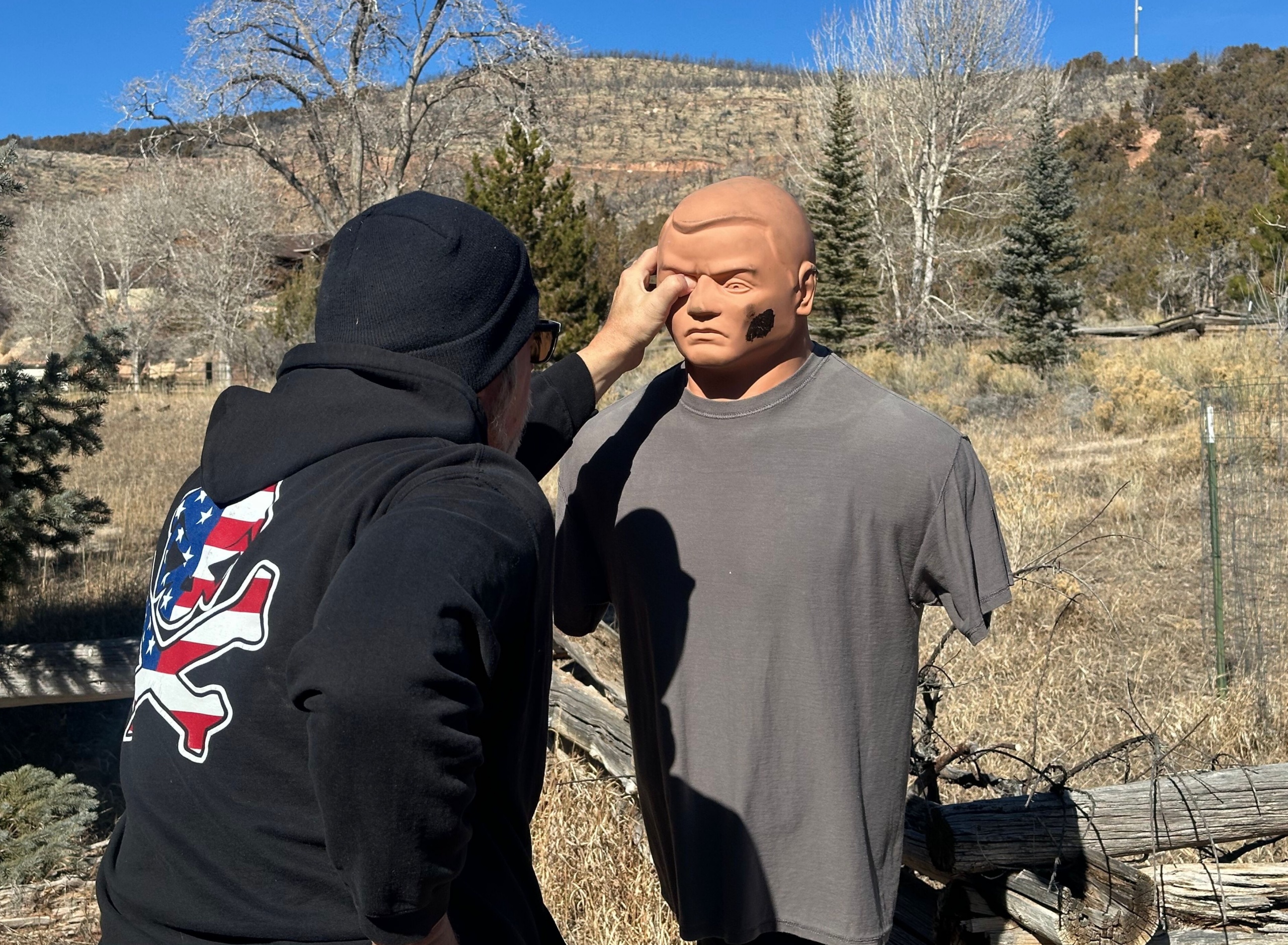
In such a case, I would suggest taking the thumb of your non-dominant hand and pushing it into the nearest available eyesocket of your attacker. This is not time to be squeamish. If you lose this fight you will either die or be maimed for life. Push your thumb into their eye socket until you feel brain and I guarantee that they will notice and switch their focus from taking your gun to stopping you from blinding them. The second that they let go of your gun to defend their face, push off of them, draw your gun and finish the fight. This is no time to be timid. Even with only one good eye, a larger/stronger attacker can still attempt to kill you.
Close Quarters Attacks
Back in the olden days, we used to practice a technique called the “Speed Rock” when preparing to deal with an extreme close quarters attack. I can recall the step-by-step black and white photos demonstrating how to speed rock. Back then, we actually practiced it on the range, up close within touching distance of our targets. On paper and on the square range, where our attacker was paper and cardboard, it seemed like a good idea.
Then came the advent of dash-cams on police cruisers and we were able to watch unedited footage of what actually happened when bad guys attacked police officers. What soon became obvious was that speed rocking backwards and deliberately putting yourself off balance was a great way to help the attacker dump you on your head on the concrete.
Unlike the movies where handgun bullets lift people up and throw them through windows. To quote John Farnam, “What do people do after you shoot them with a handgun? The same thing they were doing before you shot them with a handgun.” It often takes some time for those who are shot to realize that is the case and cease hostilities.
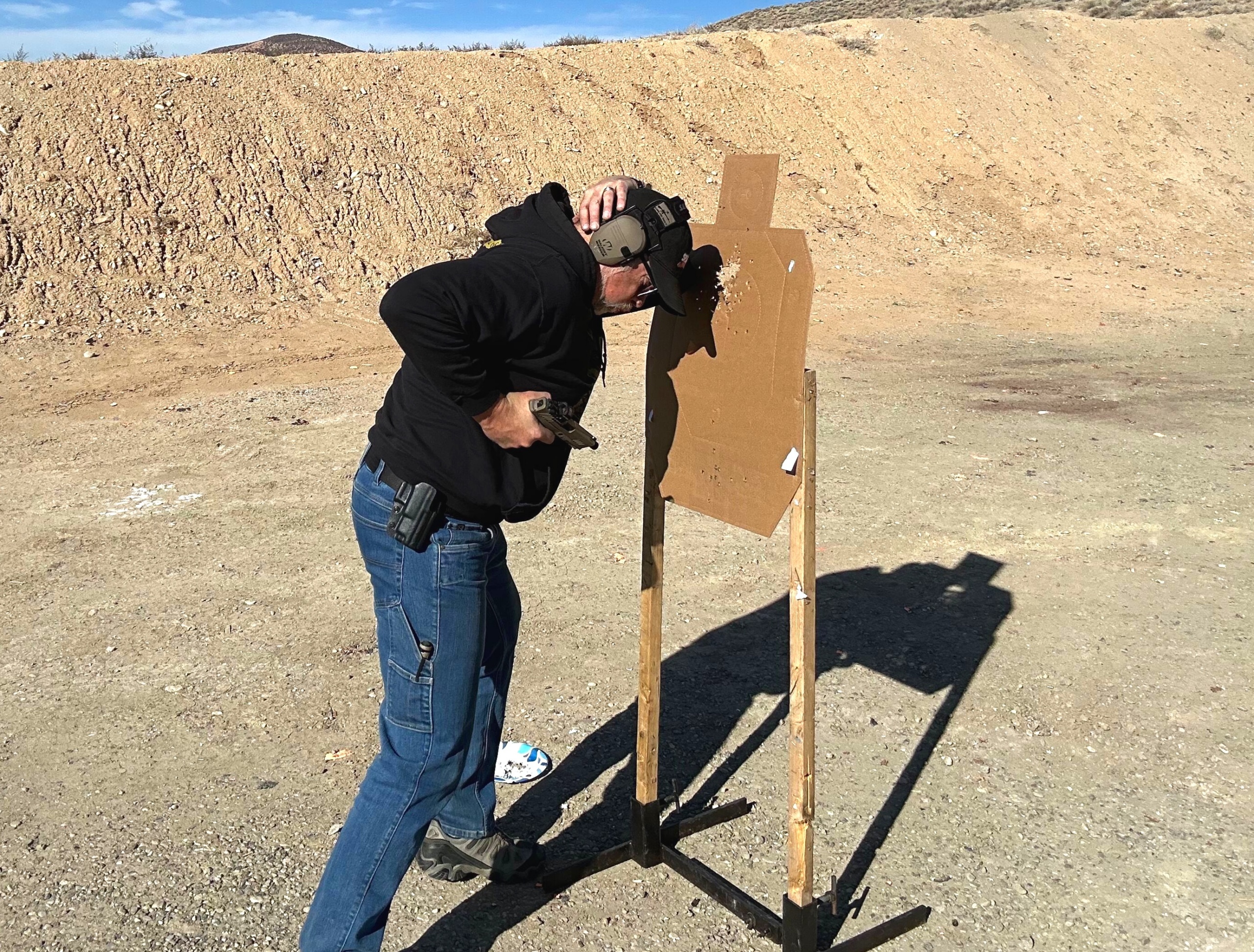
It is one thing to decide on your own that you want to go to the ground as a fighting tactic. It is another thing altogether to have someone else decide for you that you are going to the ground.
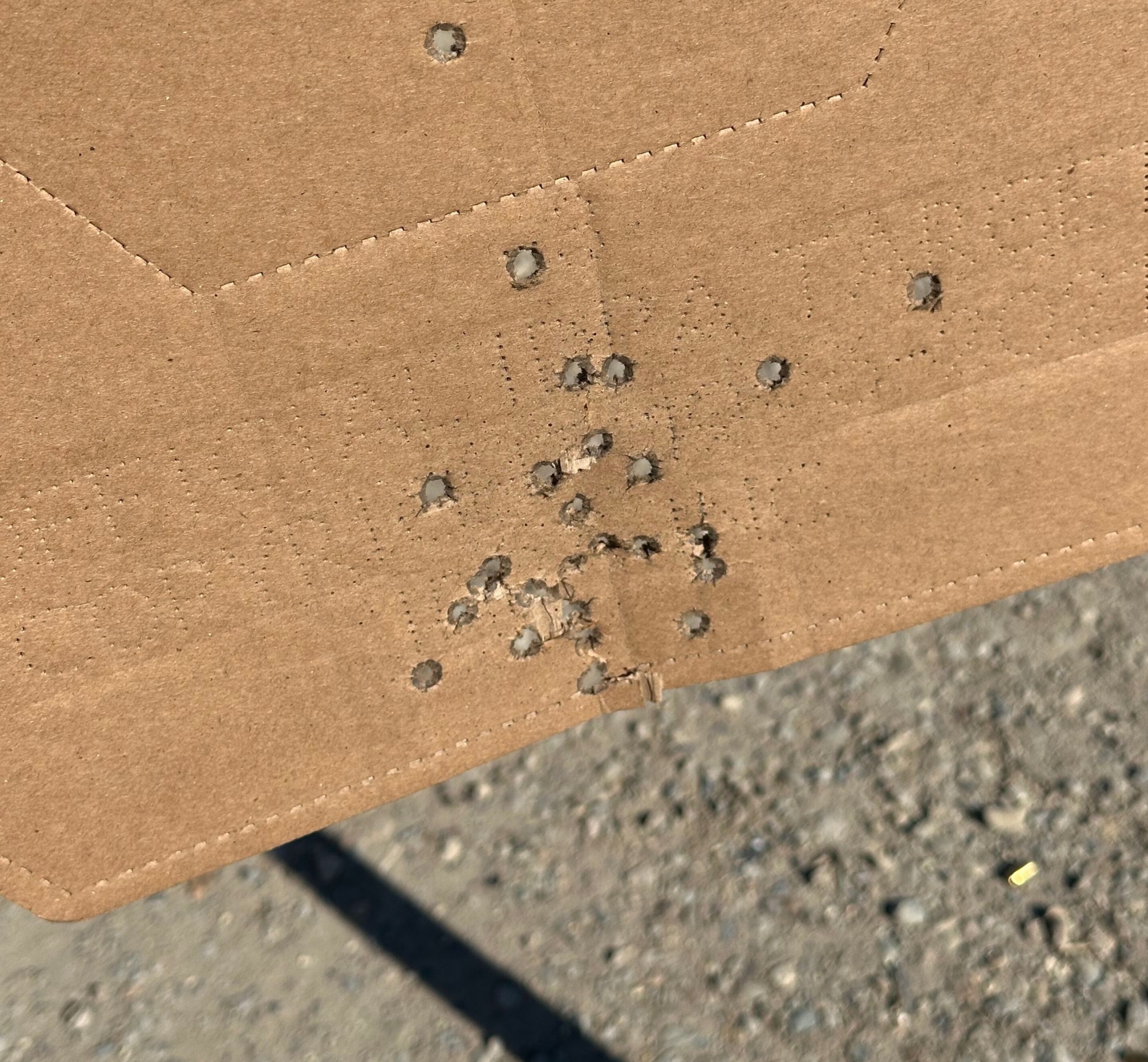
Today, rather than speed rock, we teach our students that, if forced into an extreme close encounter attack; drop you butt to lower your center of gravity, pull your gun side away from the attacker to make it harder for them to reach, use your non-dominant arm to shield your head from incoming blows, draw your pistol and anchor your forearm to your ribs, angle the slide away from your body, and fire low into the pelvic girdle, aka the crotchal region, of the attacker. As soon as it is practical, disengage and create distance. Rinse, lather, repeat as necessary.
Another technique or tactic used to help us create space when crowded upon by an aggressor is the good old palm strike to the nose. This is no more complicated than thrusting the non-dominant hand open so that the heel of the hand makes contact with the attacker’s nose. As you have done so, move to create distance which will allow you to draw your handgun. Apply force as necessary.
“Just a Citizen?”
I understand that there are some readers thinking, “I’m not a cop, I’m just a citizen, so none of that tactics stuff applies to me.” Okay, wrong, but okay.
First, cop or not, you need to acknowledge that as an armed citizen, it is your responsibility to ensure that your gun never falls into the hands of someone who should not have it, this is not just about “safe storage” this is about carrying.
If you open carry, you have to be vigilant and pay attention to who is around you and the situation you are in. You must be conscious of your gun.
Let’s say that you conceal your gun very well so that no one could know from looking at you that you are carrying. Great. What happens if you are attacked, even by a person who has empty hands? If you lose a fight and lose control of your gun it is now in the hands of your attacker. You or other innocent people could die.
Responsible gun carriers and armed citizens should understand that you need to avoid trouble, not look for it. However, reality dictates that as often as not, you don’t get to decide. You cannot choose how other aggressive/felonious people act.
Someone in the back just said, “Run away.” Cool story, bro. I’m with my wife and kid. Should I run away and leave them to the mercy of the attacker(s)?
Also, firearms are the “great equalizer” and allow smaller, weaker, older people to defend themselves against larger, stronger, younger attackers. It has been suggested that the person who decided to attack you out in public will almost always be younger, stronger, and faster than you. That being the case, you need to understand your concealed handgun is not a magic talisman, it does not surround you with an invisible cone of protection. Having a concealed gun on your person does not guarantee that you will not be attacked. Sadly, far too many people act and behave as if the opposite is true.
Parting Thoughts
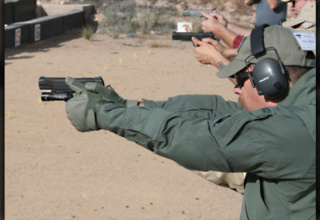
Yes, fundamental marksmanship skills and an ability to manipulate the gun are important. Nonetheless, what we find in the majority of shooting range practice is a focus on marksmanship and mechanics and a complete disregard for understanding how to fight with a gun in your hands.
It is not paranoia to think that a person who takes your gun will kill you with it, that is reality. Nor is it a crazy idea to think that you have a solemn responsibility to ensure that your gun never falls into the wrong hands. If you have only even participated in marksmanship training with our concealed carry pistol, you might consider getting into a class that focuses on the importance of being able to fight with a gun in your hands.