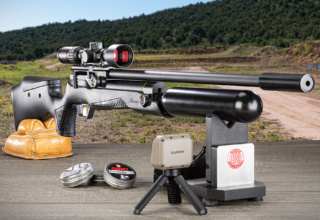
Our grizzled contributor picked up a Benjamin Marauder Gen3 PCP Air Rifle and disproved the saying — you really can teach an old dog new tricks
by Yamil Sued
Whoever coined the phrase “you can’t teach an old dog new tricks” was completely wrong. I consider myself an “Old Dog,” and I learned a couple of new tricks this week. I was assigned to review the Benjamin Marauder Gen3 PCP air rifle, and I quickly discovered just how much I didn’t know about air rifles.
My previous experience with air rifles was limited to something similar to Ralphie’s Daisy Red Ryder in A Christmas Story. In my case, my Daisy rifle wore the Sears & Roebuck name. That was the extent of my knowledge about air rifles, but that was about to change.
As I would soon discover, modern pre-charged pneumatic (PCP) air rifles are a completely different animal. They are sophisticated shooting platforms capable of impressive power and accuracy. I had a lot to learn, but I was ready to get started.
The Rifle
When I received the Benjamin Marauder Gen3, I was surprised by its complexity, weight, and overall construction. This was not the simple air rifle I remembered from my childhood. It was a substantial rifle with features and adjustments that required some research before I could take it to the range.

It took me a while to work through the instructions and determine what I needed to do to get the rifle ready for its first outing. I quickly realized that shooting a PCP air rifle involves more than loading pellets and pulling the trigger. There is an air supply to consider, a regulator to understand, and a few other details that are unfamiliar to someone coming from traditional firearms.
Fortunately, I had some knowledgeable friends willing to help me get started.
Technical Details
Benjamin is one of the most respected names in the pre-charged pneumatic airgun market. The Marauder Gen3 builds on that reputation with a regulated air system designed to provide consistent performance, smooth operation, and dependable accuracy.
The Benjamin Marauder Gen3 PCP air rifle is available in both .22 and .25 calibers. This multi-shot, bolt-action rifle uses a 500cc air reservoir that fills to 3,625 PSI, or 250 BAR. Its adjustable regulator is designed to help maintain consistent pressure delivery, contributing to repeatable shot performance.
The rifle also incorporates sound suppression to reduce the report, making it considerably quieter than many conventional firearms.
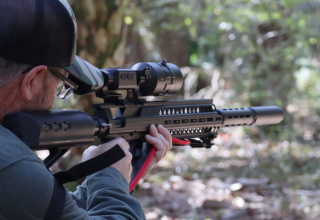
The all-weather synthetic stock is designed for outdoor use, and its adjustable cheek piece helps the shooter achieve a comfortable cheek weld and proper alignment with an optic. These features make the rifle suitable for a variety of applications, including hunting and precision shooting.
Here are the key features and specifications of the Benjamin Marauder Gen3 PCP air rifle:
- Caliber: .22 and .25
- Powerplant: pre-charged pneumatic (PCP)
- Action: side lever
- Magazine Capacity: 14 rounds in .22 caliber; 12 rounds in .25 caliber
- Magazine: rotary
- Air Reservoir: 500cc
- Maximum Fill Pressure: 3,625 PSI / 250 BAR
- Muzzle Velocity: up to 1,200 FPS in .22 caliber; up to 1,150 FPS in .25 caliber
- Muzzle Energy: 50 foot-pounds in .22 caliber; 80 foot-pounds in .25 caliber
- Trigger: adjustable two-stage
- Cocking Effort: approximately 15 pounds
- Sound Suppression: integrated
- Stock: all-weather synthetic
- Adjustable Cheek Piece: yes
- Sling Mounts: included
- Overall Length: 45.6 inches
Those are impressive specifications for an air rifle, especially when you consider the potential energy generated by the larger .25-caliber version. Of course, actual velocity and energy depend on the pellet and rifle configuration, which is something I wanted to explore during my testing.
My Rifle
For this review, I selected the .25-caliber version. I wanted to try the larger, heavier pellets and see what kind of performance I could achieve at the range.
As I mentioned earlier, I knew little about modern PCP air rifles going in. My learning curve was steep, but I had a few good friends who helped me get up to speed. Their advice made the process much easier and helped me avoid some of the mistakes a first-time PCP shooter might make.
Still, there is nothing like getting behind the rifle yourself. I was eager to see how it performed and, more importantly, how accurately I could shoot it.
The Setup
I wanted a good optic for this rifle: something sturdy, clear, and capable of reaching out to approximately 100 yards. My actual testing would take place at 50 yards, but I wanted enough magnification to give me some flexibility for future testing.

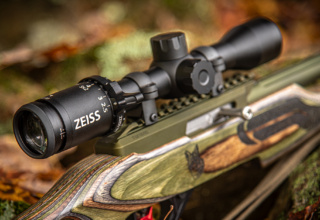
For this task, I selected the Burris Fullfield 2.5-10x42mm riflescope. It features a 1-inch tube and an illuminated E3 reticle. I have had good experiences with Burris optics, and this scope offered the magnification and features I wanted for the Marauder.
To mount it, I selected Burris 1-inch Zee Rings. I was already familiar with these rings and felt they would be a good fit for my setup.
At least, that was the plan.
As I would soon discover, mounting an optic on a PCP air rifle can involve some considerations that differ from those of a conventional rifle. I had chosen medium-height rings, thinking they would provide a comfortable cheek weld while keeping the scope at a convenient height. That decision would create a minor complication later in the process.
This Rifle Takes Air?
Well, yes, it does!
Unlike a conventional firearm, the Marauder needs a supply of compressed air to operate. Benjamin offers several solutions, ranging from a hand pump that resembles a bicycle tire pump to dedicated high-pressure compressors.

Unfortunately, I didn’t have any of those options available when the rifle arrived, and I was working under a tight deadline.
Someone reminded me that dive shops often have compressors capable of filling air tanks. My first thought was that this sounded great, although I live in the Phoenix metropolitan area and wasn’t sure how many dive shops I would find nearby. A quick search pointed me toward several possibilities, and after making a couple of phone calls, I found a dive shop just a few miles from my house.

A short trip and $7 later, my tank filled, I was ready to head to the range.
That experience taught me an important lesson about PCP air rifles: before purchasing one, make sure you have a reliable way to fill it. The rifle itself is only part of the equation. You also need the proper equipment or access to a suitable high-pressure air source.

For this first outing, I had found a convenient solution. Now it was time to see what the Marauder could do.
Range Time
My next stop was the Ben Avery Shooting Facility in Phoenix, one of my favorite outdoor ranges. Since I wanted to test the rifle at distances of up to 50 yards, it was a natural choice.
I brought three different types of .25-caliber pellets:
- Gamo Pro Magnum Penetration, 21.75 grains
- Black Star, 27.47 grains
- Benjamin, 27.9 grains
I wanted to compare their velocities and accuracy to see how each performed in the Marauder.
I began by setting up at 25 yards. For support, I used my Ransom International Multi-Cal Steady-Rest with a leather sandbag under the rear of the rifle.
This is where I encountered my first stumbling block.
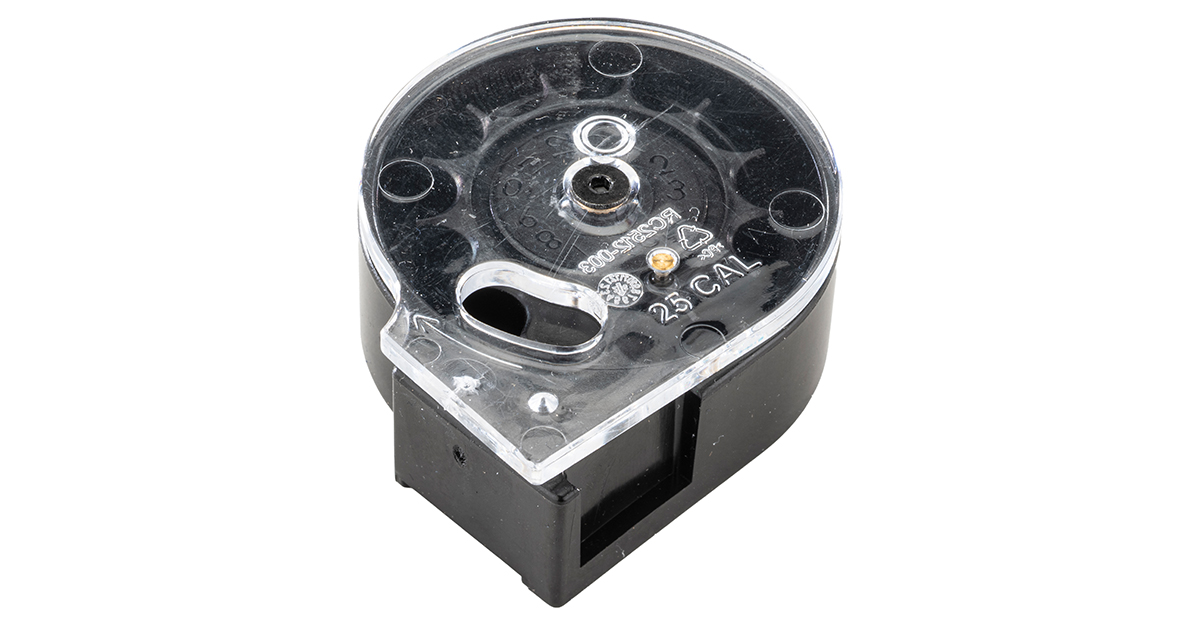
Remember those medium-height Burris Zee Rings I selected? I thought they would provide the most comfortable scope height and a good cheek weld. That would have been a reasonable choice if I hadn’t overlooked one important detail: the Marauder’s rotary magazine feeds from the right side of the rifle and requires adequate clearance.
Unfortunately, my scope and ring setup interfered with that clearance.
It wasn’t a major problem for this test, but it meant I had to load the pellets manually into the chamber rather than use the magazine as intended. This was a minor inconvenience that slowed down the testing process.

In retrospect, that wasn’t necessarily a bad thing. The slower pace encouraged me to concentrate on each shot, pay attention to my sight picture, and take my time. I was learning a new platform, and there was no reason to rush the process.
Still, I’ll need to revisit my optic mounting arrangement before my next range trip.
The Regulator
I wasn’t sure where to begin with the rifle’s regulator. I decided to leave it at the factory setting of 1,500 PSI for my initial testing.
Was that the right decision? Honestly, I don’t know.

The regulator is an important component of a PCP air rifle because it helps control the pressure delivered for each shot; however, determining the ideal setting involves understanding how the rifle, air supply, and selected pellet work together.
I wasn’t going to pretend to be an expert after only a few hours with the rifle. Instead, I left the setting alone and concentrated on learning the basics.
I plan to experiment with the regulator during future range sessions. For now, I wanted to establish a baseline and see how the Marauder performed in its existing configuration.
Multitasking
I decided to combine my chronograph testing with my initial zeroing process at 25 yards. For this part of the test, I used the Benjamin pellets.
My first shot landed low and to the left. I adjusted the elevation and windage, and after approximately four pellets, I had the rifle zeroed.
That was encouraging, especially considering my limited experience with the platform.
When I reviewed the chronograph data from my Garmin Xero C1 Pro, though, I noticed something interesting. My first shot was approximately 300 FPS slower than the subsequent shots.
My ignorance is showing here, I know. I wasn’t sure whether this was normal behavior for the rifle or whether I had encountered something that required further investigation.
Rather than draw conclusions from one observation, I recorded the results and continued with the test. I have more to learn about how PCP rifles behave, particularly when it comes to air pressure and shot consistency.

Next, I moved the target to 50 yards. I repeated the zeroing process while chronographing the Benjamin pellets, making adjustments as necessary.
Once again, I was satisfied with the results after approximately four pellets.
With the rifle zeroed at 50 yards, it was time to concentrate on accuracy.
Chronograph Data
Here are the average velocities recorded during my testing:
- Gamo Pro Magnum Penetration (.25 caliber, 21.75 grains): 956.4 FPS
- Black Star (.25 caliber, 27.47 grains): 887.5 FPS
- Benjamin (.25 caliber, 27.9 grains): 862.7 FPS
As expected, the lighter Gamo pellets produced the highest recorded velocity among the three types tested.
The heavier Black Star and Benjamin pellets traveled more slowly. These results provided a useful starting point for comparing the three options, although velocity alone doesn’t tell the whole story.
Accuracy would be the deciding factor in determining which pellet performed best in my rifle.
Accuracy
This is where the rubber meets the road: accuracy.

I fired three five-shot groups with each pellet type and selected the best group for each brand. Here are the results:
- Gamo Pro Magnum Penetration (.25 caliber, 21.75 grains): 0.615 inches
- Black Star (.25 caliber, 27.47 grains): 0.625 inches
- Benjamin (.25 caliber, 27.9 grains): 0.775 inches
I was impressed with these results. Frankly, I wasn’t expecting this level of accuracy from an air rifle, which shows just how much I still must learn about the platform.
All three pellets produced respectable groups, with the Gamo Pro Magnum Penetration pellets delivering my smallest group at 0.615 inches. The Black Star pellets came in a close second at 0.625 inches, while the Benjamin pellets produced a 0.775-inch group.

The differences were relatively small, but the results gave me a starting point for further testing.
I also must put these numbers into perspective. I am a beginner when it comes to PCP air rifles, and this was my first outing with the Marauder. I was still learning the rifle’s operation, figuring out the best way to handle the loading process, and becoming familiar with the setup.
I am willing to bet that an experienced airgun shooter could achieve even better results. Nevertheless, for a first attempt, I was more than satisfied.
Of course, these figures represent the best group from three five-shot groups for each pellet type, not the average of all three groups. More testing will be necessary to determine which pellets provide the most consistent performance.
That gives me another reason to return to the range.
My First Experience and Parting Shots
I must say, I was pleasantly surprised by how easy the Benjamin Marauder Gen3 was to shoot and how quiet it was.
Coming from a Daisy Red Ryder, this rifle was practically a whisper. The integrated sound suppression did its job remarkably well, making the shooting experience much quieter than I had expected.
And then there was the accuracy. For a rifle that was completely new to me, the Marauder delivered impressive results.

I also learned that PCP air rifles require a different approach than conventional firearms. Between the high-pressure air supply, regulator settings, pellet selection, magazine clearance, and other considerations, there is plenty to learn before you can get the most out of one.
I have only scratched the surface.
I want to test additional pellets, explore different weights and designs, and investigate how changes in regulator settings and operating pressure affect performance. I also want to improve my setup so I can use the rifle’s magazine as intended and spend more time shooting groups rather than manually loading each pellet.
There is plenty of work ahead, but that is part of the fun.
One thing is certain: I’m hooked!
There is so much more I need to learn and experiment with, and I am looking forward to the journey. Sometimes, trying something completely different reminds you how much fun it can be to start at the beginning and learn a new skill.

I went into this assignment with very little knowledge of modern air rifles. I came away with a new appreciation for the technology, the accuracy these rifles can deliver, and the possibilities they offer shooters.

- TESTED: Benjamin Marauder Gen3 PCP Air Rifle - October 30, 2026