“Tactical knives” may sound razzle dazzle, but have you considered their practical application for a real-world, extreme close-quarter engagement when your handgun may not be an option?
by Paul G Markel
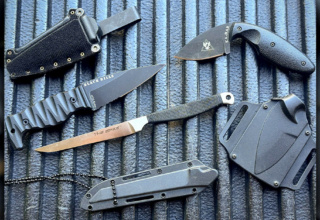
If you enter the term “tactical knife” in your favorite search engine, you will find pages and pages of knives — fixed and folders, large and small — with all manner of blade designs and configurations. Prices range from cheap Chinese imports to American custom-made blades in the hundreds and thousands of dollars price range.
Tactical Knife Popularity
What are Americans doing with the millions of tactical knives that have been sold over the last generation? The answer is twofold. If the knife is a limited-edition, custom version, the owners break them out on special occasions to show their close friends. If the knife is a factory blade, they are used to open UPS packages, cut tags off T-shirts, and clip strings.
That’s not to say that utility use should be ignored. A sharp, quality knife is a must-have for mature, responsible adults. Nonetheless, of all the tactical knives out there, how many of the owners view them as defensive tools to be used for emergency self-preservation? Of those persons, how many truly understand how to use said knife in a life or death encounter?
Hollywood Mythology
Amongst the many myths and misunderstandings perpetrated by Hollywood is the idea of the man-on-man knife fight. That is, a duel where both opponents begin with knives in hand and square off as though boxing or fencing. There are precious few historical accounts in the United States of men squaring off in such a manner. Duels with pistols were far more common, but still rare when compared to brawls and gun battles where men were moving and shooting or shooting from behind cover.
Nonetheless, Hollywood has often portrayed man-on-man knife duels on the large and small screens. One of the biggest misconceptions is that one of the participants surfaces unscathed. In real world examples of two combatants going at it with edged weapons, not only are both commonly cut, but it is also not uncommon for both to eventually expire from exsanguination.
The moral of the story is this; if someone invites you to a knife duel, politely decline or shoot them before they can get close.
Martial Arts Mastery
For more than forty years, I have been involved in martial arts in one form or fashion. For all those years, I cannot think of a single school or dojo that did not have the ubiquitous rubber knife or two laying around as a part of their training gear.
If you grew up reading Black Belt and other martial arts magazines, as I did, you likely remember the battery of black and white staged photos where the “bad guy” is holding a rubber knife out and the man in white pajamas kicks it out of their hands or some such nonsense. The reality of the situation is that no person intent on stabbing you with a knife is going to hold it out, unmoving, so you can kick it out of their hands. What they do is keep it close to their body until you are close enough to punch and then they “punch” you with the knife as many times as they can get away with.
The harsh reality of American emergency departments is that gunshot victims will arrive with one or two, maybe three bullet wounds. Knife assault victims arrived in the ER with a half dozen to twenty cuts and stab wounds. A dozen wounds from a knife assault or murder are not uncommon.
From a martial arts training standpoint, we have two extremes. On one hand, we have the farcical slow-motion knife disarming that is taught in the strip mall dojos. On the other hand, we have those who have trained for years and decades in Kali, Arnis, Esrima, et cetera. Such folks are truly lethal with a knife in hand.
But where does that leave the average person? Are our only choices the clown-school rubber knife tactics or a lifetime of devotion to mastery? Believe it or not, there is a third option.
Mobility Kill: Cutting the Strings
Although a marionette analogy might seem horribly dated in the 21st century, most readers should be familiar with the string-operated puppets. Depending on the design, a marionette has 8-10 strings. If you were to stand next to the puppet master with a pair of sharp scissors and start cutting strings, the arms, legs, and other body segments of the marionette would go limp.
Duh.
Now let’s consider human physiology for a moment. When using a firearm as a defensive tool, there are two ways to force a physiological stop on an attacking human animal: exsanguination (critical blood loss) and neurological, or critical damage to the central nervous system.
Michael Platt, the murderer of the FBI Miami Shootout, was bleeding to death when he killed two and critically wounded three FBI agents. Despite taking what doctors called a “non-survivable gunshot wound,” Platt had enough gas in the tank to keep fighting for another three minutes or so. Emil Mătăsăreanu, one of the North Hollywood Bank Robbers, was shot 29 times, mostly in the legs, before he eventually bled to death.
Causing critical damage to the central nervous system can be a “lights out” injury, but the CNS is a relatively small target and is deep inside of the human animal. If you score a CNS hit, that’s great, but we cannot bet our lives on that one perfect shot.
Now, let’s consider using an edged weapon as a life-saving tool. During a heated struggle, you’re not likely to score the famous sentry-kill “lights out” strike. Also, when humans know they are in a fight, they instinctively protect their core (head, neck, and torso area). Poking holes in an attacker will begin the exsanguination process; however, as we discussed, that type of stop takes time. If you are pinned to the parking lot and your attacker is set on bouncing your head off the asphalt, poking holes in them might bring about their eventual demise, but how many times can they smash your skull into the ground during the two to three minutes it takes them to bleed out?
Extreme Close Quarters Defense
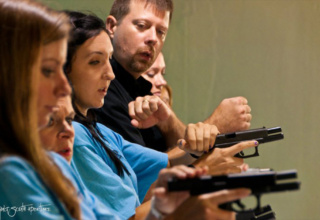
About fifteen years ago, perhaps a bit longer, I attended an Extreme Close Quarter Defense training course at Tactical Defense Institute. The class was taught by John Benner, a veteran police officer. John saw a gap in law enforcement extreme close quarters training, particularly the threat of an attacker taking an officer’s sidearm. Way back when I was in the police academy, we were admonished that if an attacker took our gun in a fight, the first thing they would do is try to kill us with it. We were taught to use our strong hand to “trap” the pistol in the holster and our support hand to fight back.
Such was all well and good, but size and strength are always a factor in a fight. If the attacker were larger and stronger and not in a position to notice or care about the strikes from our non-dominant hand, we could eventually lose the tug-of-war for our pistol.
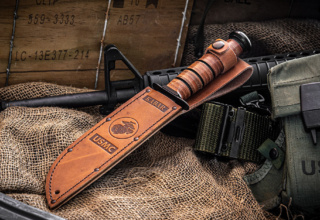
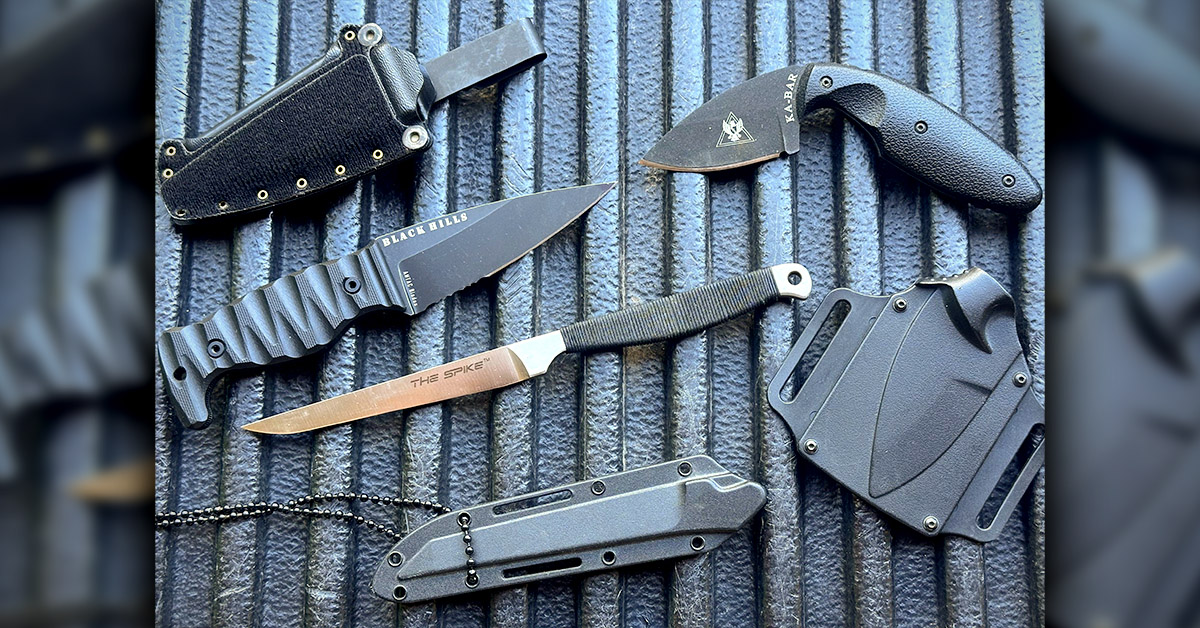
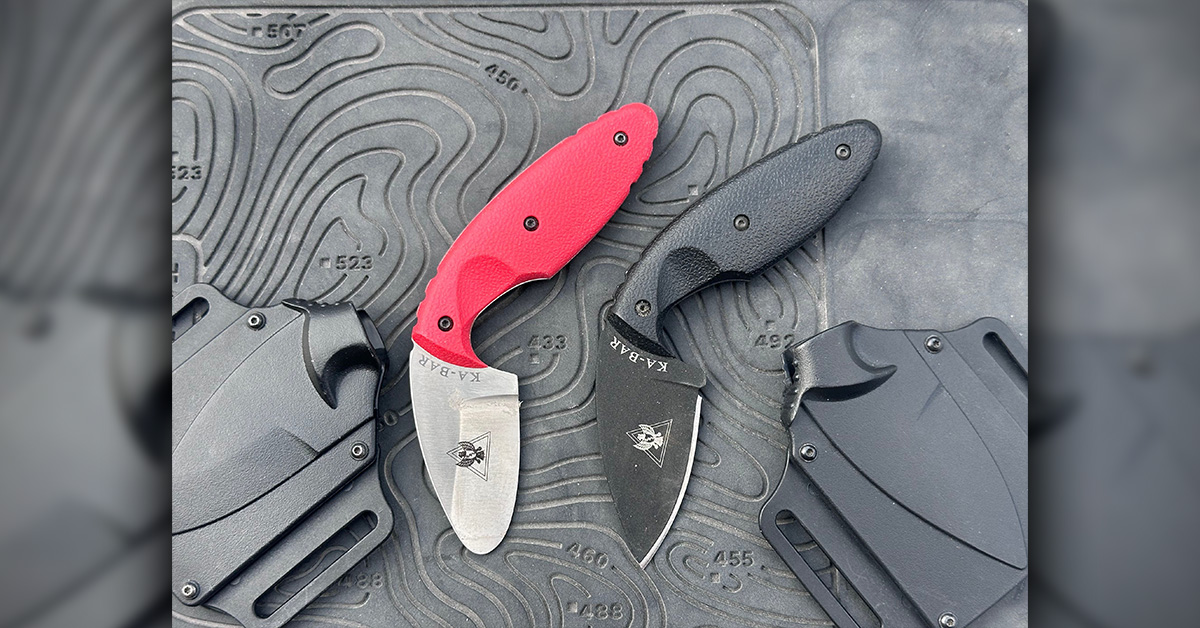
John Benner understood that and realized that a small, sharp, fixed blade knife could be the great equalizer. John designed the TDI Law Enforcement knife so that it could be mounted behind the magazine pouch on a duty belt and accessed with the off hand. In said struggle over the officer’s gun, the off hand grabbed the knife and would run it over the back of the attacking arm in what John called a “carving motion.” A similar carving motion could be applied to the inside of the offending arm as well. Severing the tendons and muscles required to grab and pull out the gun would cease that threat. No matter how angry, adrenalized, or drugged up the attacker might be, the strings on the puppet would be cut.
If an attacker had you pinned to the ground with a two-hand choke, a carving cut across the forearms, the biceps, and/or the triceps brachaii once more cuts the strings. You will note that neither of the cuts discussed require exsanguination or a CNS hit to work. The moment the tendons and muscles are cut, that’s it. Only a skilled surgeon can repair them.
Targets: Flexor vs Extensor Muscles
Something that I learned from strength training long ago was that all muscles pull, they do not push. The hand is closed to grip by the pulling of one set of muscles. The hand opens and releases its grip via the pulling of another set of muscles. Ligaments stabilize joints and connect bone to bone. Tendons connect muscle to bone and transmit the pulling force to move the bone.
The muscles that decrease the angle between bones (bend) are called flexor muscles. The muscles that increase the angles (straighten) between bones are called extensor muscles.
Training and Practice
Unlike the strip mall dojo rubber knife training, which is both deceptive and a waste of time, or the decades of dedicated blade training, a course that teaches you how to execute a mobility kill on offending limbs is one that can be accomplished during a weekend. Such skill is within reach of the average person.
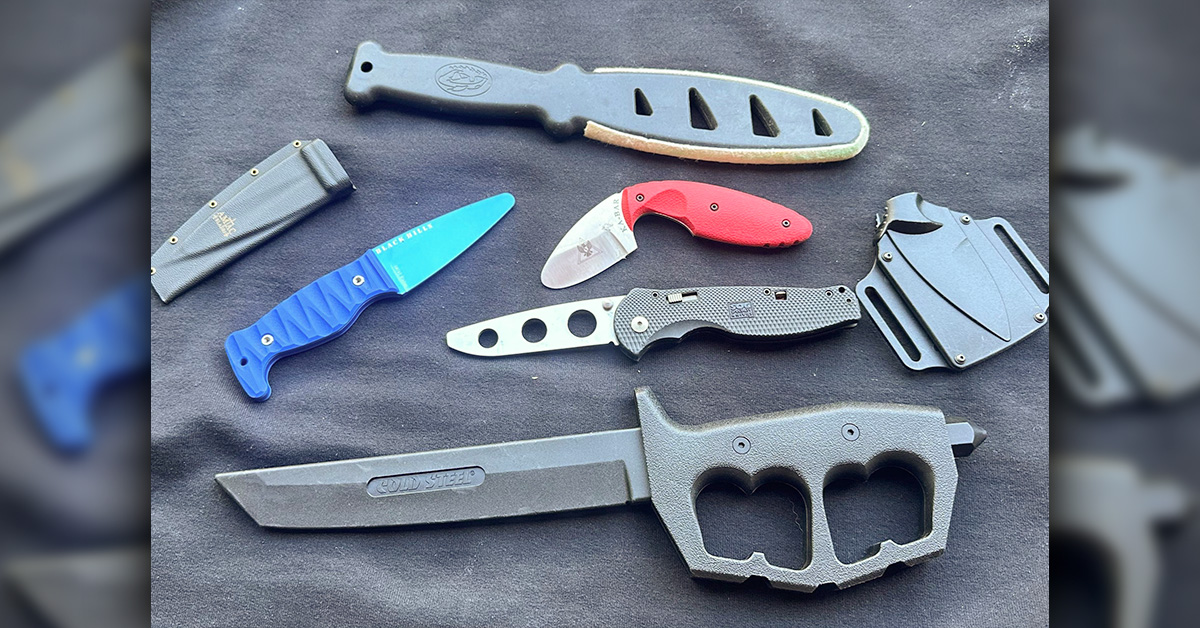
For practical training, this is where the dull or rounded-edge trainers come into play. The best possible scenario is to have a non-sharp trainer that mimics the size, weight, and feel of the actual blade. KaBar once produced red-handled trainers to go with the TDI Law Enforcement knife back when they were first released.
It is a sad state of affairs that gun community folks have no qualms when it comes to discussing or talking about double-taps, Mozambique Drills, body-armor drills, or failure-to-stop drills. We converse about the topic of shooting humans as though we are discussing engine tune-ups or oil changes; however, when the topic of using an edged weapon to literally “cut your attacker off of your body” comes up, we get all squeamish and the thought of it upsets our stomachs. Many gun people will eschew the notion of using a knife for self-preservation because, “I’ve got my pistol.”
Finding a practical and serious defensive knife course can be a bit of a chore. If you know what you are looking for, though, the selection process can be refined. We know two things. First, the karate school, kicking the knife out of their hand thing is a joke. Second, we don’t need to become black sash knife fighters in order to use an edged weapon to save our lives. Craig Douglas and his company “Shivworks” are serious about knife training and we recommend giving them a look.
Stopping, Not Killing
What should be obvious by this point is that the goal of a justifiable use of force encounter is to stop that attacker as quickly as physiologically possible. Whether they bleed to death is not our concern. From a practical standpoint, the aforementioned carving cuts or “cutting your attacker off of you” are actually less likely to cause expiration of the attacker. That is fine as long as they stop trying to smash your head into the asphalt or take your gun in order to shoot you to death, which is, naturally, the goal of the exercise.
Author’s Note
John Benner and I became instant friends when I attended one of his classes in the early 2000s. While residing in Ohio, I visited John and jumped into several of his classes. During one visit, John pulled me into his workshop. He picked up a rough-looking prototype from his workbench and handed it to me.
“This is my latest project,” he informed me. “I’m trying to come up with a simple, easy to use fixed-blade that any patrolman can mount on his belt for the ‘just in case’ situation. If a perp grabs a cop’s handgun, they can trap it in the holster and use the knife to cut the attacking arm off the gun.”
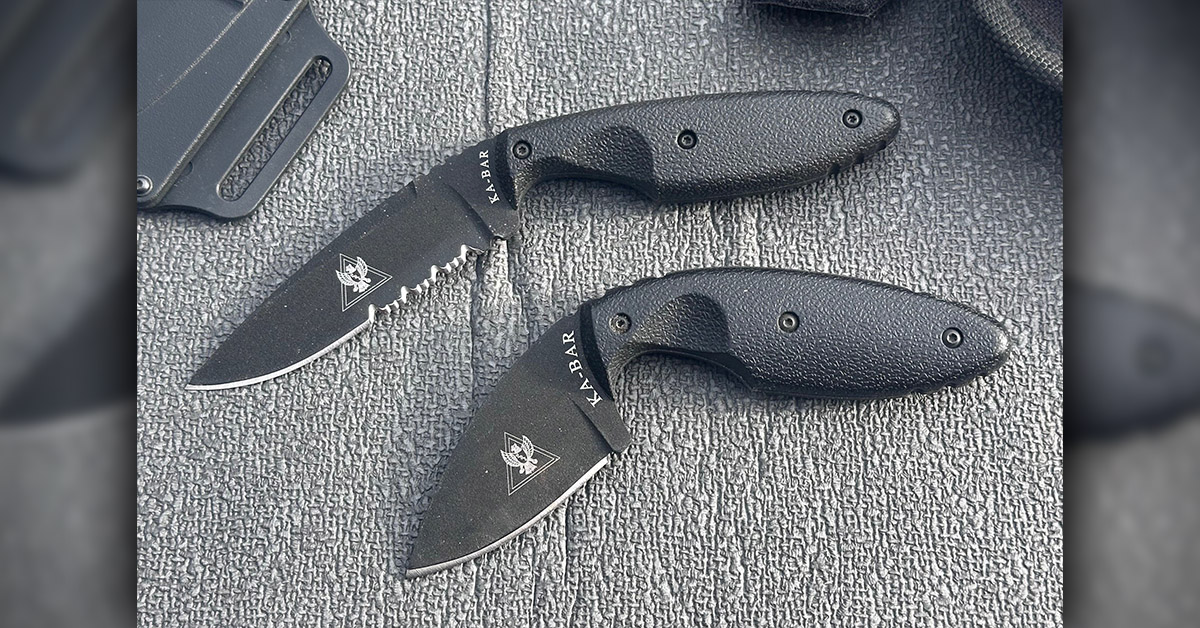
At the time, John related to me that he had approached several knife makers and all had passed on it. “Ka-Bar has shown some interest, and I’m hoping that they’ll make it,” John said.
Well, we all know how that went. Despite being a bit trepidatious about the design, Ka-Bar agreed to make the TDI Law Enforcement knife; however, they told John that if they didn’t sell five thousand units the first year, they could not justify keeping it in the catalog. After one full year of sales, the TDI LE knife was so popular that Ka-Bar put it on the cover of their catalog for the upcoming SHOT Show. The second year after being released, they informed John that the TDI knife had become their number one seller.