A fistful of revolver power, the Taurus Raging Hunter 350 adds a new dimension to the hunting game and a next-level spin to the 350 Legend straightwall cartridge
by Rob Reaser
Steady Shoot ON readers know that, in recent years, I’ve developed something of an affinity for high-octane, straight-wall cartridges for whitetail hunting. Don’t ask me why because I can’t tell you other than it’s something different and it ramps up the challenge a bit. I lean hard on 44 Magnum and 357 Magnum chamberings, but I’ve also enjoyed the newer kids on the block as well, like the 350 Legend and the 360 Buckhammer.
Last year, I took a nice Ohio buck with a Thompson Center Encore chambered for 350 Legend. The shot presentation was less than desirable, but with darkness coming and only a few minutes of legal shooting light heralding the hunt’s finale, I made a careful calculation and executed a quartering-to shot. The results were devastating…for the buck.
Well then…
It should come as no surprise that when Taurus announced a chambering expansion to their popular Raging Hunter revolver lineup — 350 Legend to be precise — I wanted in.
The initial November 2025 release of the Raging Hunter 350, as the company calls it, included two variants: a 10.5-inch barrel version and a 14-inch barrel model. Last month (October 2026), Taurus announced a third Raging Hunter 350, this time with an 8-inch barrel.
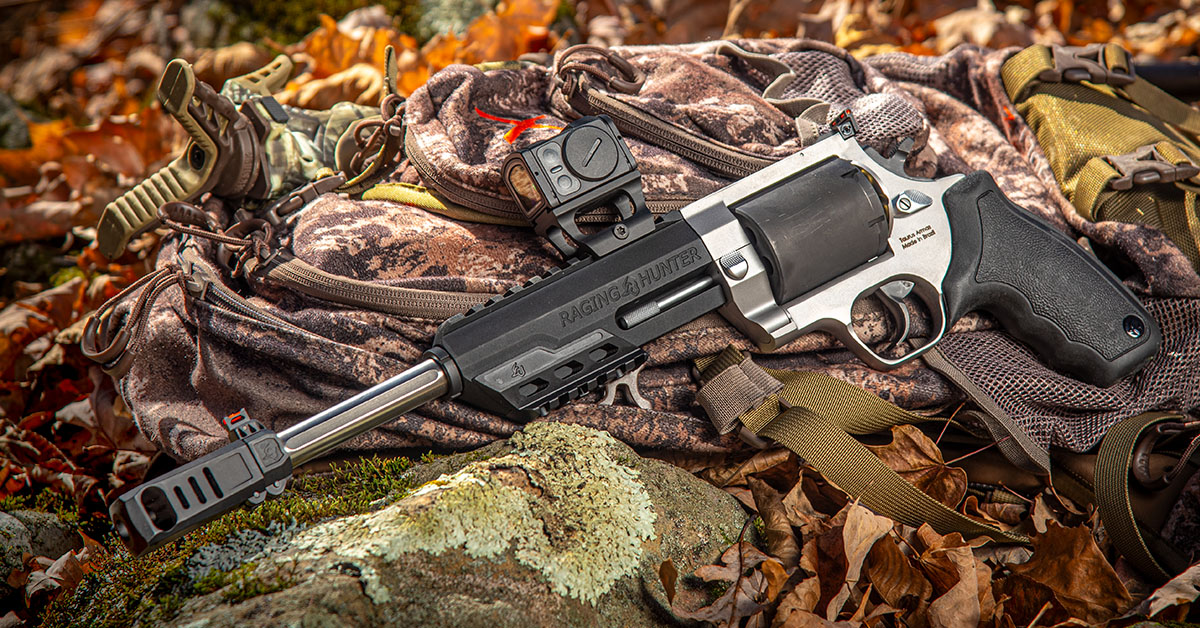
I chose the 10.5-inch model for testing because, let’s face it, the Raging Hunter is a handful of pistol both to carry and to shoot with those burly loads. The 14-inch version would be a bit more than I wanted to deal with in the whitetail woods, but I reckoned the 10.5-incher would be more manageable (only a couple of inches longer than my 44 Magnum Raging Hunter) and still preserve a functional amount of the 350 Legend’s punch.
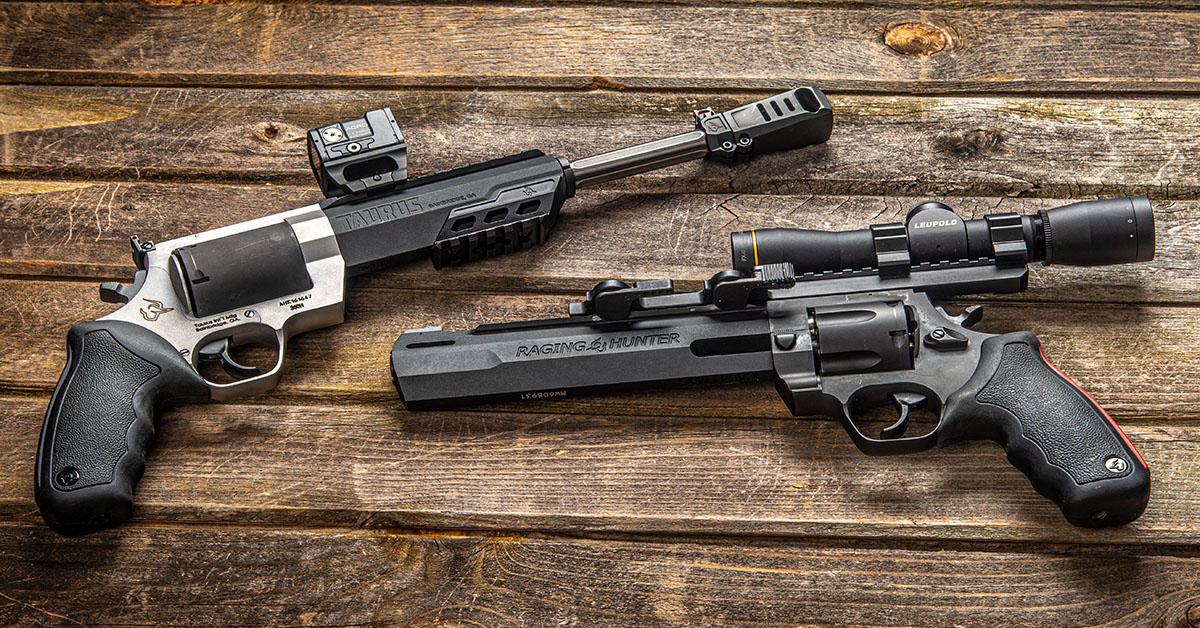
With our state’s firearm season only a couple weeks away, I gathered up a selection of ammo, installed Aimpoint’s Acro P-2 red dot, and headed for the Shoot ON proving grounds this past weekend to see how this gun would roll.
I didn’t get off to a good start.
It wasn’t the gun’s or the ammo’s fault.
It was this dummy.
I spent probably half an hour setting up a 25-yard zero, then extending out to 50 yards, burning through several rounds each of Hornady American Whitetail Tipped 165-gr. FTX, Hornady’s American Whitetail 170-gr. InterLock, and Federal’s Non-Typical 180-gr. soft point (which, as I learned while writing this article, Federal doesn’t make anymore). Shooting 4-round proof strings, the groups kept “ungrouping.”
I was on the verge of deploying colorful and possibly damnable metaphors when I did my “one last thing” check. None too gently, I grabbed the Acro P-2 and gave it a shake.
It shook.
I had gotten interrupted during the sight install and forgot to torque the sight’s attachment screws to the mount.
Rrrrr…
Lesson learned — until I do it again, I guess.
Raging Hunter 350 Particulars
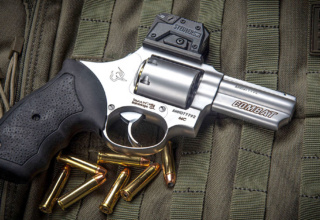
The Taurus Raging Hunter 350, like all in the Raging Hunter series, is a big-bore, large-frame revolver designed for one purpose: to roll medium- to large-size game animals.
I had my first go with the Raging Hunter in 2018 — when Taurus introduced the model — busting hogs in the Central Florida oak hammocks, and I fell in love with the platform. As I mentioned, while the revolver takes a bit of manhandling, it delivers the goods and is worth the effort if you are a wheelgun fan or someone who is simply looking to up their hunting challenge.
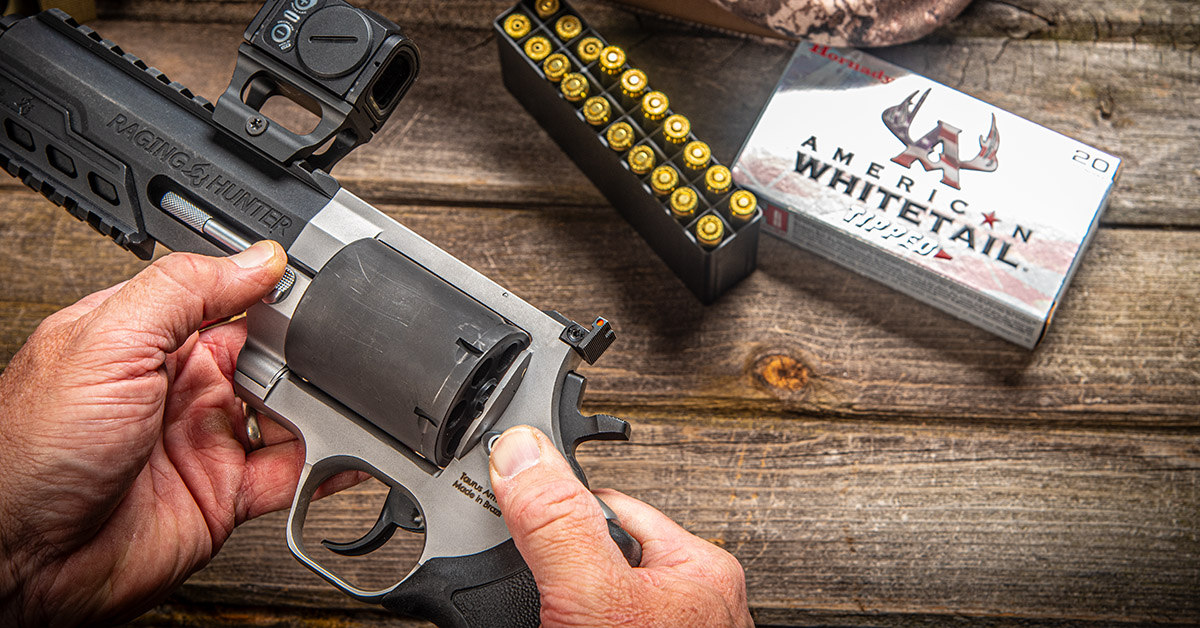
Dual cylinder locks is one of the first features you notice when you pick up a Raging Hunter. Push forward on the rear cylinder lock button and down on the forward lock button. This dual retaining system ensures maximum lock-up when unleashing the high-power cartridges for which the pistol was intended.
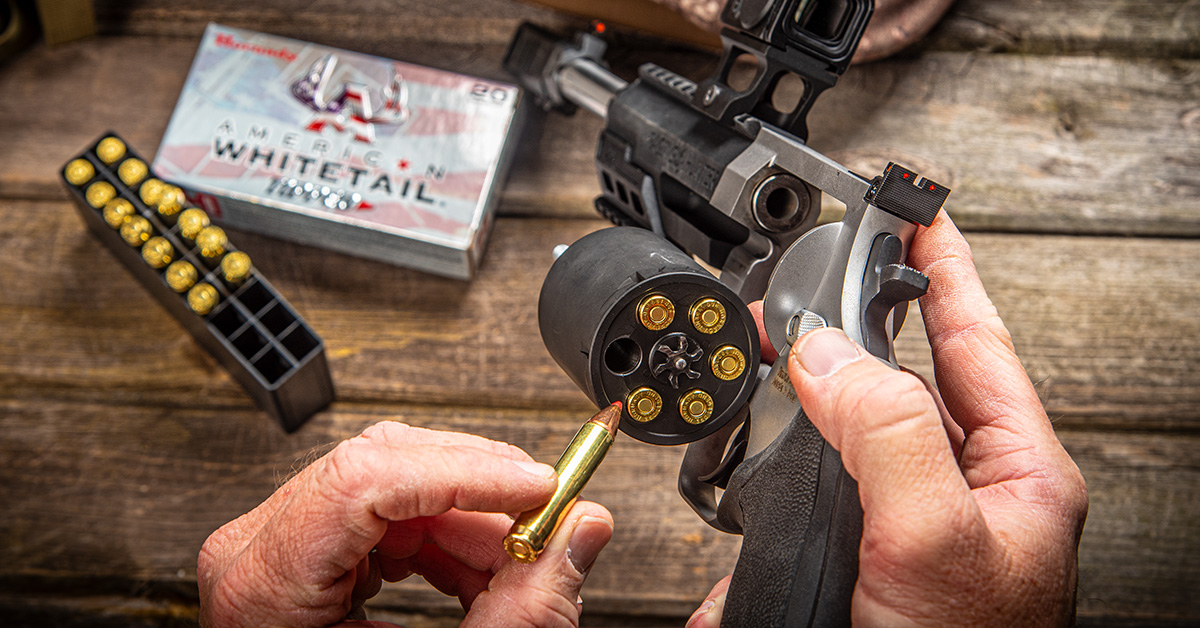
Rotate the yoke and you see the cylinder is ready to accept six rounds. You can safely load and carry the gun at full capacity courtesy of the transfer bar safety system.
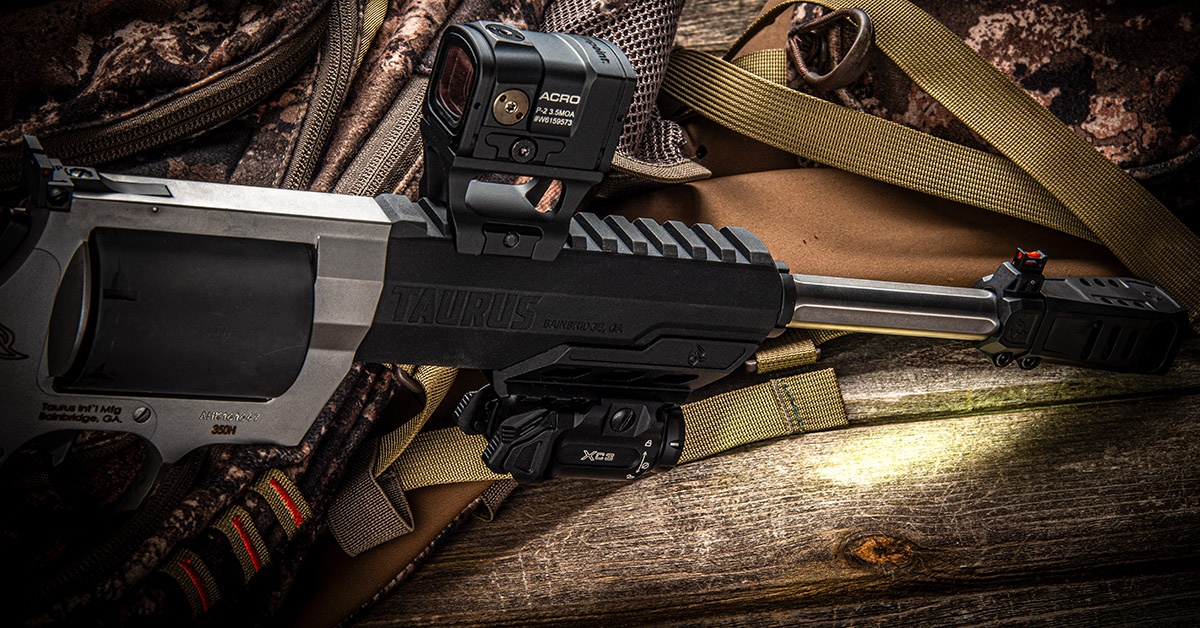
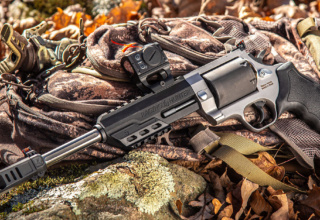
You’ll also be quick to notice the Raging Hunter 350’s extensive railing. As with all Raging Hunter models, the barrel shroud includes a machined-in top rail for optic mounting. The 350 Legend models with the 10.5- and 14-inch barrels also include a rail module underneath the shroud, where you can attach a light for nighttime varmint work or secure the gun to a Picatinny rail-compatible shooting support.
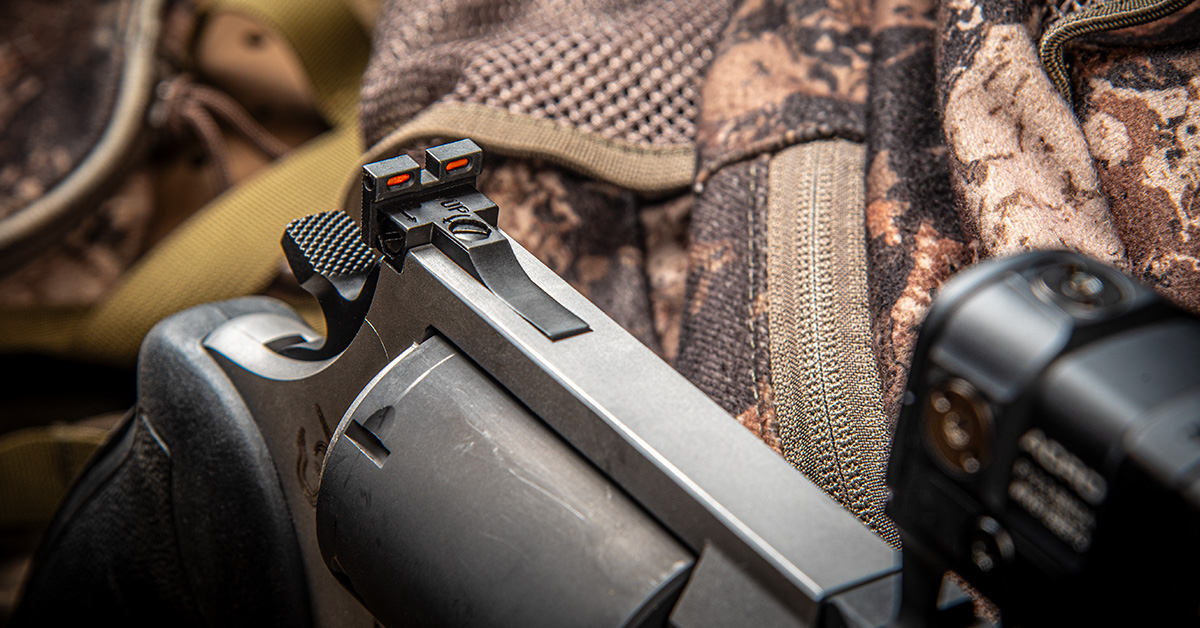
While most hunters will choose an optic — probably a red dot — to deliver an easy sight picture, the Raging Hunter 350 comes with a fully adjustable fiber-optic rear and front sight setup. These are great sights for those who wish to stay with irons. My first hog taken with the Raging Hunter 44 Magnum fell to the factory open sights at 30 yards. If you wish to be efficient at taking game at longer distances, though, a red dot or a low-magnification pistol scope would be more appropriate choices given the gun’s short sight radius.
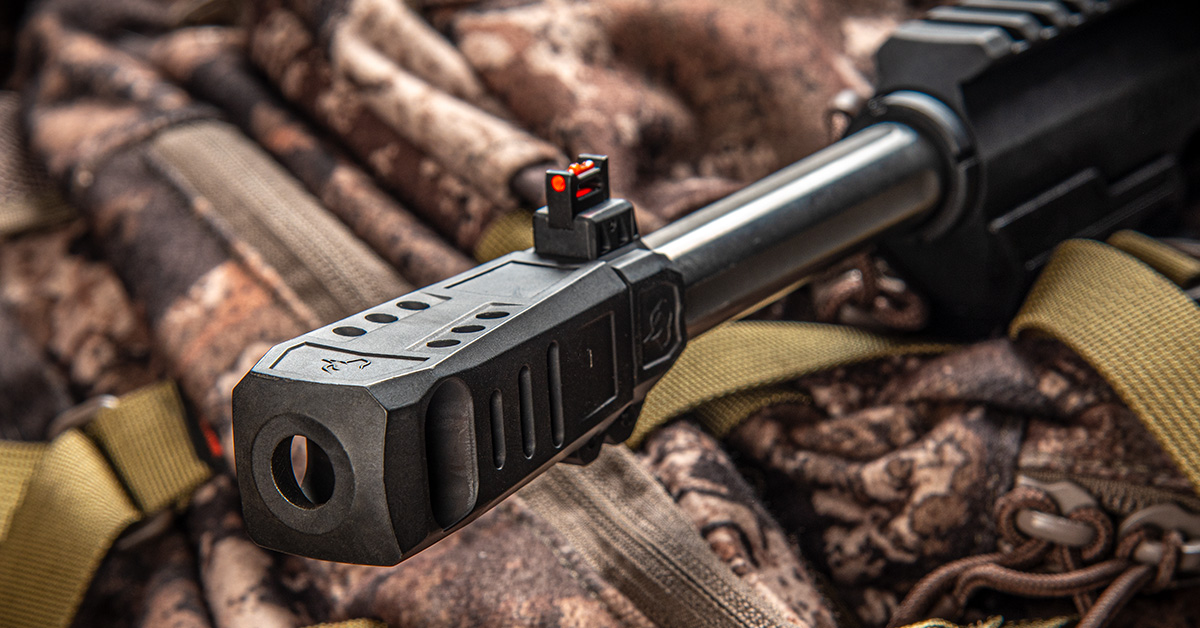
Due to the boisterous nature of the 350 Legend cartridge in a handgun platform, Taurus engineers designed a muzzle brake that clamps onto the barrel. I didn’t remove the brake to get a “with and without” comparison of muzzle rise, but I would have to assume that the brake must mitigate muzzle flip to some degree. Is it enough that the average shooter would notice the difference? Hard to say.
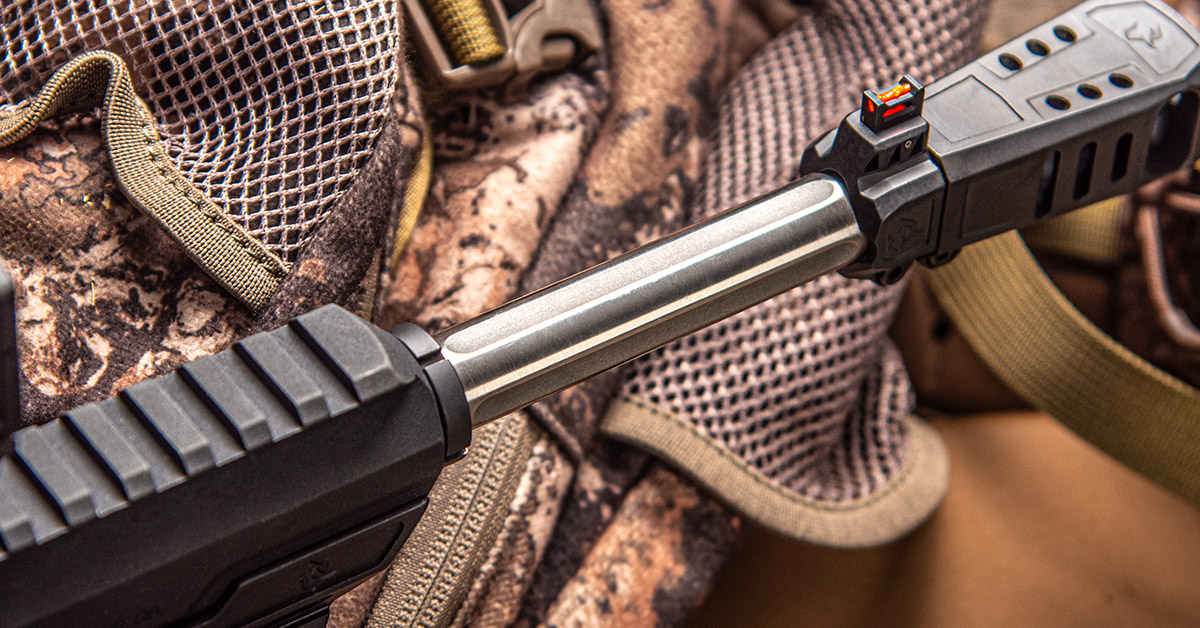
The barrel is made of stainless steel with a matte finish. Four fluting channels give the barrel a squarish appearance and help reduce weight by a skosh.
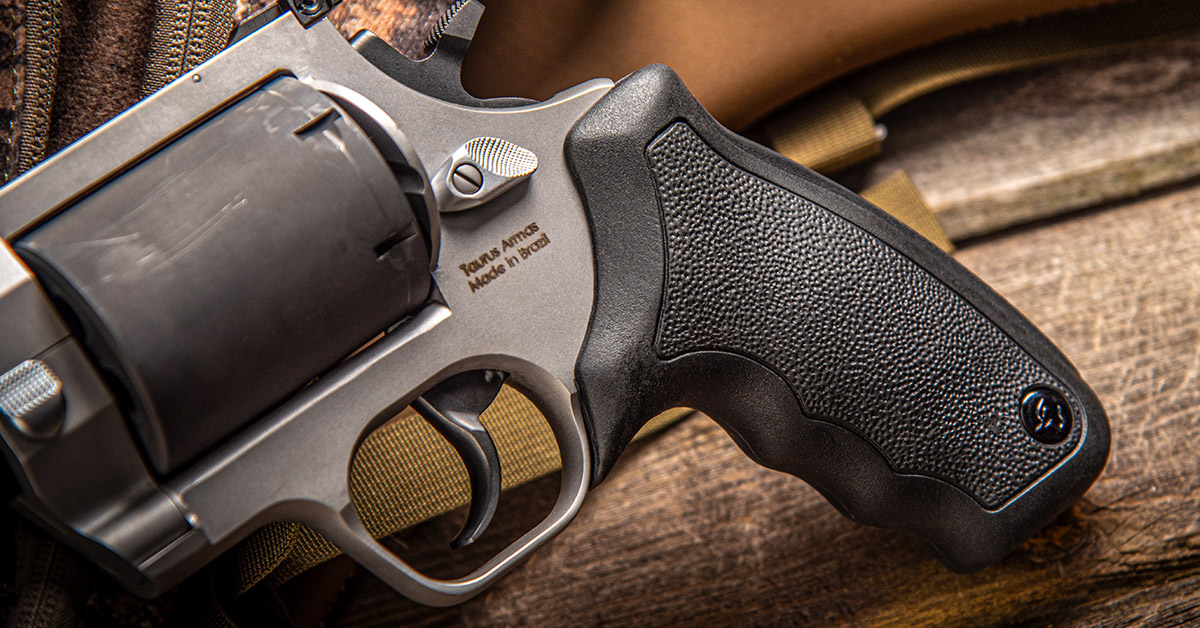
I wasn’t sure how the Raging Hunter 350’s felt recoil would compare to the 44 Magnum variant. Both come with the same Taurus rubber grip that I’ve always found to be quite comfortable and positively locking in the hand.
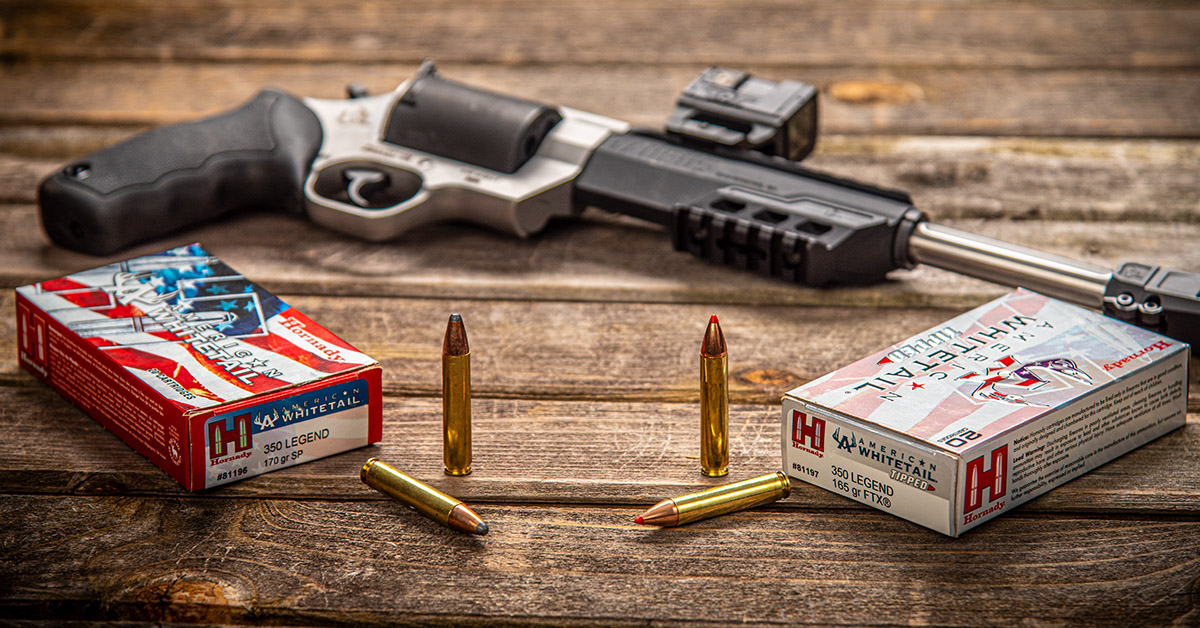
On the range, I didn’t feel like the 350 Legend bucked or banged into my palm any more than does the 44 Magnum. Then again, a lot of the Raging Hunter 350’s recoil mitigation can be credited to the larger, heavier frame, longer barrel, and non-fluted cylinder — all of which add mass that helps soften recoil. Over two hours of range time, it never wore me out and my hand wasn’t sore the next day.
An Outstanding Trigger
Trigger performance proved to be an unexpected treat. Right out of the box, the trigger felt exquisite, with absolutely zero grit or hesitation in the sear. In fact, other than observing the ever-so-slight sear travel as I pulled the trigger to break, the action was utterly smooth and the disengagement crisp. This excellence continued throughout the testing phase.
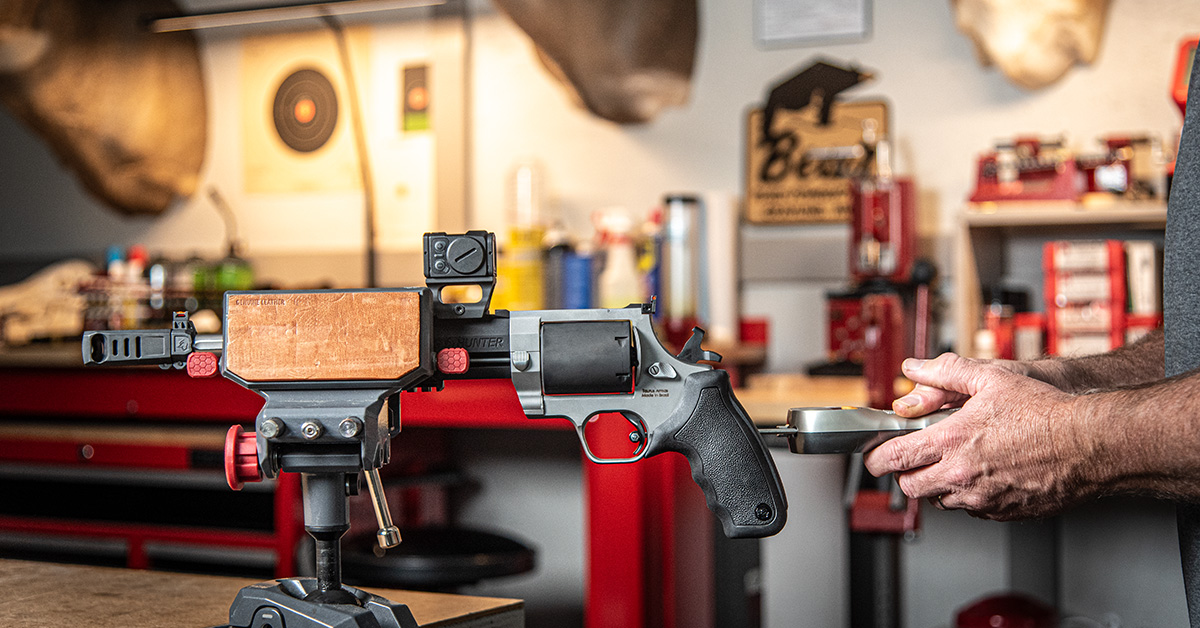
Curious, I later checked the trigger pull weight. I tried to get a read on the double-action mode (pulling through the trigger movement, starting with the hammer down) but the weight exceeded the capability of my Lyman scale, so there was no number to record.
In single-action mode (starting with the hammer cocked), a ten-pull average showed a pull weight of 3 lbs., 4.7 oz. This feels pretty good for a hunting revolver — not so heavy as to pull you off the mark, not so light as to get you in trouble when wearing gloves.
Just right.
Ballistics
A big question I had going into this test was just how much velocity does the 350 Legend give up in a pistol platform? I had collected the data on Hornady’s American Whitetail InterLock 170-gr. loading during our T/C Encore ProHunter CFT-X testing.
Hornady publishes 2200 fps at the muzzle with this cartridge out of a 20-inch test barrel. The velocity I clocked on the 26-inch T/C barrel with a Dead Air Primal suppressor was 2353.8 fps.
The same load shot out of the Raging Hunter 350 came in at 1773.5 fps — a 19.38-percent drop in velocity at the muzzle and 1152.3 ft-lbs of energy.
Here are the numbers from the test ammo:
- Hornady American Whitetail Tipped 165-gr. FTX (1773.5 fps, 1152.3 ft-lbs, std dev 12.3)
- Hornady American Whitetail 170-gr. InterLock (1717.5 fps, 1113.5 ft-lbs, std dev 24.1)
- Federal Non-Typical 180-gr. soft point (1616.5 fps, 1044.3 ft-lbs, std dev 15.5)
All of that to say, we are talking about a handgun with the expected handgun caveats: 1) the longer the distance to the target, the greater the point-of-impact dispersion and 2) a shorter barrel diminishes velocity and impact energy.
The latter consideration is why a bullet’s terminal performance is critical when picking a pistol hunting load. For example, Bullet A may be designed for optimal expansion at higher velocities while Bullet B does its thing at a lower velocity.
If you are going to hunt with a handgun that takes a cartridge intended for use in a rifle, like the 350 Legend, check with the manufacturer to make sure it is also suitable for ethical hunting of your chosen game animal at lower handgun velocities.
And then there is the issue of load testing.
I zeroed the Raging Hunter at 50 yards for several reasons.
First, that is about the average distance I would shoot a deer in the kind of woodland environment I hunt.
Second, I’m really not hip on using a red dot at distances much greater than 50 yards. That’s just me.
Third is the aforementioned issue of terminal performance at lower handgun velocities.
Of the two Hornady and one Federal load I tested, I discovered that my gun absolutely did not like the lighter 170- and 165-grain Hornady ammo. The shot groups were completely unacceptable. That’s not a fault of the ammo or the gun, but the combination.
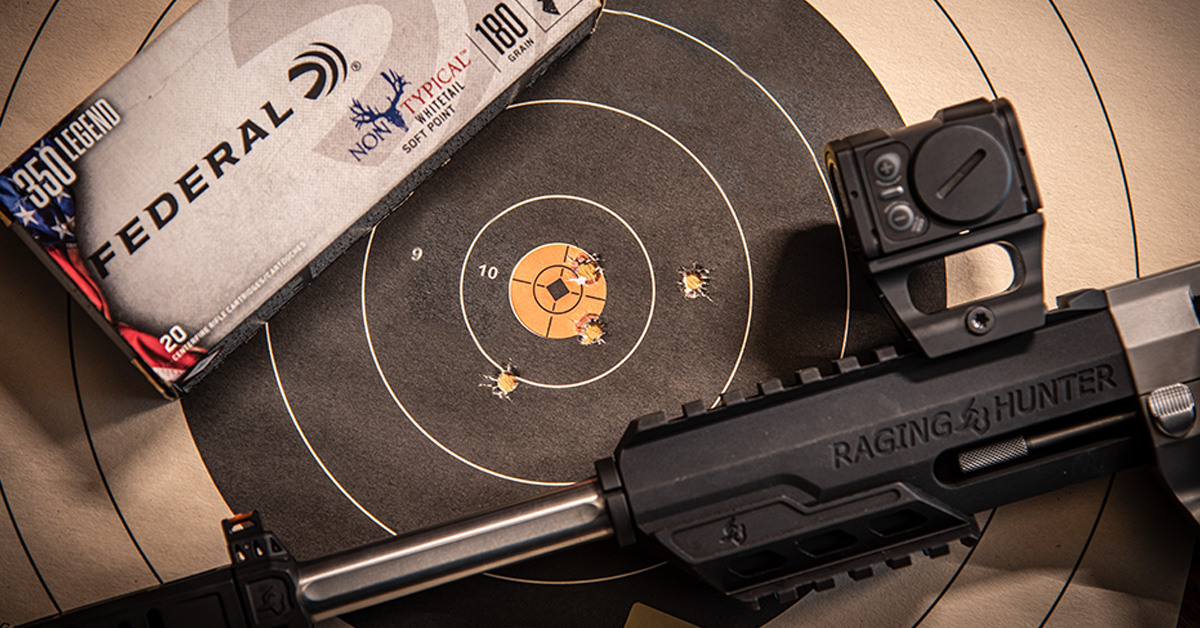
The heavier 180-gr. Federal load, on the other hand, was favored by the Raging Hunter. That also proved unfortunate because Federal no longer manufactures this load!
I hate to put a group size to any load that is guided by a red dot because I am not as precise in my aiming with a red dot as I am a conventional magnified optic. That said, the Federal Non-Typical delivered a 1.975-inch group at 50 yards. That was the best I could do with the Aimpoint Acro P-2.
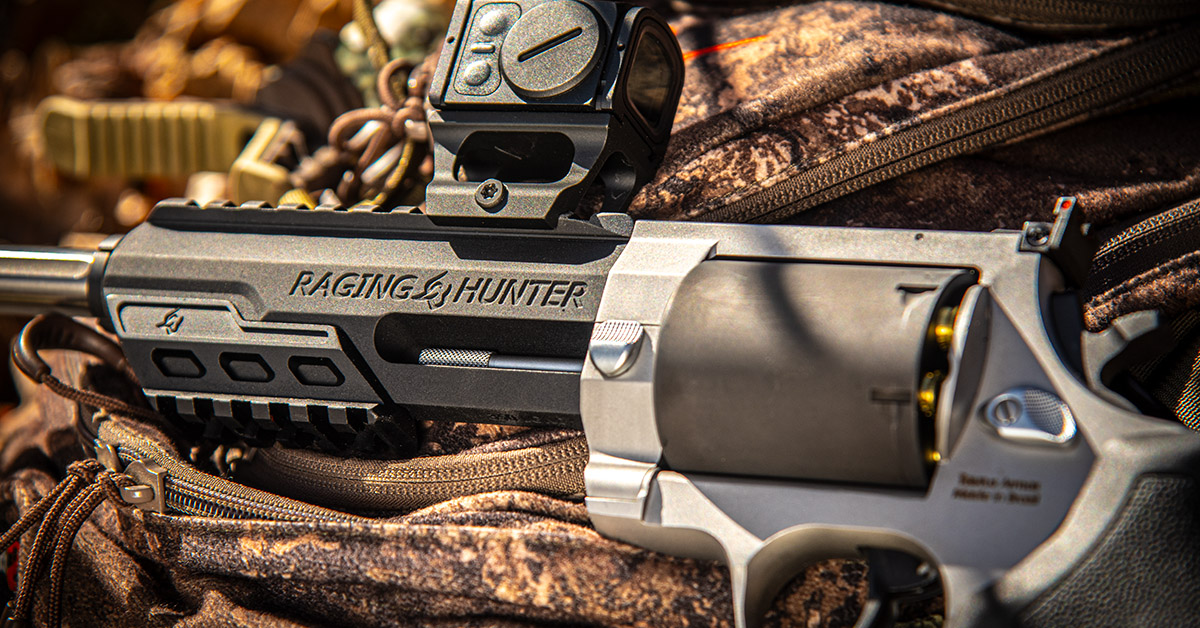
The Taurus Raging Hunter 350 is no plebian revolver, being purpose-built to put meat in the freezer. The gun demands a firm hand and a shooter’s dedication to finding the optimal load that delivers both accuracy and acceptable terminal performance. Its short-range nature also means you’ll need to hone your hunting skills to get close to game. Some may see those as negatives, but those of us who have passed through the “brown and down” phase will view these qualities as a bonus challenge — a means to add a new level of excitement back into the hunting game.
Taurus Raging Hunter 350 Specifications
- Caliber: 350 Legend
- Front Sight: fiber-optic
- Cylinders Included: 1
- Capacity: 6 rounds
- Rear Sight: fully adjustable
- Action Type: DA/SA
- Frame Size: large
- Overall Length: 16.5 in.
- Overall Width: 1.80 in.
- Barrel Length: 10.5 in.
- Overall Height: 6.6 in.
- Overall Weight: 79.40 oz. (unloaded)
- Twist Rate: 1:16 RH
- Frame Material: stainless steel
- Cylinder Material: alloy steel
- Barrel Finish: barrel matte stainless
- Frame Finish: matte stainless
- Cylinder Finish: matte black oxide
- Barrel Material: stainless steel
- Safety: transfer bar
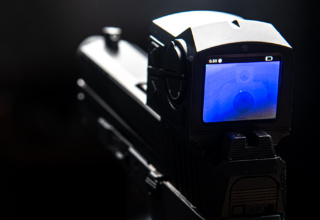
Aimpoint’s Acro P-2
I acquired an Aimpoint Acro P-2 red dot for this evaluation for a couple of reasons.
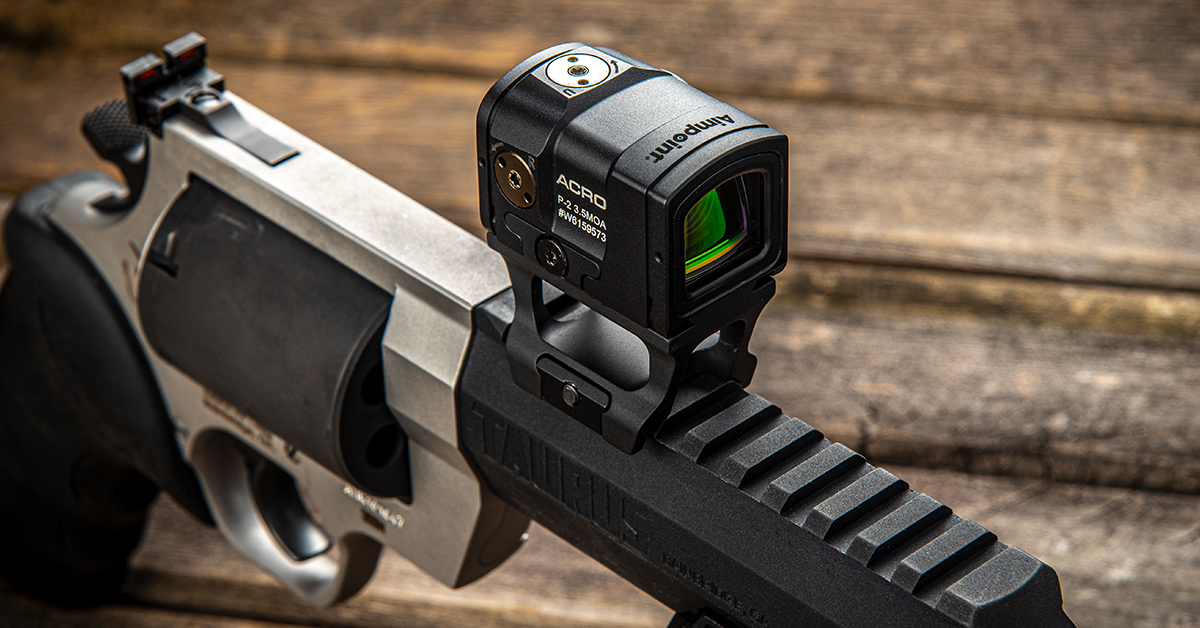
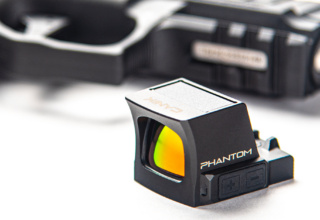
First, a hunting reflex sight should, in my opinion, be of an enclosed emitter design because…face it…hunting is a messy business. You want to be sure that red dot remains unobstructed regardless of the hunting conditions, and an exposed, single-lens reflex sight is vulnerable to environmental hazards and interference.
Second, Aimpoint bills the Acro P-2 as a red dot designed to withstand extreme shock and vibration. The Raging Hunter combined with a high-power pistol load is going to deliver just that, so I wanted something I could be confident would hold up to the big bang.
Once I properly torqued the mounting screws, the Acro P-2 performed to expectations.
Aimpoint Acro P-2 Specifications
- Sight Design: reflex collimator with LED
- Magnification: 1x
- Dot Size: 3.5 MOA
- Dot Color: red
- Optical Coating: multi-layer coated
- Clear Aperture: 0.59×0.59 in.
- Eye Relief: unlimited
- Battery: CR2032
- Battery Life: 5 years (50K hours) at setting 6
- Illumination: 6 daylight, 4 NVD
- Size: 1.9×1.3×1.2 in.
- Weight: 2.2 oz.
- Housing: aluminum, black anodized
- Adjustment Range: +/- 1 yd @ 100 yds
- Click Value: 0.7 in. @ 100 yds
- Footprint: Acro
- MSRP: $617