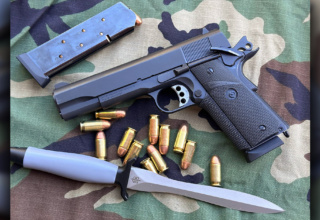
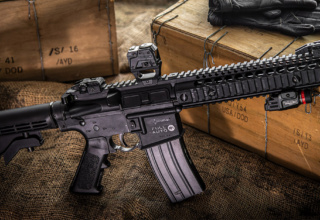
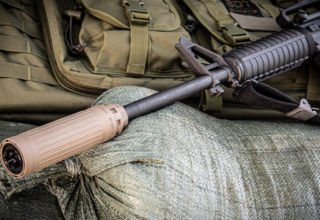
In the great pistol vs rifle cartridge debate, myths, conjecture, and sometimes foolish thinking often muddle honest discussion. But is there a difference? You better believe it, and here’s what you need to think about…
by Paul G Markel
I fully understand that the title of this piece might sound a bit rhetorical and that you would be inspired to think, “Duh, of course there is a difference, any idiot knows that!”
While it might seem prima facie that pistol cartridges and rifle cartridges are different and used for different purposes, the evidence that we encounter from online comments, overheard conversations, and from the actual behavior of people would beg to differ.
Allow me a moment.
Back in the pre-GWoT days, when I became a police officer, the standard armament for law enforcement was the personally-carried duty pistol (or revolver, as was the case in the 1980s and early ’90s) and the 12-gauge pump-action shotgun. In the police academy, we were taught to use both and were required to demonstrate competence before being allowed to graduate.
If you were to ask any cop, “Which is a better fight-stopping tool, a handgun or a shotgun?” the resounding response would be “shotgun.” Because gunfights were relatively rare, though, many officers would default to their handgun despite the intellectual realization that a shotgun was far more likely to stop a deadly threat faster than a handgun.
Real Examples
During one incident, my department got a call that there was a “man with a gun threatening people” at a certain location. All available units converged on the area. One officer pulled his patrol shotgun out of his cruiser while the rest simply unholstered their handguns and responded. The incident ended with no shots being fired and the suspect in question being arrested for “aggravated menacing.”
Great, all’s well that ends well, you say. Well, kind of. After it was all said and done, the officer who deployed the shotgun was subjected to ridicule or ribbing. What did he think was going to happen? Wasn’t that overkill? Yes, that is a stupid thing to think, but it actually happened. Why?

I’ll give you another example. During a force-on-force training evolution, we were using “Simunition” guns — blue Glocks and blue ARs. During one particular scenario, we were in a large shoot house with multiple rooms and were given a pistol to holster and there was a loaded AR staged within reach. Students were seated at a kitchen table as though enjoying their morning coffee. The scenario began with a home invader kicking in the front door, out of view, and yelling expletives. We students had to solve the problem at hand.
During the after-action debrief, our instructors interviewed each student and then critiqued our performance as a group. The class was made up of a dozen experienced men, all police officers. Of those present, only myself and one other man grabbed the long gun to confront the armed intruder. I should mention that this was in the early 2000s, probably ’05 or ’06, before the widespread adoption of “patrol rifles” by US law enforcement agencies.
I should also express that every student was an experienced shooter; these were not rookies, and most were also certified firearms trainers. Were you to sit the entire class down and ask, “Which tool is a better man-stopper, rifle or pistol?” Everyone one would have emphatically stated that an AR in 5.56mm will stop a deadly threat more effectively than a 9mm handgun.

So, why, under the stress of the force-on-force scenario (those marking cartridges hurt), did all but two students default to a handgun when a long gun was right there? I must admit that during the after-action discussion, I was truly surprised by the results. One reason that I was able to come up with was that of the dozen guys, the only ones to grab the rifle were military infantry veterans — myself a Marine and the other a former soldier. All the other men were career police officers who had carried a duty pistol for decades.
We had some further discussions and none of the non-military guys were able to articulate an intellectually valid reason for not grabbing the rifle. Also, since every student was able to successfully shoot the bad guy without themselves getting shot, it seemed like it really didn’t matter all that much. They all had the time to grab the rifle; they just instinctively used their pistols.
Distance vs. Close Combat
What we see and have seen is that, despite the ballistic reality that a long gun is a superior fight-stopping tool when facing a deadly threat, there is also a very real, if subconscious, belief that handguns are for close combat and long guns are for distance shooting. Even people with education and experience tend to fall into that mindset.
Yes, many deadly force scenarios are unexpected, and you might only have a handgun available at that moment in time. But what about the times when you have the option to grab a long gun?
We should all understand that a deadly force scenario is deadly serious. Our goal should be to stop the deadly threat as rapidly as our tools and time will allow. Given the ballistic superiority of a long gun chambering a rifle cartridge, one or two shots from a rifle are far more likely to incapacitate the threat versus a historically less-than-effective tool launching pistol bullets.
Just recently, during a discussion of “truck guns,” a person offered that if the distance was close, 25 to 50 yards, a pistol-caliber carbine could be just as good of a choice or better than a rifle.
From where does this thinking arise?

When discussing the use of a rifle-caliber long gun, or what we like to call “carbines” in modern parlance, we remind our students that we are not using that tool to overcome distance. In close-quarters combat, a rifle-caliber carbine is a ballistic sledgehammer.
Consider this. If you needed to break a cinder block into small pieces, you could do so by hitting it with a carpenter’s hammer a dozen times or more, or you could smash it into small pieces with one good swing of a 10-pound sledgehammer. Which of the two tools would be the better choice? Duh…you’d be stupid not to use the sledgehammer.
If faced with a lethal threat — one that could make me dead at any moment — I would rather stop that threat as rapidly as possible with one or two well-placed 5.56mm rounds rather than hoping a half a dozen pistol bullets will get the job done.
For those looking for historical evidence, consider the FBI Miami Shootout. That was one of the most famous real-world examples of handgun bullets versus rifle rounds. Michael Platt used a rifle and had ten handgun and buckshot wounds in his body before he stopped killing FBI agents.
Over-Penetration Boogeyman
One of the reasons American citizens offer for not keeping a rifle-caliber home defense gun readily available is “over-penetration.” Our question is, what are you worried about over-penetrating?
If the answer is interior walls in your house, we have some bad news for you. Unless they strike a wall stud squarely, every handgun bullet you fire is going clean through your interior walls — even the .22 LR. The drywall material separating the rooms in your house is NOT going to stop a 9mm bullet. If the answer is “I’m worried about over-penetrating the bad guy,” handgun bullets are MORE LIKELY to go through a bad guy than a 5.56mm projectile.

While US law enforcement was initially a bit nervous about switching from the standard MP5 9mm subguns to 5.56mm carbines for their SWAT officers, the after-action results from real gunfights told a different story. The bullets from officers’ 5.56mm patrol rifles over-penetrated suspects FAR LESS often than did the bullets from the subguns. Additionally, fewer rounds were needed to put down a deadly threat with rifle-caliber bullets when compared to the pistol-caliber bullets fired from the MP5.
Comparing Apples to Apples
We have conducted gelatin/ballistic medium tests on two exceptional self-defense cartridges: the Black Hills Ammunition 115-grain JHP +P 9mm and the Black Hills 77-grain OTM 5.56mm. While the 9mm load meets and exceeds the FBI standard penetration testing, both the permanent and temporary wound cavities pale when compared to those of the 77-grain 5.56mm load. Also, the solid 9mm projectile will travel farther into the gelatin while the 5.56mm projectile violently comes apart while staying inside a target, which is the relative thickness of a human torso.
For those who like statistics; the 9mm is moving at 1275 fps out of the muzzle with 415 foot-pounds of energy delivered. The 5.56mm load is moving at 2750 fps out of the muzzle and delivers 1293-foot pounds of energy on target. That’s double the velocity and four times the energy delivery.

Yes, to be fair, the standard 62-grain 5.56mm round known as “green-tip” or M855 “penetrator” will indeed zip through bodies. That load was designed to defeat Cold War-era Soviet body armor, not to be used as a close-quarters combat round. When the US Army Special Forces started using the Black Hills Mk262 77-grain OTM, the results were like night and day on enemy combatants. We would not suggest the “green tip” for a home defense carbine.
Mindset
Even when fired from a pistol caliber carbine, a handgun cartridge is still a handgun cartridge, it does not magically take on the properties of a rifle cartridge because it is fired from a longer barrel.

Are there valid reasons to use a PCC, such as an AR-style gun in 9mm? Economy is the first one that comes to mind. Even with today’s prices, you can get twice as many shots with 9mm training ammunition as you could with 5.56/.223 training ammo. Also, if you are restricted to a “Pistol Caliber Only” indoor range, a 9mm carbine will give you the opportunity to practice where you might not be able to with a true rifle caliber gun.
That being said, we must understand that much, if not all, of the misunderstanding about pistol versus rifle calibers, overpenetration, and the need to overcome distance, is based upon feelings or subconscious beliefs and not upon true ballistic science.