Scope design, parts, and assembly no longer have the same origin. Better products or just economical?
by Wayne van Zwoll
Italian sports cars, English grouse guns, French wines — all signature products with intimate ties to place. You might add German optics to that roster, despite the pride many hunters take in riflescopes made in the USA.
But ancestral names carry less weight now than they did in the 1950s, when sales of riflescopes steam-rollered those of metallic sights. Short decades later, hunting rifles would appear with naked barrels, “irons” superfluous under scopes by Lyman, Weaver, Leupold, and Redfield. These dominated in the U.S. market, burying the Noske and other pre-war competition, then scopes by Marble, Norman-Ford, Pacific, and those branded by rifle manufacturers: Marlin, Mossberg, Savage. By the 1970s, the name on a scope only sometimes identified its origin. And imported optics were wearing all-American labels.
Bushnell
The subsequent tide of scopes from abroad started as a trickle in 1948, with 400 binoculars Dave Bushnell brought from a honeymoon trip with his first wife in Japan. He peddled them through an import-export business from his mother-in-law’s Pasadena house. When a shipping strike stopped deliveries, he dug himself out of cancelled orders by risking $200 on a small ad in Sports Afield. He sold 54 binoculars for $648. Inspired by this bonanza, he stocked more binos. They were gone within the year, netting him $20,000. He then invested heavily in a nationwide ad campaign that, by 1953, included riflescopes. Soon, Dave was taking the entire output of two Japanese optical firms.
In 1954, Bushnell 2 ½x, 4x, and 6x ScopeMasters were re-named ScopeChiefs. A subset without internal windage and elevation (W/E) adjustments required adjustable mounts. In ’59, after adding 3x, 8x, and 10x scopes, Bushnell introduced a 3-9x ScopeChief variable with the Command Post reticle — a post you could flip up against the crosswire in dim conditions. Attractive pricing sold Bushnell scopes. Also, they were sturdy, reliable, and delivered bright images. My first new riflescope was a 2 ½x Bushnell I bought at retail in the late ’60s for $39.50.
Zeiss
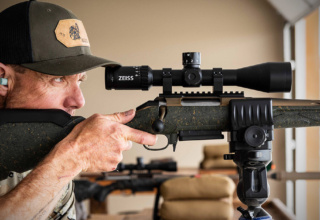
Domestic production of receiver-mounted scopes had come to the U.S. long after they’d appeared in Germany. In 1846, a young Carl Zeiss began working near Wetzlar, soon to become the country’s hub for optics manufacture. Moritz Hensoldt and Carl Kellner founded the Hensoldt company there in 1849. Optical glass to improve scopes appeared in 1884 in Jena, Austria’s Glastechnisches lab. (Later it became Schott Glaswerke, now with hubs in more than 100 countries. Schott supplies — and contracts for — much of the world’s top-tier optical glass.)
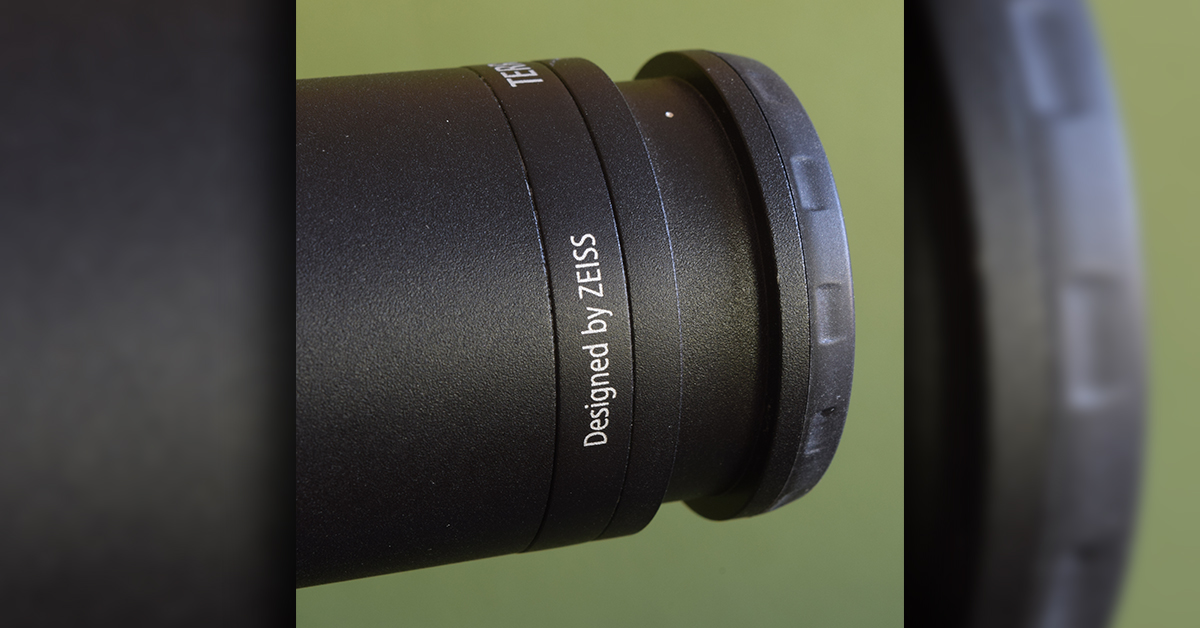
When Carl Zeiss died in 1888 at 72, the Hensoldt/Zeiss union was making optics for hunters. By 1897, Zeiss had a roof-prism binocular. In 1904, it employed a prism instead of lenses to make riflescopes shorter. Its Zeildovier and Zieldosechs scopes of 1921 featured variable power and illuminated reticles. A 1926 booklet (Carl Zeiss, Jena) lists a 2 ½x Zeilklen riflescope at $25, a 4x Zeilvier at $45. Variable 1-4x and 1-6x models cost $66. By 1928, Zeiss controlled M. Hensoldt & Sons. In the early ’30s, an engineer at the company found that coating lenses with magnesium fluoride significantly reduced light loss. After the Third Reich imploded, this practice was adopted world-wide.
Swarovski/Kahles
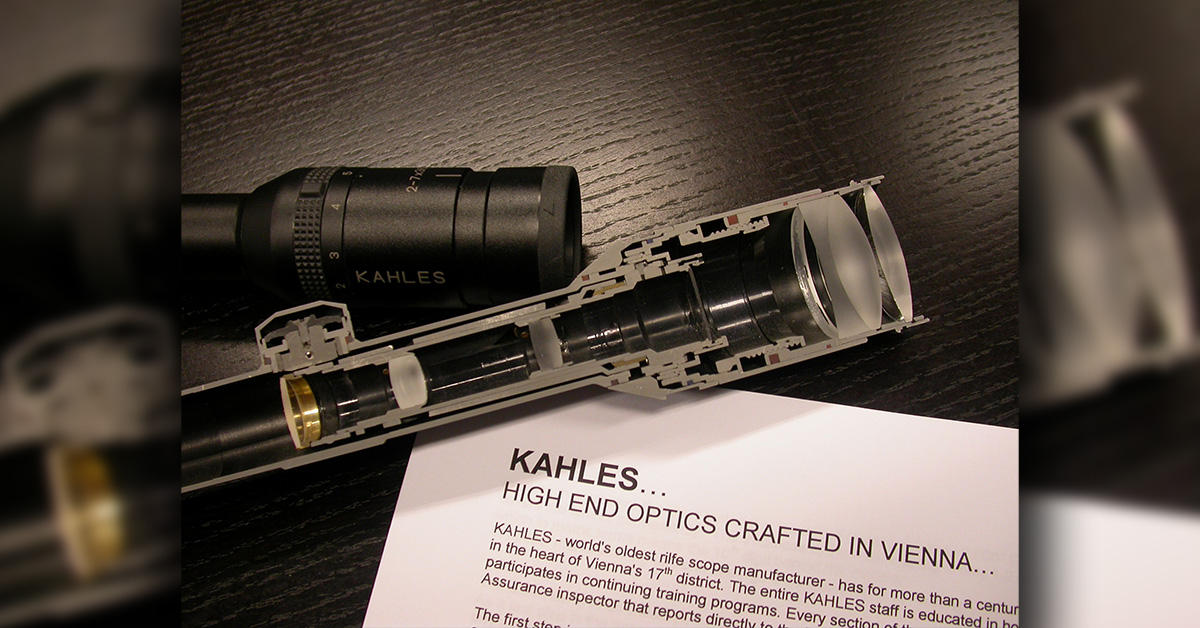
The Austrian firm Swarovski, founded by Daniel Swarovski in 1895, entered the hunting market with a 7×42 Habicht (hah-beesh, hawk) binocular in 1949. A 4×32 riflescope appeared a decade later. Another Austrian brand, Kahles, dates to 1898, when Karl Kahles came to manage an optics shop started 75 years earlier by Simon Plossl. After Kahles died in 1908, his widow, then sons Karl and Ernest, took charge. Late in WWII, the factory was bombed; young Karl perished. His widow and son Friedrich rebuilt the business. In 1959, it pioneered multi-coated lenses. Five years later, Del Sports brought Kahles scopes stateside. In 1974, the Kahles family sold the company to Daniel Swarovski, whose optics found their way to the U.S. via Del Sports in 1976.
Weaver
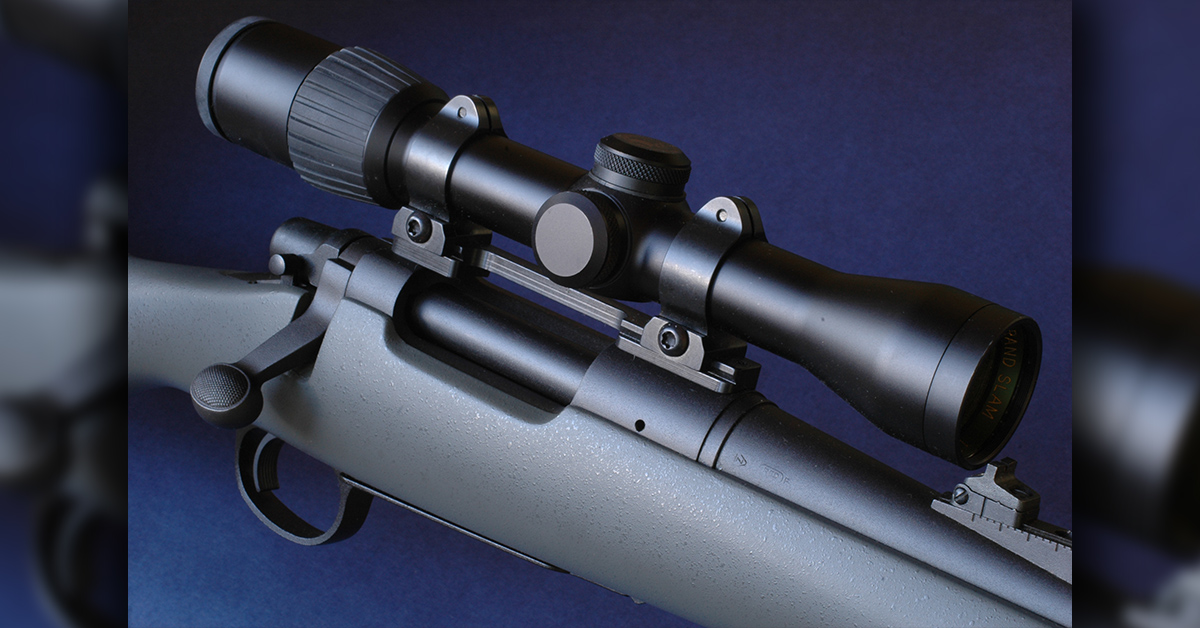
The lens-making expertise of central Europe was well traveled before this country’s first practical short riflescope emerged, frontier fashion, from the Kentucky shop of 24-year-old Bill Weaver. Built on a 3/4-inch tube from scratch, with tooling Bill designed, the Weaver 3x Model 330 sold initially for $19 — half the price of a Zeiss. It included a functional if not elegant mount.
Lyman
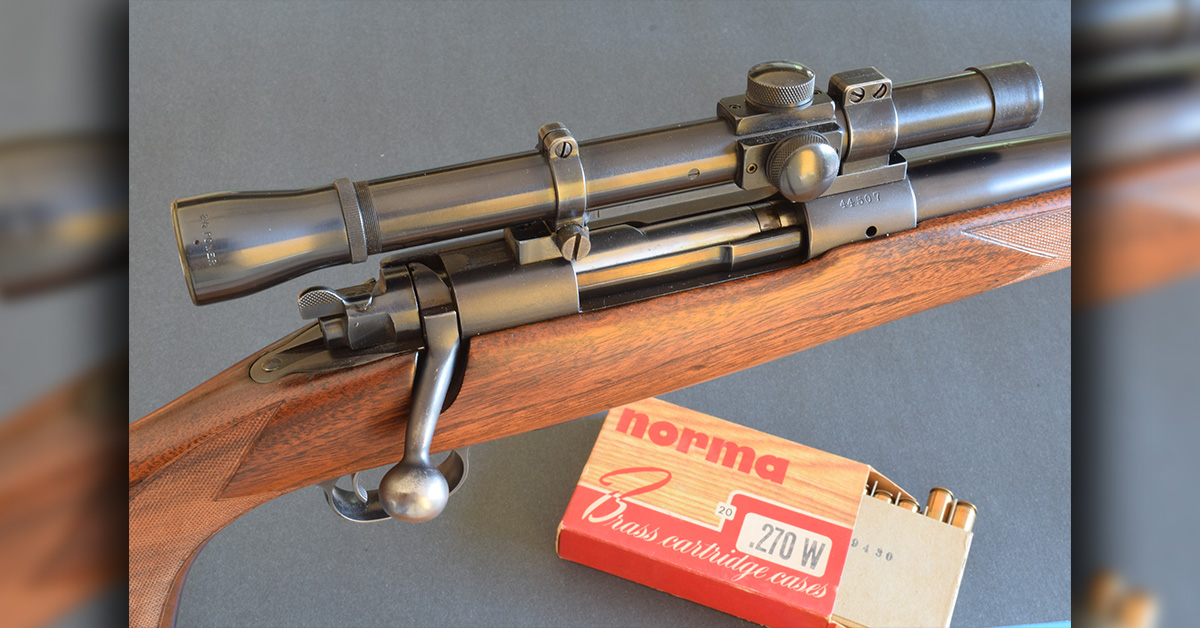
Two years earlier, Lyman Gunsight Co. had marked its 50th anniversary by acquiring the rights to and tooling for Winchester’s barrel-mounted A5 riflescope. It became the Lyman 5A. The optics division of the J. Stevens Arms Co. joined Lyman’s portfolio in 1929. A series of target scopes ensued, with a 3x hunting optic whose offset forward mount adapted it to lever rifles. But the 7/8-inch 2 ½x Alaskan, on the boards in 1937, then produced from 1939 to ’57, became Lyman’s biggest hit. Only after Weaver’s 1-inch K4 arrived in 1947, with Leupold’s first scope, would the Alaskan get stiff competition.
Leupold
Frederick Leupold had emigrated from Germany in 1895, age 16. In 1898, he and Adam Voelpel joined the rush for Alaskan gold. The Klondike proved a hard master. After a stint on the East Coast with C.L. Berger & Sons, maker of survey instruments, Leupold moved to Portland, Oregon, in 1907 and, with Voelpel, set up his own shop. In 1914, John Cyprian “Jack” Stevens added his water-level recording devices to its product line. Two years after Voelpel died young in 1940, the company became Leupold & Stevens. In 1944, Frederick Leupold perished during a surgery. His son Marcus shifted the company focus to riflescopes in 1947 with the 7/8-inch, 2 ½x Plainsman. Like all scopes, it fogged. So, with ideas gleaned from his Merchant Marine service, Marcus replaced air in the tube with nitrogen. In 1949, Leupold trotted out the first U.S.-built fog-proof scope. This 2 ¼x “Leupold Riflescope” weighed less than 7 ounces and, in 1951, sold for $64.50. In 1954, the 4x Mountaineer became Leupold’s first 1-inch scope.
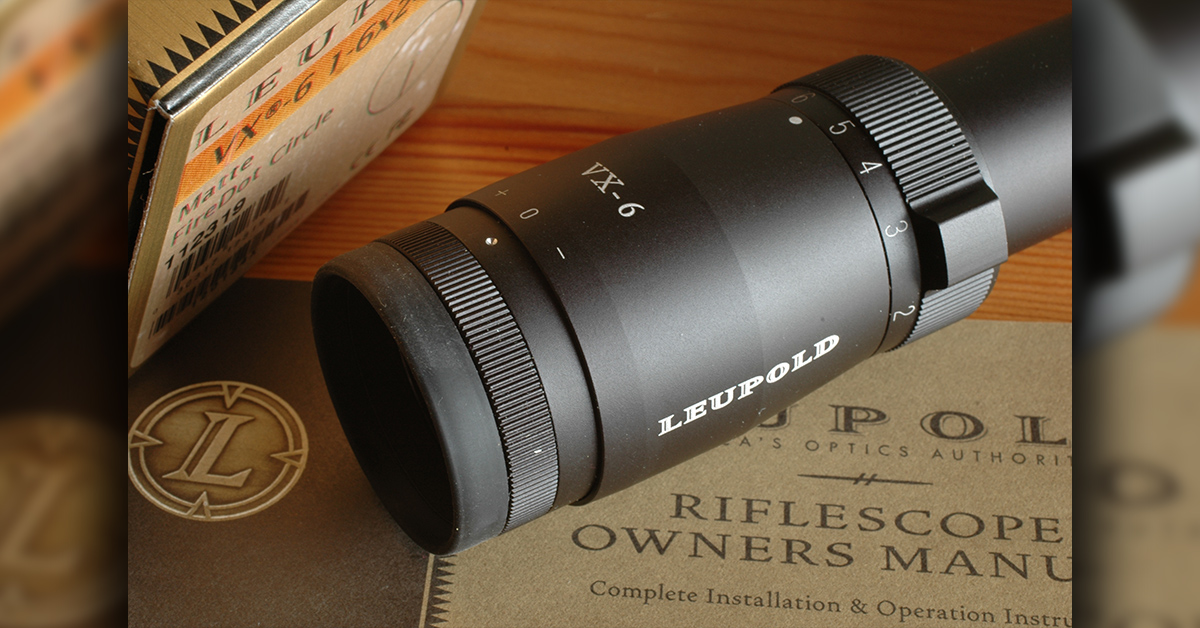
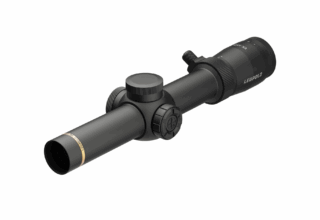
The last 70 years of riflescopes have brought constantly centered reticles and brighter, sharper images, also positive W/E adjustments. New features, too: parallax correction, lighted reticles, and trajectory-matched elevation dials. Brisk U.S. demand for riflescopes has fueled competition from abroad, nudging U.S. makers to source components, even assembly, offshore. Leupolds are among the few scopes still built stateside; but even they include components from overseas. Besides trimming costs, outsourcing can also ensure a company has an adequate supply of parts that meet its specifications. Not just screws, but glass types, even finished lenses. “Specifications are what matter,” manufacturers tell me, “not place of origin.”
Leica
Assembly has shifted, too. Quietly, the revered German optics firm, Leica, manufactures scopes in Portugal — has for 50 years! “Many components from Wetzlar are installed here,” affirmed Joe Simoes, an engineer at the modern 193,000-square-foot Porto plant. “All Leica sport optics are built and tested in this facility. We service them, too.”
Et Al
The low end of the optics price ladder leans heavy to imports. Some offer solid value. Tasco and Simmons began operations in Miami in 1966 and 1985, respectively. They’ve thrived. Ditto distributors with their own brands. From 1957 to ’64, Sears, Roebuck peddled its “J.C. Higgins” scopes. Herters, the Minnesota mail-order firm whose weighty wish-books of “Model Perfect” products mesmerized youth for a decade after 1968, sold me a worthy 1-inch 4x scope for much less than I’d have paid for an equivalent “brand-name” optic. From 1973 to ’83, Jana International of Denver hawked imported scopes for as little as $11 and “Zeiss-style” binoculars for $12.45!
Ads that include storied names or scopes that mimic the best of their type can fool customers and steal sales from makers of superior optics. Leupold’s “gold ring,” first on M-8 and Vari-X II scopes about 1964, was a brilliant stroke: a classy, understated mark visible from any angle. It’s been jealously guarded in court. Leupold cautions that its warranty is exclusive as well. Misuse of brand-specific names (“Xerox” for “copier”) gets a pass if the manufacturer benefits. Still, savvy hunters know that among “plex” reticles the “Duplex” is Leupold’s alone.
Companies in the Far East have sometimes added value to scopes. Nikon set standards in cameras and their lenses. Like Pentax, it has branded riflescopes. Arguably, the best riflescopes from Japan and the Philippines now match the optical quality of scopes made anywhere.
Maven
So it was that two of my rifles now wear Maven scopes. In 2013, three outdoors industry veterans launched this Wyoming company on the idea that it could develop and market top-quality products while nixing mark-ups with direct-to-consumer sales. Mike Lilygren, Cade Maestras, and Brendon Weaver now have a 20-person team designing riflescopes, binoculars, and spotting scopes and bringing them stateside. “There’s an ocean of competition in optics,” they admit. Their bet: customers will recognize value — and take advantage of Maven’s “custom build” option.
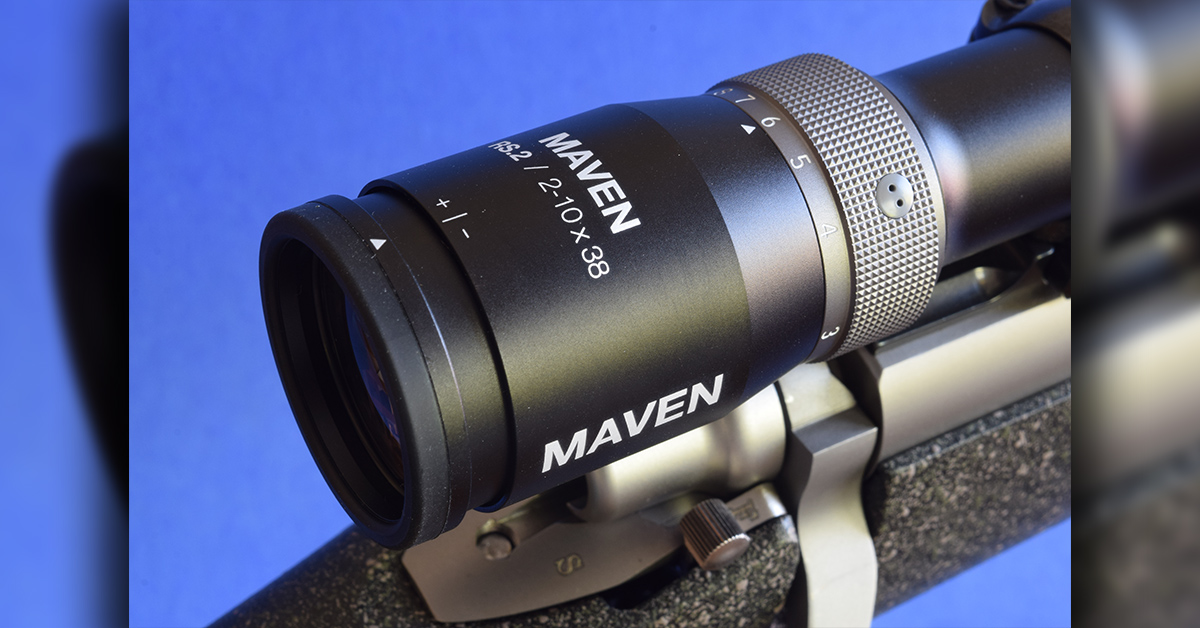
ED (extra-low-dispersion) glass is one optical component Maven gets from the best sources in the Far East. The 2-10×38 RS.2 riflescope I installed on a titanium-light 700 Remington in .30-06 performs with the optics that made German and Austria famous. Its five-times magnification range suits it to almost any hunt. Though just over 12 inches long, it has plenty of free tube for mounting on long receivers. The modest objective bell permits use of very low rings. W/E dials on the centrally placed turret have snappy quarter-minute clicks, 50 minutes each of wind and elevation movement. Re-setting zero is easy with no tools. The second-plane plex reticle standard on the RS.2 is by far the most popular hunting reticle.
At 6x, the scope’s 38mm objective transmits all the light your eye can use in the dimmest hunting conditions. The field is pleasingly flat, even at 3x, with almost no color fringing on the rim. Eye relief is adequate. Scaling just 12.4 ounces, this Maven keeps lightweight rifles light and won’t raise their center of gravity or affect their balance. Result: quick, responsive handling. While cosmetics get scant attention in scope reviews, they matter to me. I appreciate handsome rifles and scopes. Maven’s 3-10×38 has satin black anodizing with brushed-silver accents, pleasing on blued and stainless steel. Its sleek, businesslike profile mates nicely with trim rifles. As fetching is the direct-to-customer price: $625.
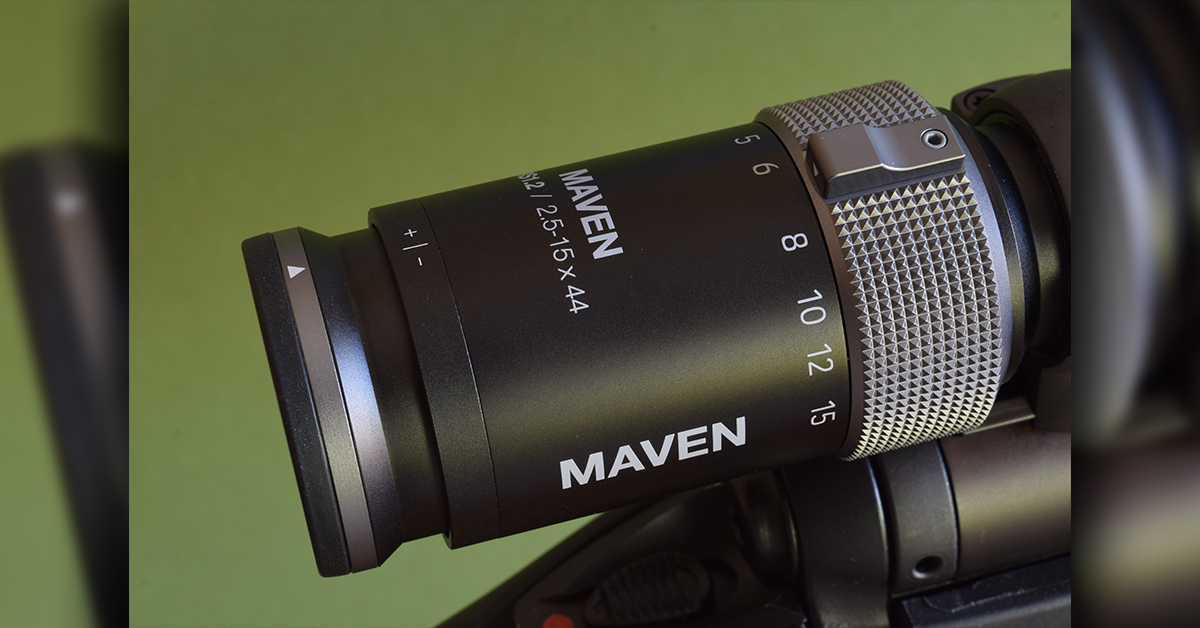
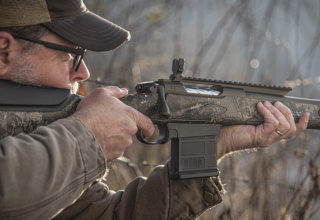
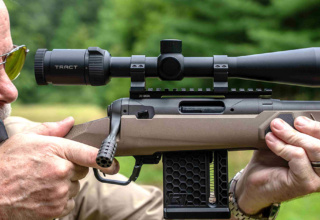
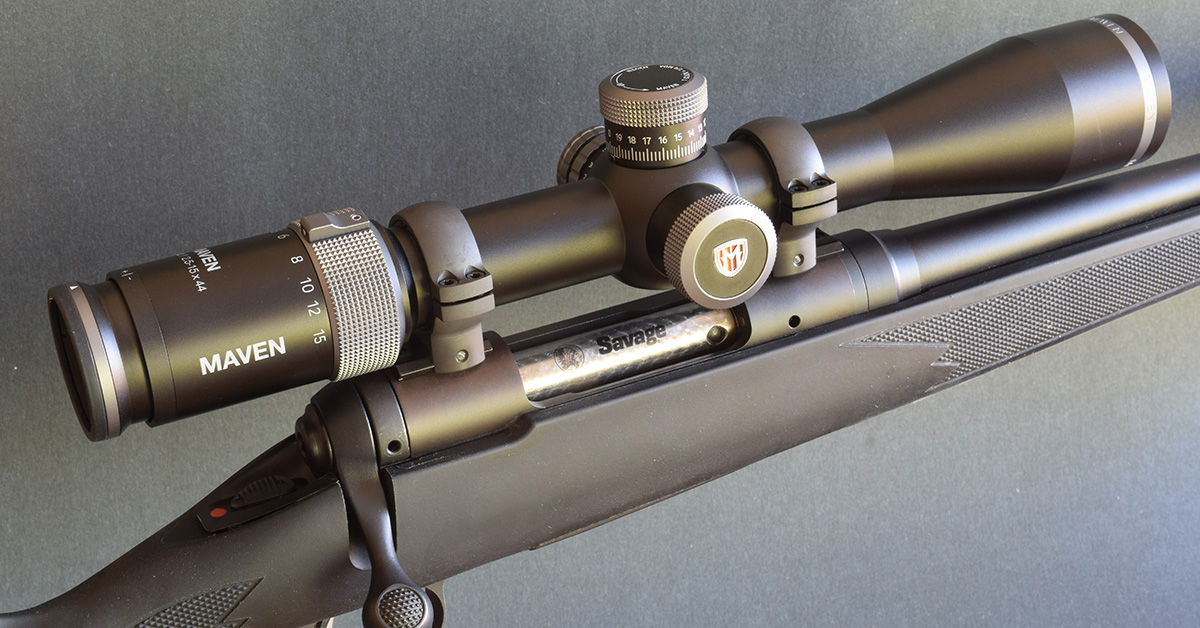
The other Maven scope available — a 30mm 2.5-15×44 RS1.2 — hopped aboard a longer, heavier Savage 110 rifle, whose dead-black stock and metal left all the prettying up to the optic. Maven offers this scope in black or black-and-grey. I’m mightily impressed by the two-tone option.
This scope boasts ranging, etched-glass, first-plane reticles. W/E tics in MILs or MOAs help with adjustments for bullet drift and drop at distance without cluttering the field of view. Reticles stay visible as you dial magnification all the way down and can be used as standard crosswires for urgent shots. Mid-height W/E dials (elevation un-capped) are neatly knurled, generous but not bulky. Positive clicks meet precise markings. The elevation dial has 100 MOA of lift, windage 70 MOA of sweep. A focus/parallax dial on the turret’s left side ranges from 10 yards to infinity. It cups a 10-station reticle-illumination knob and battery recess. Like its 3-10×38 stablemate, the 2.5-15×44 Maven features carriage-class lenses with phase-correction coating.
At 14.5 inches and 24.5 ounces, this powerful variable is an odd fit for a lever-action carbine or a skinny air-weight bolt rifle; but it looks and feels as natural as bees on blossoms atop a standard sporter. On many rifles, it’s compatible with low rings. The six-times magnification range makes it a go-to optic for just about all game, deep-cover deer to prairie dogs out yonder. The 2.5-15×44 RS1.2 lists for $1,400.
Maven scopes must pass many factory tests, including 3-meter submersion trials and performance checks under severe recoil and temperature extremes. While spec sheets of many scopes either omit light transmission targets or inflate them, Maven presents realistic numbers: 95 percent for the 3-10×38 RS.2 and 89 percent for the 2.5-15×44 RS1.2. These bracket the figures for costly European scopes. (No riflescope passing light through lenses can transmit 100 percent of it to your eye. Beware claims even edging 100 percent!) Using an Air Force eye-check chart in fading light, with power rings set at 6x, I found the brightness and resolution of these Maven scopes a close match to other high-quality optics with identical exit pupils — whatever their home country.
“Specifications are what matter.”