The growing popularity of enclosed emitter red dots seems to buck the “micro red dot” trend. Is there something to it?
by Bob Campbell
Visiting the local range is always a pleasant experience. I am in the business of testing equipment, and while I sometimes lapse into nostalgia and fire older firearms, during the past few months, I have been immersed in innovative technology.
Retraining has been essential. No one wishes to believe their skill set is obsolete. When training with a PMO (pistol mounted optic), you may hit a road bump or two. But there will be milestones leading to superior speed and accuracy given proper training and attitude.
Few fail to grasp the basics of the reflex sight based on a lack of ability but rather on a lack of willingness to train. The PMO is trendy in that the polymer frame, striker-fired handgun is trendy. It works and works well beyond most expectations. It isn’t a fad but the real thing. Threat-focused, both-eyes-open shooting results in an increase in speed and accuracy for those who practice. And that is the bottom line. The difference isn’t debatable, it is demonstrable.
There are advances in the PMOs, or carry optics, which are even better. The enclosed emitter sight is an example — rugged and nearly impervious — if you are looking for a new choice. Should you trade up to a closed emitter sight? If the RMR or DeltaPoint Pro is serving well, you are good. Should you wish to have an optic tougher than you thought possible and you are on the point, the enclosed emitter is something you should consider.
Choices
There are recent introductions in the PMO world that shouldn’t leave anyone out. Trijicon introduced a green dot sight in response to user demand. Green dot sights are friendlier to some eyes for several reasons and offer a good option for many shooters.

The RMR is a proven platform. A USSOCOM contract punctuates my remarks. This is good kit. Leupold’s DeltaPoint Pro often butts heads with the RMR in institutional competition. The DPP was selected by a special unit of the US Marshals Service as their standard issue. I would say that these institutional tests go far beyond what a single tester such as myself may achieve. But I have studied the history and use of red dot sights in competition. That is a difficult and demanding test and information is plentiful.
The PMO has arrived in reliability and respect.
One of the early dabblers in carry optics used a dovetail mount and experimented with a tube-type red dot. He called this gun his “Jedi gun” and it was easy to use. We have come a long way since. At one time, carry optics were not well suited to small handguns. Their slide width simply would not accommodate the technology of the time. The Shield RMSc changed that to a great degree. Modern handguns such as the Glock 43X offer direct mounting of a limited number of footprints. The Glock 17 MOS, with its variety of plates, is far more versatile, and the Springfield Echelon Variable Interface System is even more advanced. As reflex sight technology advanced, so did acceptance. Thirty percent of the optics market today is comprised of carry optics (per the NSSF). In USPSA competition, the carry optics division exhibits the greatest growth according to Jake Martens, USPSA media director.

The PMO is good but not perfect. Nothing made by man is. The open emitter sight projects a dot onto a glass or polycarbonate lens. If the open sight is fouled with mud or other debris, you cannot see the dot. While some sights are tougher than others, the standing roof of the sight may be subject to damage. A lens with good coatings may not be subject to fogging in extremes of weather. I have done a freezer test on red dot sights and the results were interesting. I have also taken a hammer to sights. I am surprised at just how tough they really are. But the traditional 90-degree L-shaped design of the red dot sight could be improved for durability.
After all, rifle sights use a tube or box design, which previously was thought not well suited to handguns. A serious redesign of red dot sights has given up the enclosed emitter sight.
The first generation of enclosed emitter sights had two things in common. They were larger and heavier than open emitter sights. And they were much more expensive than open emitter sights. But there is always development spurred by competition. And technology moves quickly.

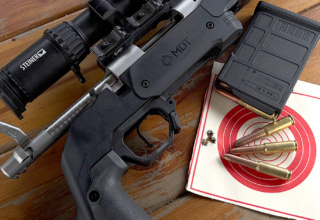
The Steiner MPS is a superbly crafted sight. The MPS features a design that reinforces the usual stress points of the PMO. This enclosed emitter design offers good adjustment and quality glass. The Steiner is a genuine hard-use sight with service-grade construction and features. Some enclosed emitter sights weigh more than the average PMO. At 2.05 ounces, the MPS isn’t a weight on the hip. Sights like the Steiner are rated for ten meters and two hours water immersion. But there is more to it than that.

If the enclosed emitter sight is subjected to soupy mud, snow, or dust, simply wipe the lens off with your thumb. It is best to softly clean a lens with the proper cloth, but in an emergency, quickly wiping the lens is expedient. This is a great advantage.

The next move was adapting enclosed emitter sights to a footprint more useful for compact pistols. This means the RMSc footprint. Meprolight’s MPO Pro is available in both the RMR (Pro-F) and RMSc (Pro-S) footprint. The enclosed emitter sight is now an option for those choosing a compact pistol, such as the Canik Prime or S&W Shield X. The Meprolight is a well-designed unit with excellent features and adjustments.
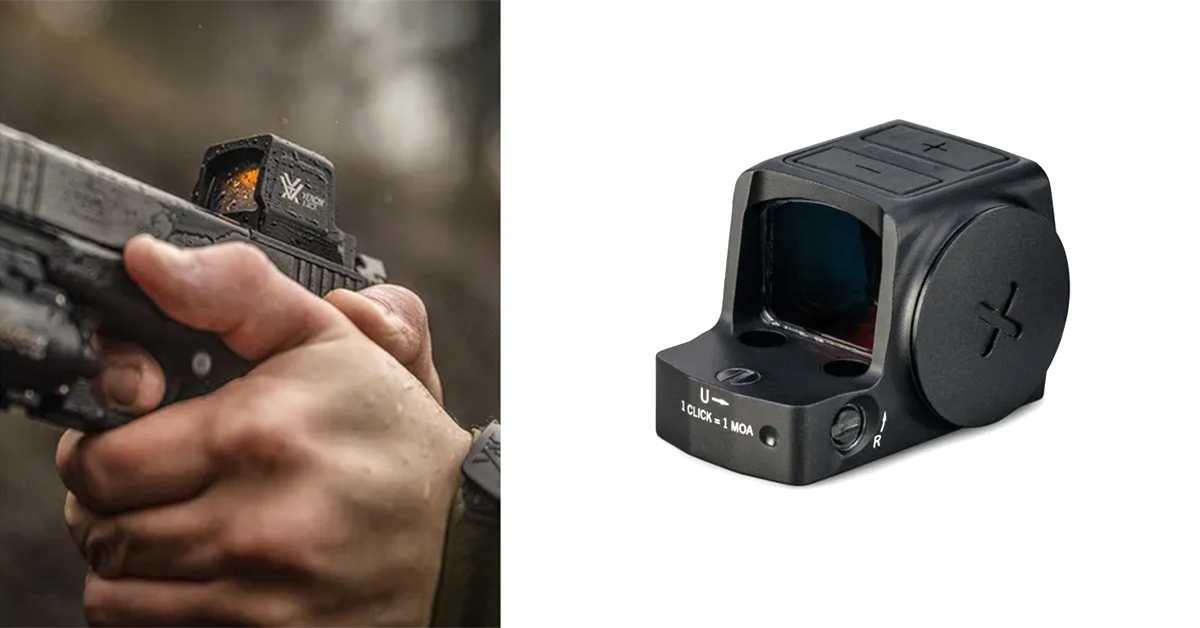
The Vortex Venom enclosed emitter sight is another compact unit offering a conventional footprint. This sight uses the DeltaPoint Pro mounting pattern. The Vortex Venom was introduced in September 2025. I have tested it extensively and find it a worthy upgrade of the well-respected Venom RDS. I took up a test program comparing the Venom and the Vortex Defender open emitter while working up this report. During that exercise, I reached some interesting conclusions. More on that later.
A maker held in the greatest respect by military units abroad is Shield Sights. To the best of my knowledge, theirs is the only electronic sight immortalized in bronze in a war memorial — this one in the UK as a tribute to soldiers who served in Afghanistan and Iraq. Shield’s RMSc footprint originally introduced red dot sights to compact handguns. The footprint has been widely used by many optic manufacturers.
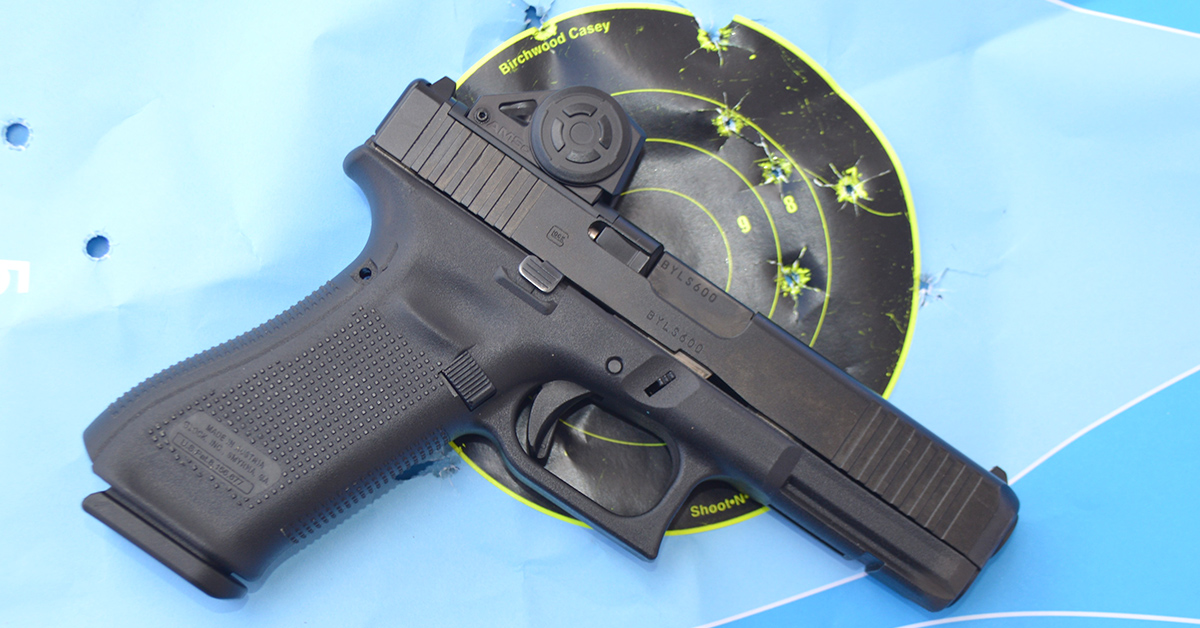
Shield has introduced the AMSc, an enclosed emitter sight weighing less than an ounce on the RMSc footprint. This is an innovative product, as it allows the use of three different battery sizes by changing the battery cover. Automatic brightness adjustments are aggressive. The sight’s zero is precise and easily adjusted.
Holosun has earned a reputation for good value for the price in the affordable, open emitter sight category. The company also makes enclosed emitter PMOs. The Holosun 509T enclosed emitter sight may be switched from red to green dot, and offers three reticle choices: dot, circle, or dot in a circle.
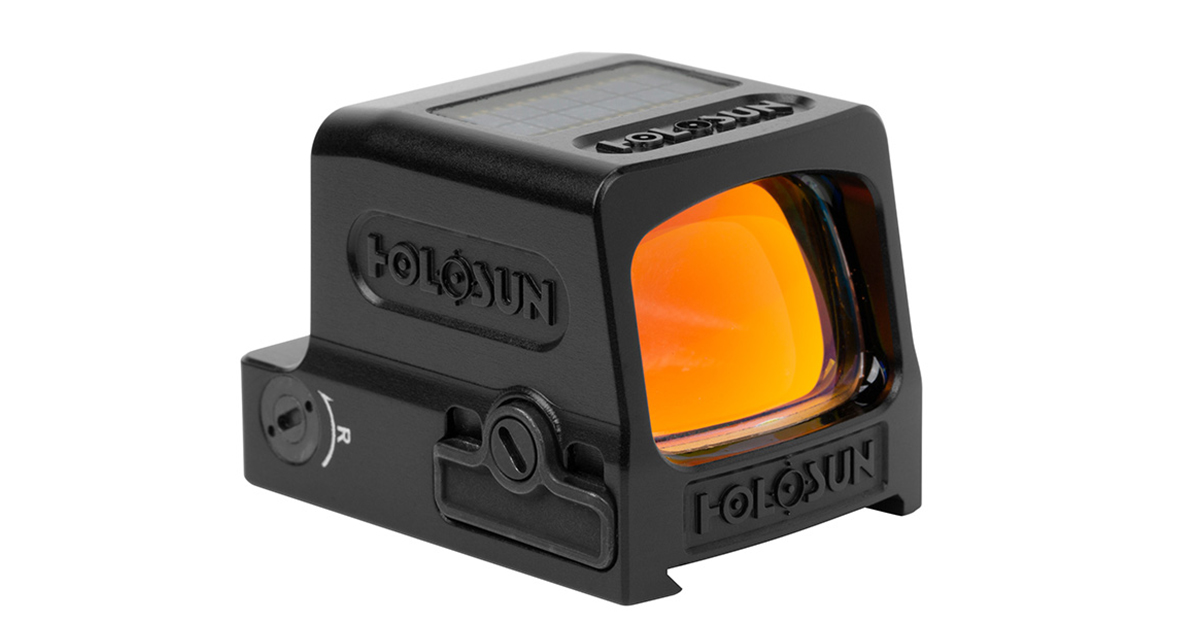
I have studied institutional test programs of service-grade optics. The Holosun consistently absorbs damage without losing function or zero, and it is often in the top three of any test program. This is saying a lot.
Firing Tests
The extra strength of the enclosed emitter is a given. The geometry of the sight and its supporting structure will survive hard knocks more so than the open emitter design. In a worst-case scenario, clearing the lens of obstruction is much simpler.
There are a couple of concerns I put to rest in testing and evaluation. First, would the enclosed emitter sight be problematic for concealed carry? Per my testing, not at all. One of my associates even feels the design is less likely to snag on the draw. At the least, the enclosed emitter is no impediment to concealed carry.
Another concern I did not take seriously was that the extra weight of an enclosed emitter may affect slide velocity. Another associate, who has seen it all, went through struggles with adding a compensator to his competition gun and spent an outrageous amount of time, money, and ammunition getting a compensated 1911 to run. Then there was a PD that had trouble with rail-mounted combat lights and the .40 caliber handgun. When fired with the rail-mounted light, there were function problems.

I run the Streamlight TRL-7 and TRL-8 without any difficulty. I also point out that factory compensated pistols are run-of-the-mill now and are reliable. Just the same, a mix of a few hundred rounds of 9mm heavy bullet, +P, and +P+ loads did not induce malfunction running both an optic and a light.
The final question presented more concern — that is, the ability of the shooter to use an enclosed emitter well. Would the sight window be as fast and accurate as the proven open emitter? Would the enclosed emitter limit rapid sight acquisition? It took a few hundred rounds of 9mm, but the test returned clear results. I extended the test on a limited basis to Holosun optics a few weeks later.
Firing Results
Value and quality may only be judged by testing a project in a realistic environment. I loaded up several magazines of Black Hills Ammunition and compared the Vortex Defender open emitter and Vortex Venom enclosed emitter. The test wasn’t perfect, as the handguns were not identical; however, in the end, I came away with the impression I was the better shot with the enclosed emitter.
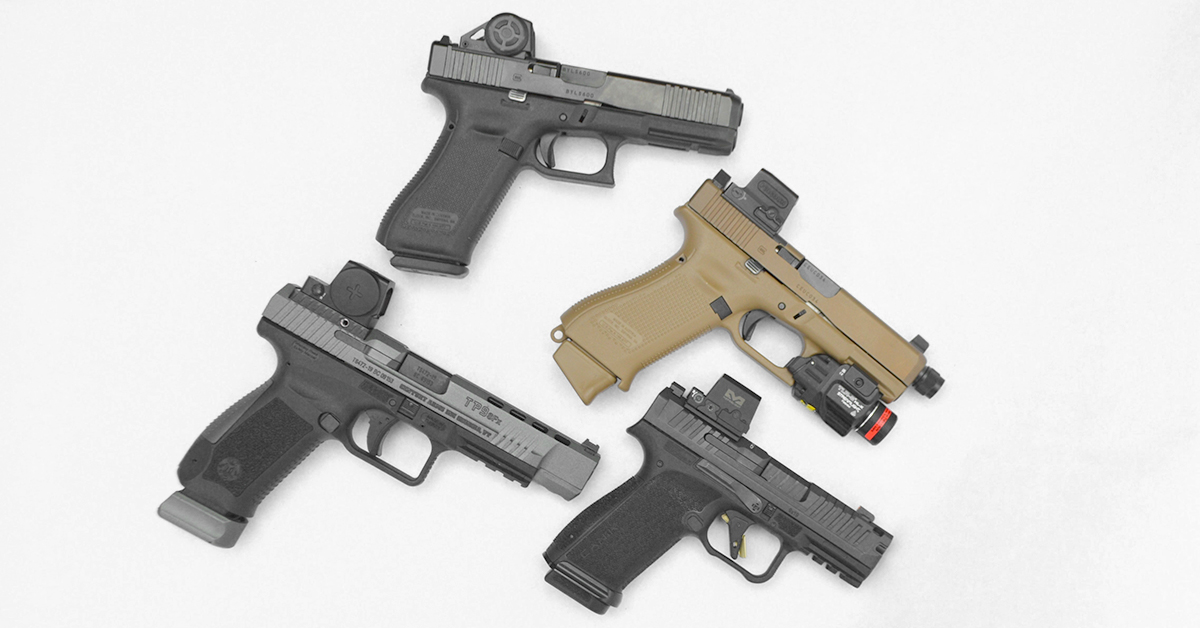
A few weeks later, I performed a similar test with two of my favorite carry guns — a Glock 19 and Glock 19X, each with Holosun carry optics. This time, the 509T enclosed emitter really walked away from the 407 open emitter. The 407 is a good sight, well distributed, and popular in carry optics. The reasons I find accuracy easy to come by with the enclosed emitter are many.
There seems to be a clearer aiming point. One shooter felt that the enclosed emitter offers a tunnel-like aiming point. I think so. The glass is angled slightly with the open emitter and not so with the enclosed emitter. Most shooters find the enclosed emitter the better choice for rapid fire shooting. In the end, on a basis of durability and shootability, the enclosed emitter is the superior choice.
These are interesting times, and we will surely be seeing a continuing trend toward enclosed emitter use.