If you want to wring out maximum accuracy from your muzzleloader, the process is simple (but your shoulder might beg for mercy before you’re through!)
by Rob Reaser
Unlike most veteran deer hunters, I do not consider modern muzzleloading rifles — especially the newest variants that utilize Federal Premium’s FireStick technology — to be a lesser performance option to a conventional centerfire rifle. In fact, depending on my intended hunting situation, I sometimes choose the muzzleloader over a centerfire rifle.
Why?
A well-designed .45- or .50-caliber bullet pushing around 2000 fps that reliably delivers pinpoint accuracy to 100 yards and even beyond is an instant fight-stopper if you know where to place the shot. And, no…I do not need more than one shot to do it. A lifetime of bowhunting has forged that one-shot, one-kill mentality deep into my psyche. You wait patiently for the optimal shot opportunity. If the perfect shot doesn’t present itself, you keep your finger off the trigger. When the shot does arrive, your confidence rests in the knowledge that your equipment will put that bullet exactly where you aim.
It’s that simple.
Of course, getting to that point-of-aim/point-of-impact confidence is the trick. I’ve heard so many stories of bad hits and unrecovered game by conventional muzzleloader hunters that it’s almost sickening.
“Those bullets don’t work!”
“My gun doesn’t shoot good!”
“That powder sucks!”
Blah, blah, blah…
No, the problem 90-percent of the time is that too many people treat muzzleloading rifles and hunting with them as some sort of novelty that doesn’t demand the same careful load development and accuracy refinement as they might put into their centerfire rifles.
I want to call out that mindset right here and show how a state-of-the-art muzzleloading rifle system can be as accurate and even more accurate than a decent factory centerfire rifle shooting its most-favored cartridge.
Think that’s a load of bunk? Continue on…
The “Modern Muzzleloader”
When I want to hunt with a muzzleloader, the gun I reach for is not a modern muzzleloader at all. It’s a .50-caliber sidelock Kentucky-style rifle I built from a Traditions kit many moons ago that I use with a round ball, patch, and black powder. I’m old-school and I like it that way.

But when I’m serious about putting something in the freezer, I want the best that today’s technology will deliver. And in the modern muzzleloader realm, that means a Traditions NitroFire rifle with Federal Premium’s FireStick encapsulated powder charges and a proven bullet design.
Why this combo? Three words: precision, reliability, and safety.
You can read our in-depth discussion of the NitroFire and FireStick system here. The short version is that Traditions and Federal (along with Hodgdon) teamed up to develop this breakthrough ignition system over six years ago. It uses an encapsulated powder charge (the FireStick) that accepts a 209 shotgun primer and inserts into the breech of the NitroFire rifle. The bullet of your flavor then loads from the muzzle just like a traditional muzzleloader. The powder charge is precise (offered in 80-, 100-, and 120-grain equivalents) and is impervious to moisture, so you can always be sure your powder is dry. Since it loads from a break-action rifle, the charge can be easily removed to render the gun safe.
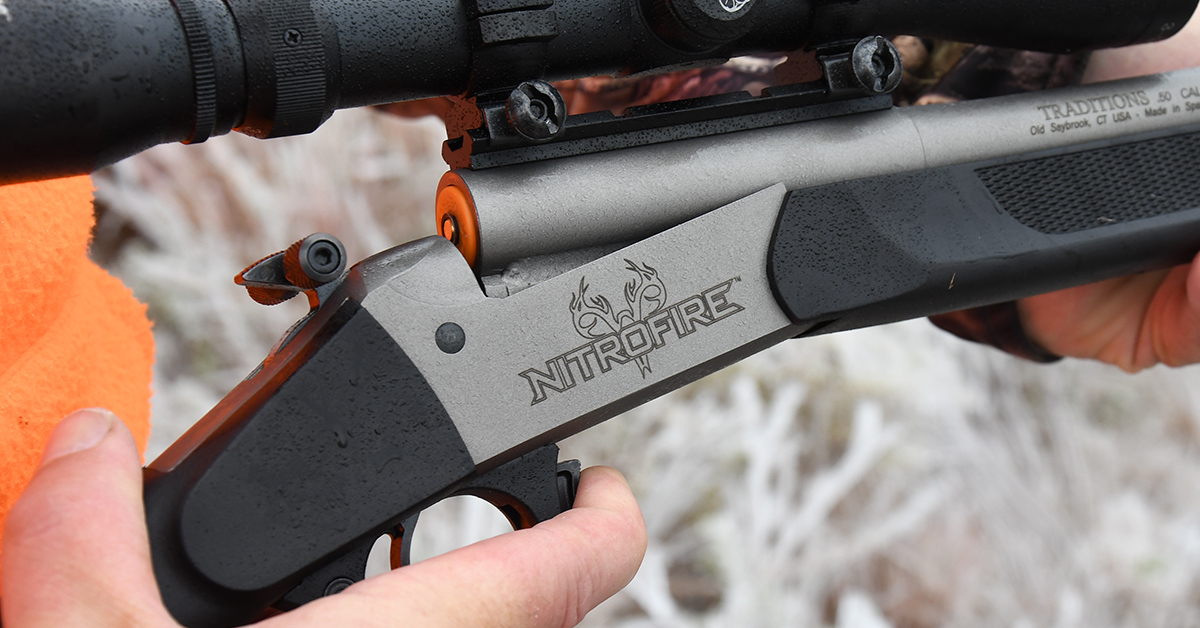
That’s what I call a “modern muzzleloader” system.
But just like a conventional centerfire rifles or even an old-school sidelocks, flintlocks, or more modern in-line (pellet or loose powder) muzzleloaders, the NitroFire/FireStick system must also work out its optimal load combination to find the one that delivers the highest degree of accuracy.
So, while this discussion focuses on finding that optimal load with the NitroFire/FireStick system, the process is the same for any muzzleloader. You need to find the right combination of bullet type, bullet weight, powder charge, and primer that delivers the tightest group.
That’s not earth-shattering news for many of you, of course. But what many folks don’t realize is just how much variance there can be in point-of-impact from a single muzzleloader when you change the variables of projectile and powder charge.
That’s the main point of this article — to show just how critical it is to find the right load for maximum accuracy.
The Protocol
For this test, I selected five different hunting bullets ranging from a light 170-grains up to a 350-grain chunker. A wide weight distribution is important because you want to determine which way your barrel skews. Does it tend to favor a lighter projectile or a heavier one? If you can narrow that down, then further refinement can be made with variations in bullet design.
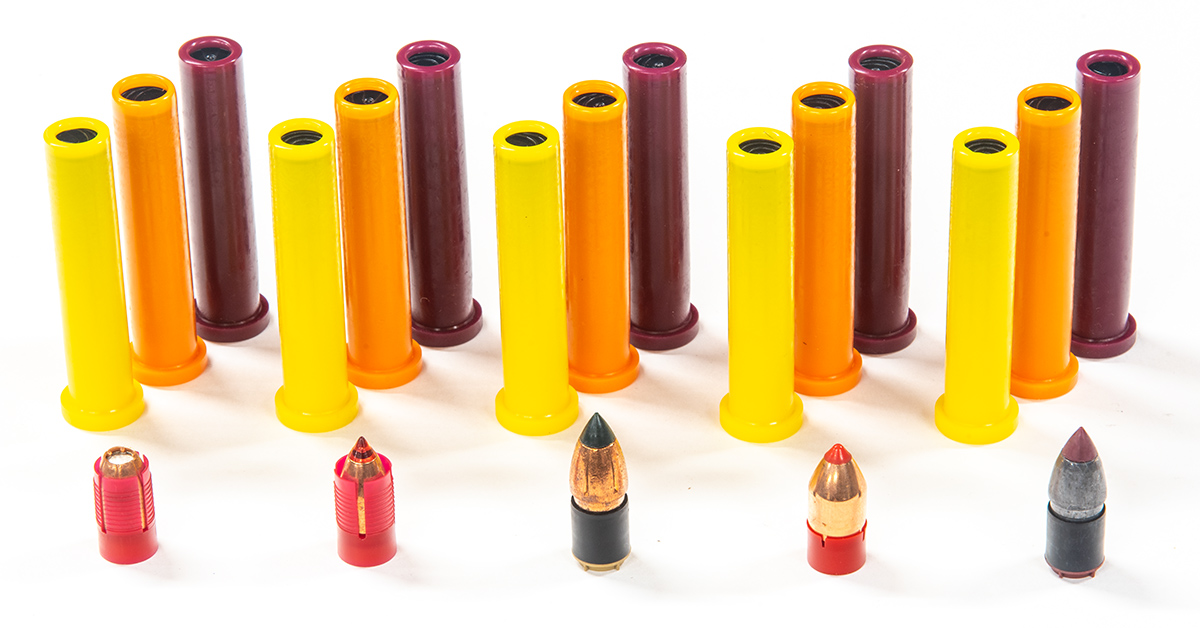
Here, I selected (left to right) two Traditions .45-caliber sabot bullets (Smackdown Bleed 170-gr. and Smackdown XR 250-gr.), Federal Premium’s Trophy Copper 270-gr., Hornady’s Bore Driver FTX 290-gr., and Federal Premium’s Lead 350-gr.
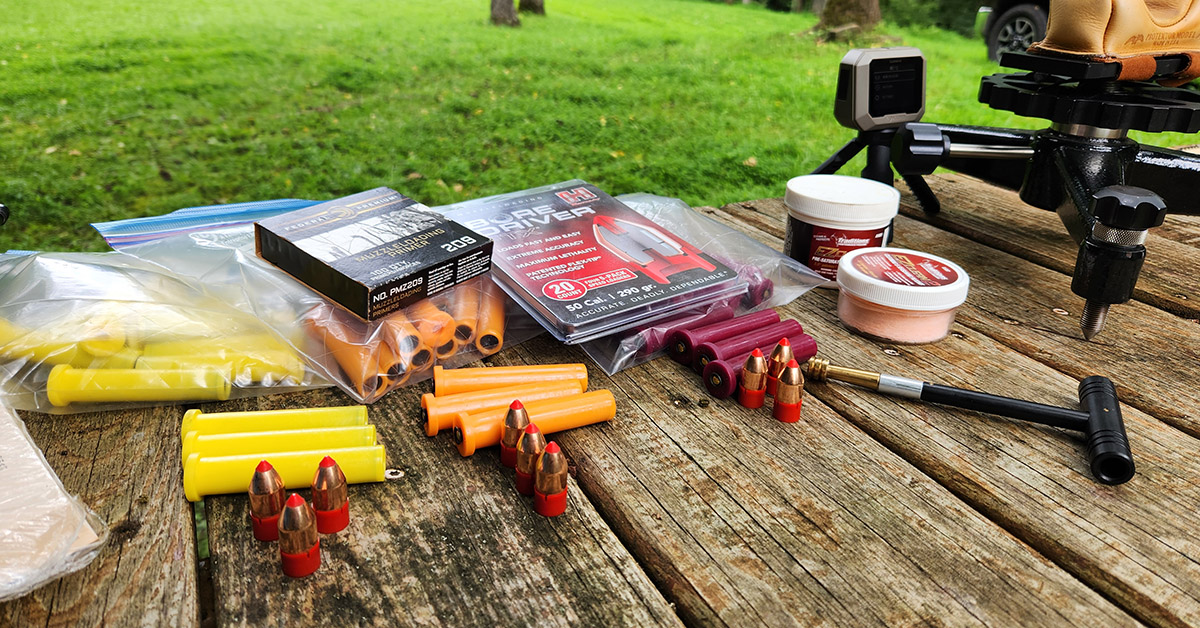
Each bullet would be shot three times with each FireStick load to provide a three-shot group size (three with the 80-gr. FireStick, three with the 100-gr., and three with the 120-gr.). With this, I would be able to test the complete range of FireStick charges that Federal offers. That makes a total of 45 shots fired just to test five different bullets.
You can see, therefore, that load testing can be a major production even on a limited scale such as this. You’re not likely to accomplish an even bigger, more expansive test on a singe range outing. That’s why it is good advice to get your muzzleloader lined out well before season begins.
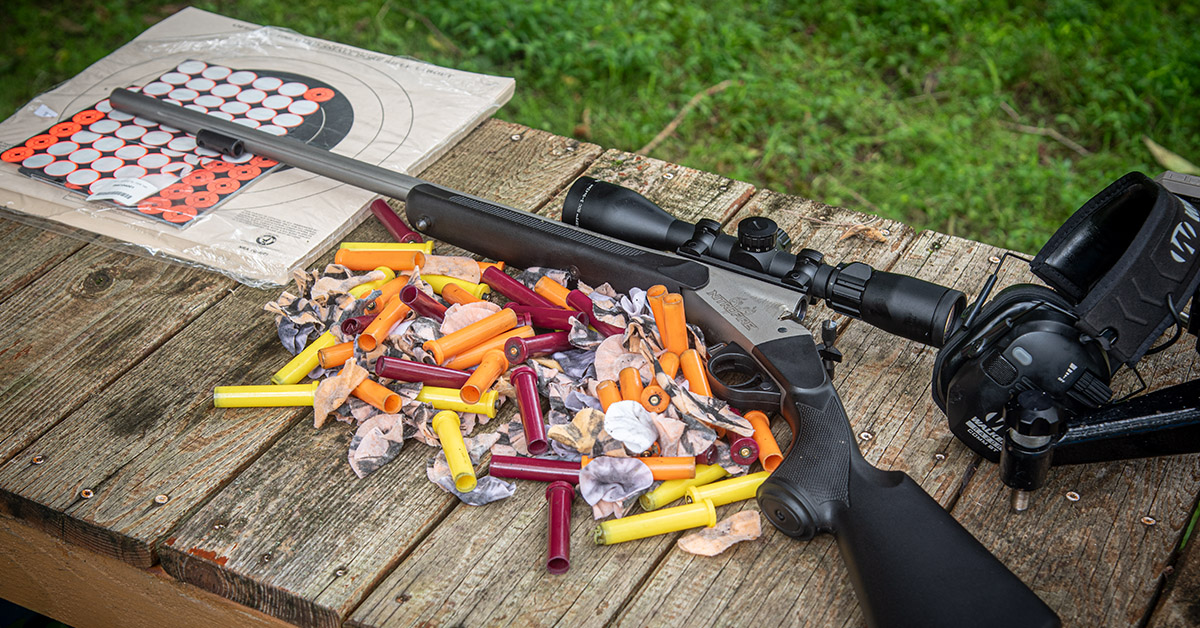
Another part of the test is maintaining consistency in the barrel bore. Muzzleloaders get dirty fast, and even after a couple of shots, the build-up of particulates can influence bullet point-of-impact.
To ensure consistency across each load test, I began with a clean bore and zeroed the rifle out to 100 yards. This took five or six shots before I was satisfied. I then began the cleaning protocol that would continue throughout the testing:
- shoot three shots (same bullet and FireStick charge)
- swab the bore with one Traditions EZClean 2 Cleaning & Seasoning Patch and a jag after each shot
- after the last (third) shot, swab the bore with one EZClean 2 patch to remove the gross fouling
- swab the bore with two Traditions FireStick Pre-Saturated Cleaning Patches
- swab the bore with one EZClean 2 patch
As you can see, this process eats up a lot of cleaning patches, but it helps to eliminate performance variables that could be caused by fouling buildup.
The Results
For this test, I was shooting a first-generation Traditions NitroFire. This rifle came with a 1:28 twist rate. Since this gun was first offered, Traditions has upgraded all NitroFire rifles to their VAPR 1:24 twist barrels. The faster twist rate of the VAPR barrel was intended to better stabilize a wider range of bullet weights to give hunters expanded options in their bullet selection.
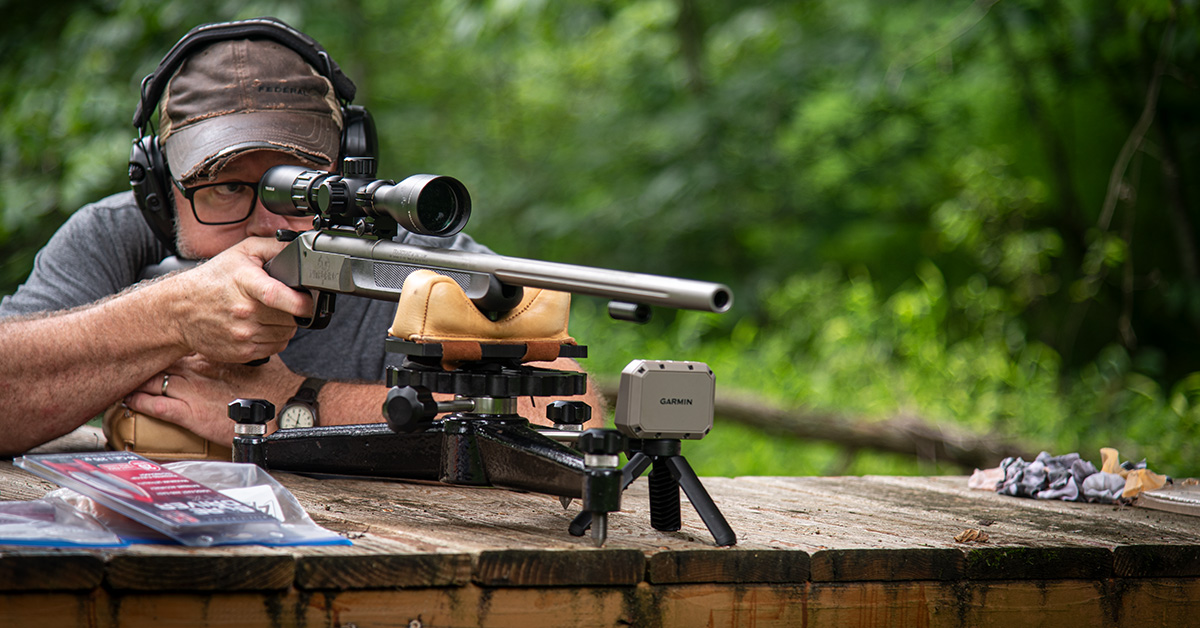
Again, consistency matters. This needed to be a bench-rest test to remove as many shooter-induced variables as possible.
As I worked through the five different bullet/powder charge combinations, it became immediately clear that my rifle absolutely did not like the bullets on the lighter end of the scale. The 170-gr. Smackdown Bleed (the lightest of the bunch) shot the largest groups with all three FireStick charges — in excess of 6.5 inches (one shot with the 120 equivalent FireStick went completely over the target, negating the measurement).
As I worked up through the heavier bullets, the group sizes began to shrink. Here you can see the complete results:
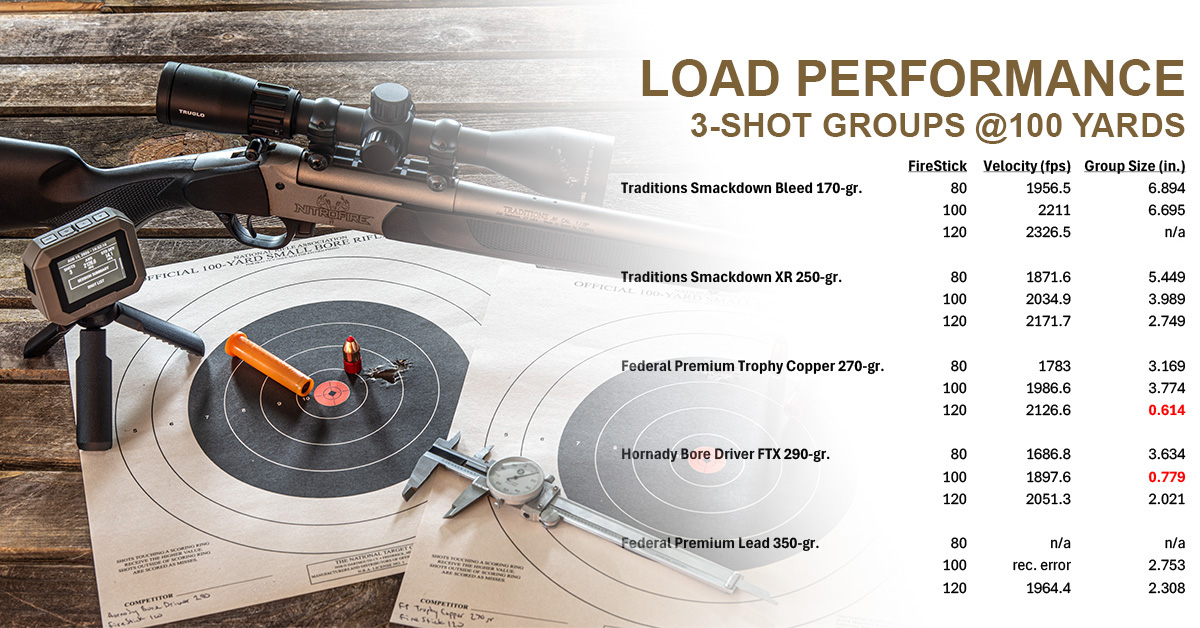
The smallest group size came from the Federal Premium Trophy Copper 270-gr. bullet propelled by the 120-equivalent FireStick at 0.614 inches. Folks…that is top-shelf rifle and premium centerfire ammunition performance right there.
Think that was a fluke?
The Hornady Bore Driver FTX 290-gr. bullet flung by the 100-equivalent FireStick rocked it at 0.779 inches.
Remember, this is shooting at 100 yards.
I’ve come to expect this level of accuracy from my NitroFire, so there was no surprise that the gun printed sub-MOA with the Hornady bullet during this test. It had done so many times before.
More telling, though, is how much diversity there is in shot groups simply by changing the powder charge — all else being equal.
Take a look at the Trophy Copper groups below. Again, same rifle, same bullet…just a difference in the powder charge.
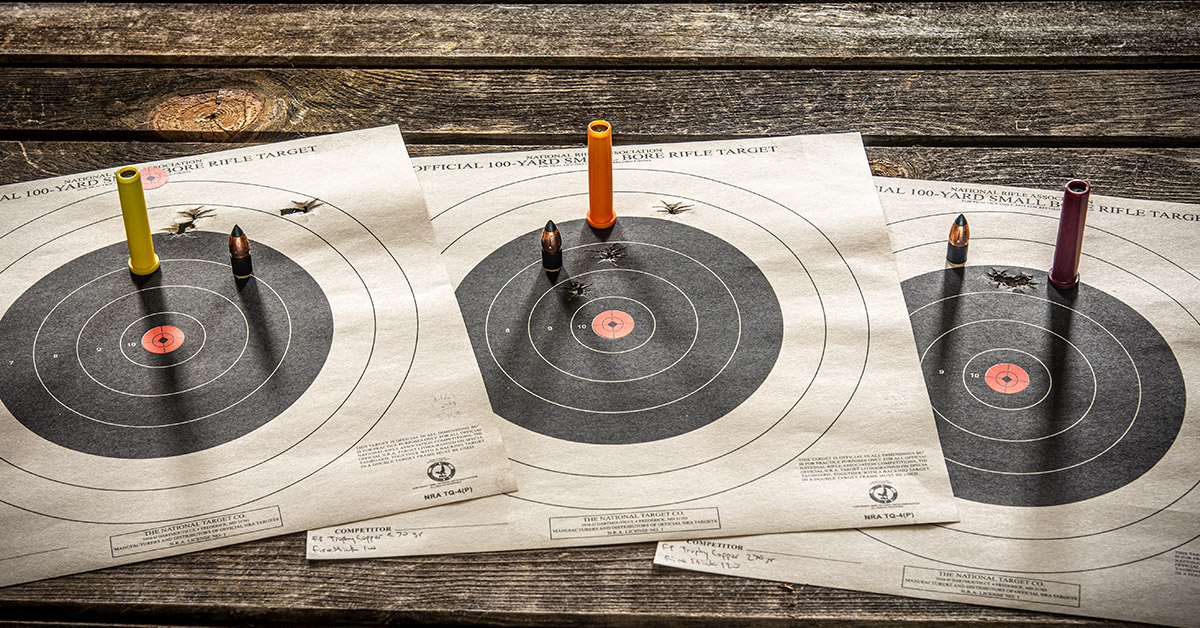
From left to right: 3.169 inches (80-gr. FireStick), 3.774 inches (100-gr. FireStick), and .0614 inches (120-gr. FireStick).
We see similar results with the Hornady Bore Driver FTX.
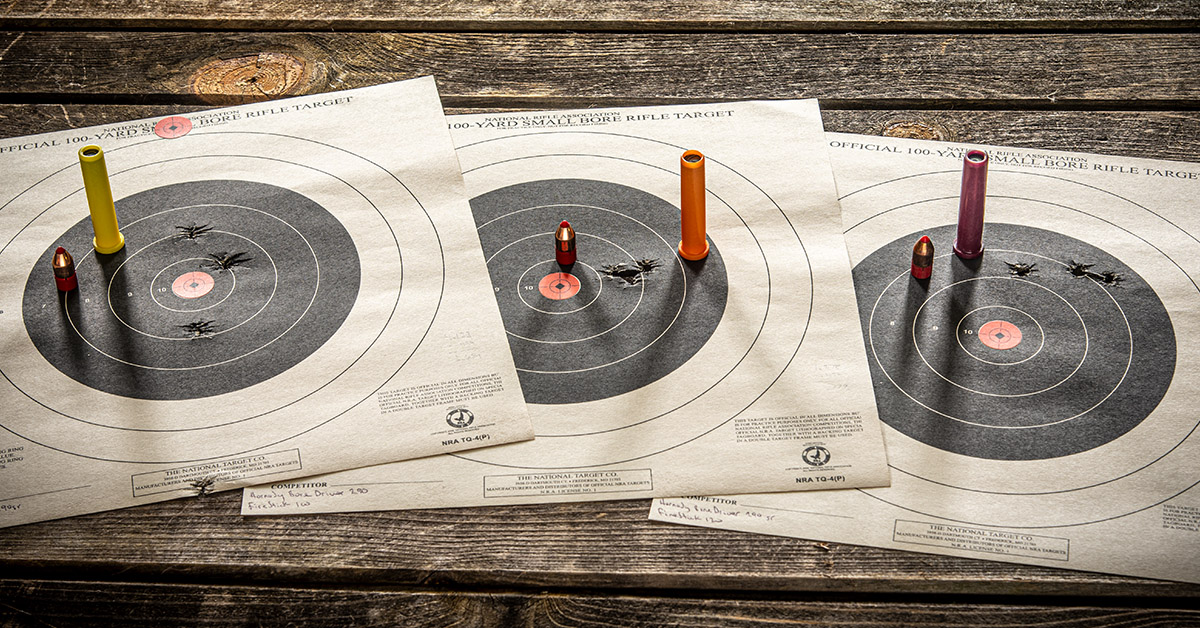
From left to right: 3.634 inches (80-gr. FireStick), 0.779 inches (100-gr. FireStick), and 2.021 inches (120-gr. FireStick).
The difference here is that the Hornady is a 20-gr. heavier bullet than the Federal Premium Copper Trophy, yet it favored the lighter 100-gr. FireStick charge.
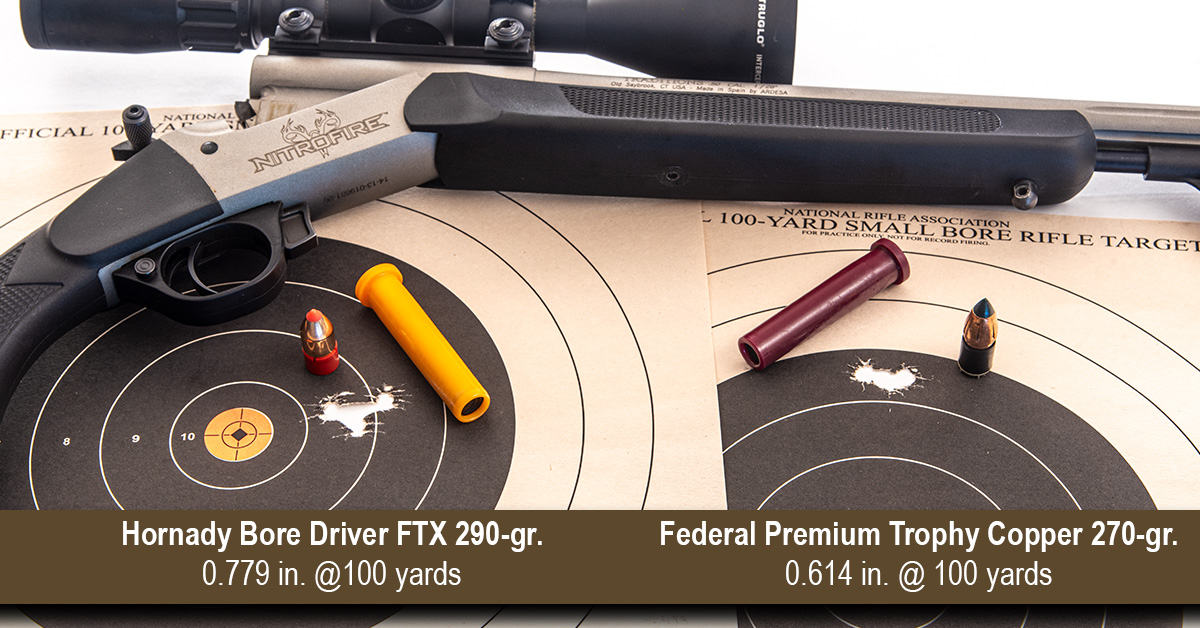
This is what I find so fascinating about load development…you never know which way the wind will blow, nor do you ever know why. All you can do is hoist your sail and catch it!
A Caveat
Obviously, my initial conclusion, as stated prior, is that this gun, with its 1:28 twist rate, favors a heavier bullet. But there are a couple more potential variables here that I am not taking into consideration, and that is the bullet design — specifically, the gas sealing system and bullet diameter.
Let’s take a closer look.
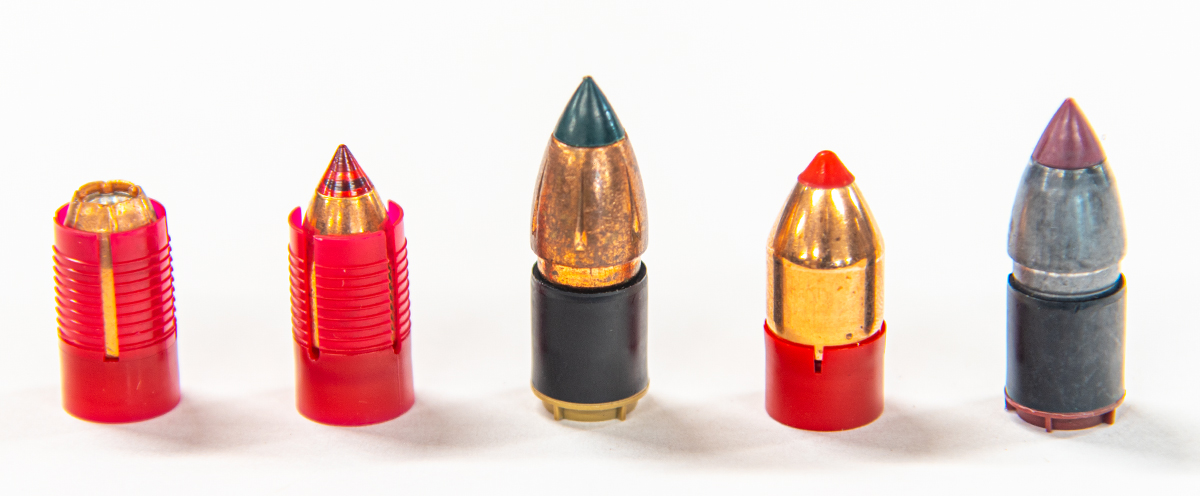
The lighter (and worse-performing in my .50-caliber gun) bullets on the left are .45-caliber, and both utilize a sabot as their bearing surface. The three heavier bullets on the right are .50-caliber (0.498-0.499 inches in diameter) and feature different sealing systems.
Both the Federal Premium bullets (center and far right) use the B.O.R. LOCK system, consisting of a fiberglass-reinforced base with a fouling cutting ring and a polymer base cup that serves as the bearing surface. The Hornady bullet (second from right) has a short polymer base that barely fits over the bullet base.
How much does the gas sealing systems and closer-to-bore bullet diameters contribute to the improved accuracy exhibited during testing? Perhaps these factors more than bullet weight played the decisive parts.
Pealing back these nuanced layers is part of the fun (and sometimes the aggravation) of load testing.

At the end of the day, it is predictable point-of-aim, point-of-impact performance that we are after with our muzzleloaders and with any firearm we pick up. Finding that optimal load takes time and a sore shoulder in order to make it happen. But it’s all worth the effort when the result is one shot, one kill performance.
MTM Muzzleloader Dry Box
Muzzleloading rifles take a lot of kit, whether you are at the range or in the field. In addition to projectiles, ammunition, and powder, you need cleaning patches, solvent, lubricant, jags, brushes, a sturdy cleaning rod and probably a few more things to get you through the session.
One product I use and can recommend in support of your muzzleloader habit is the Muzzleloader Dry Box from MTM Case-Gard.
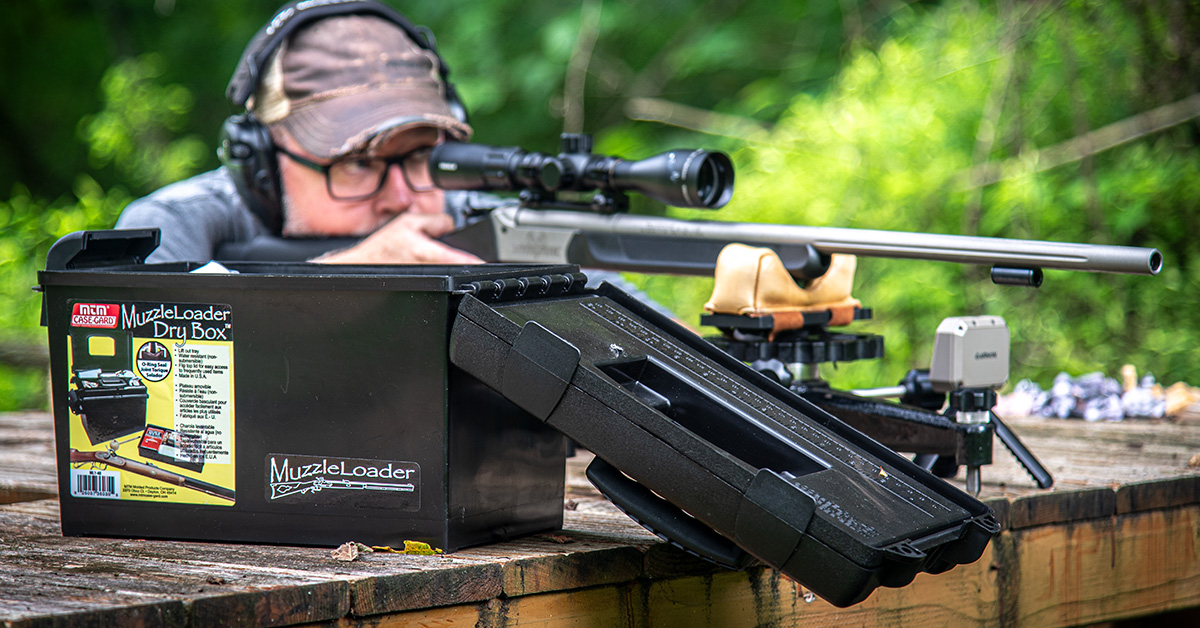
The Muzzleloader Dry Box comes with an O-ring-sealed lid to keep out moisture (important when you’re toting powder!) with an extra storage compartment in the lid for quick access to small, frequently used items.
Inside is a lift-out tray and a spacious interior that will hold pretty much everything you need for a range session.
Because there are so many items needed to keep a muzzleloader running, a storage solution like the Muzzleloader Dry Box lets you keep everything in one place.