The new-generation Glock represents the apex of the breed by our estimation. Timney’s equally new Alpha Competition Trigger for Glock Gen 6 takes that exquisite performance to the next level.
by Rob Reaser
Glock whipped up quite a stir among the fan faithful at the end of last year when the company announced its new Gen 6 series handguns. As one of those faithful fans, I was immensely pleased with Glock’s fresh spin on this iconic handgun. The updated ergonomics won me over immediately.
Yet as with most things, there is always room for focused enhancements, with the most significant enhancement for this — or any firearm — being found in the trigger system. And where you find trigger upgrades being “a thing,” you’ll usually find Timney Triggers ready to deal out the functional gains.
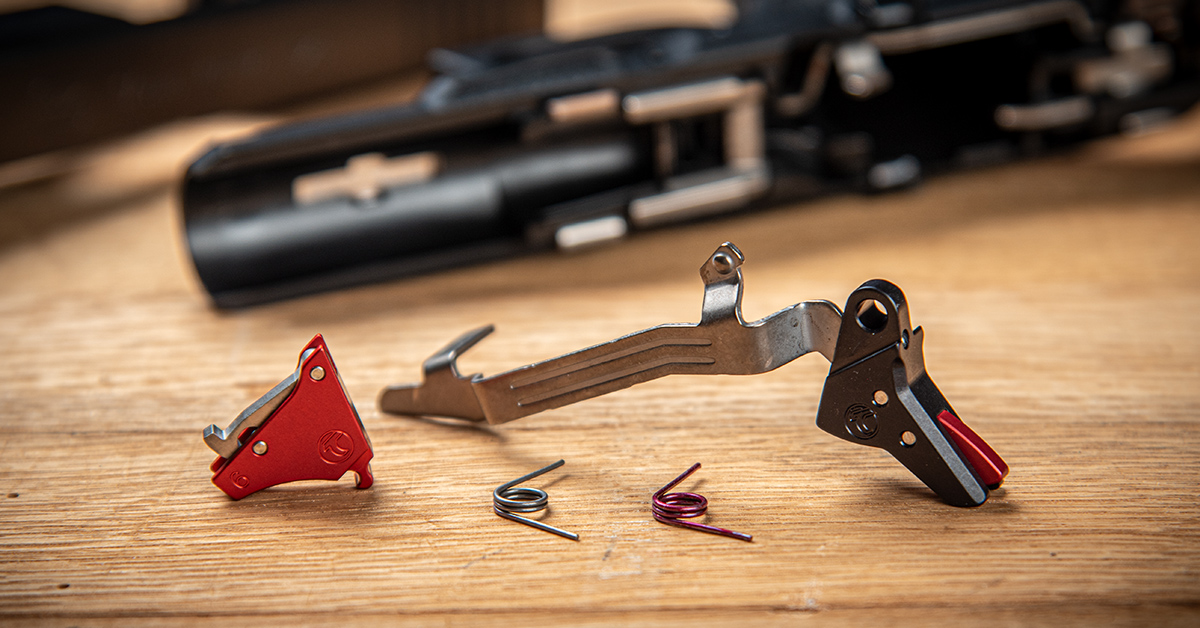
Of course, we’re talking about the Timney Alpha Competition trigger system — a comprehensive, “shoe-to-sear” upgrade of the OE trigger system designed for, as the name implies, the competitive shooting arena or for anyone desiring a performance trigger for precision target work.
“Can this trigger be used for my defensive gun?” you may ask.
Of course it can, but there is a reason Timney states that the Alpha Competition is “intended for competition use only.” We’ll get into that shortly.
We have installed a couple of the Alpha Competition triggers — one on a Gen 3 G17 and one on Ruger’s RXM — since Timney came out with the series in 2021. The improvements over the stock configuration are significant.
- The uptake feels cleaner and more consistent.
- Two different trigger reset springs let you choose the optimal positive reset performance for your shooting style.
- The reset is a tad shorter.
- And, naturally, the sear performance is significantly enhanced courtesy of the Timney sear module.
Now Timney has developed an Alpha Competition trigger system for the new Gen 6 Glocks.
Pull Weight
Comparing the trigger pull weight was part of the objective portion of our trigger evaluation. Since this was a fresh, out-of-the-box test mule G17 Gen 6, I was able to determine the trigger pull weight as it came from the factory with no wear-in. This would give a fair, apples-to-apples comparison of the OE and the Timney trigger systems. Before installing the Alpha Competition trigger, I tested the factory trigger. The methodology was two 10-series pulls on a Lyman digital scale.
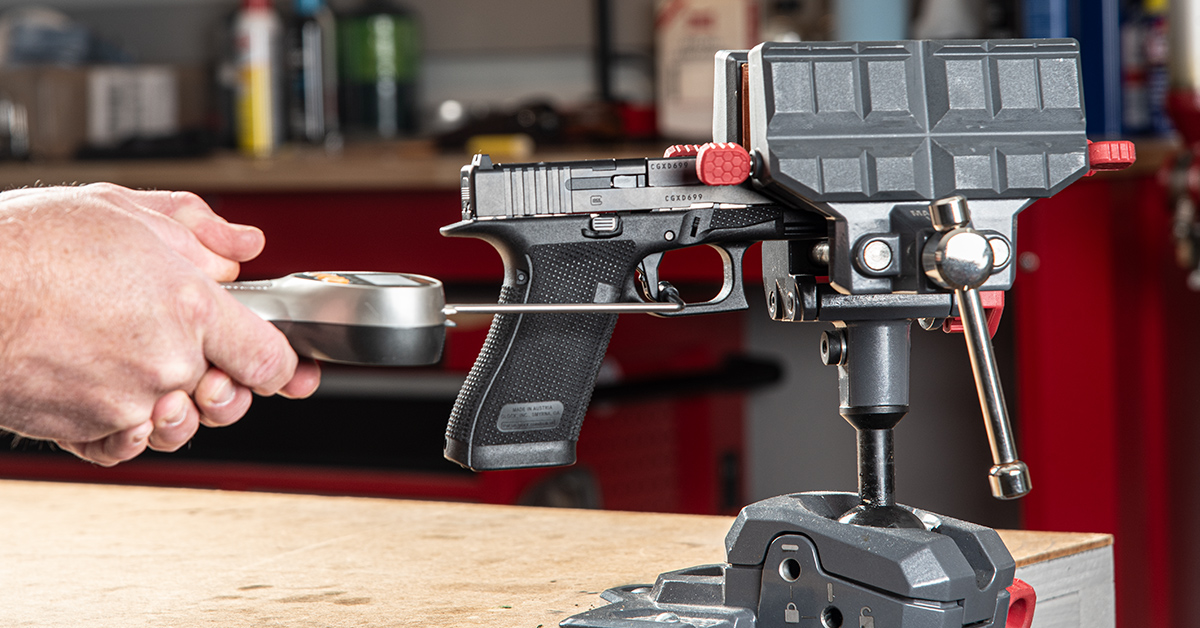
The first ten pulls with the factory Glock trigger logged a weight of 4 lbs., 0.0 oz. The second series registered 3 lbs., 15.8 oz. That level of consistency surprised me.
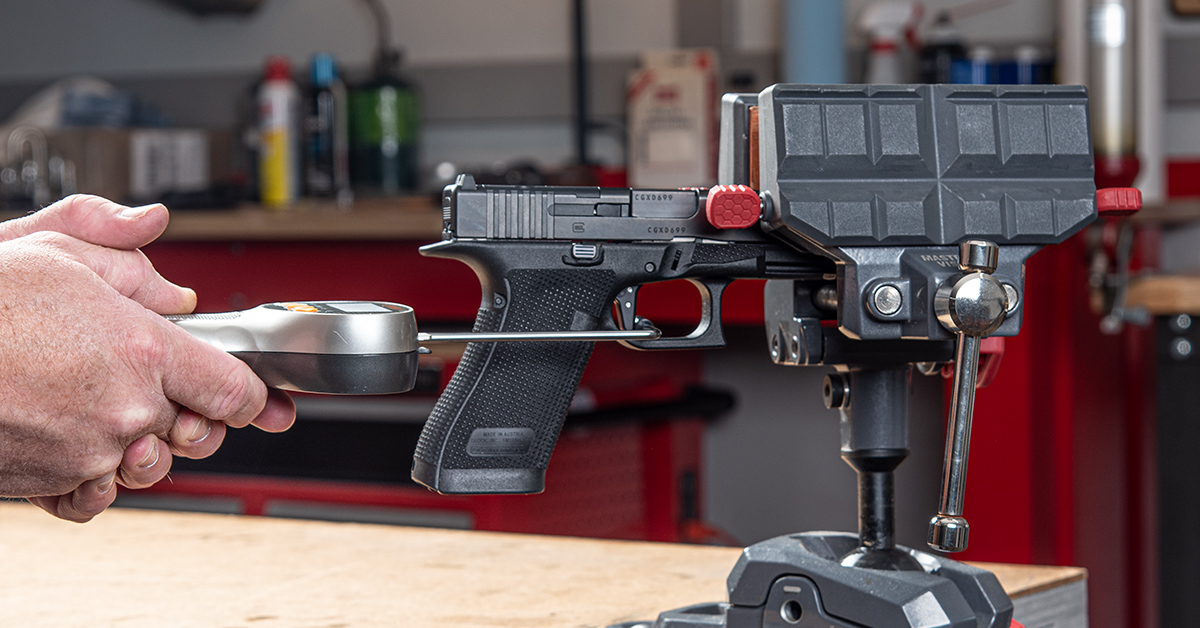
Upon completion of the Alpha Competition trigger install, I repeated the test with two 10-series pulls. The first series averaged 2 lbs., 9.1 oz. The second 10-pull average was…wait for it…2 lbs., 9.1 oz. Exactly the same.
If it were possible to find a more consistent trigger pull, I’d need a scale that would carry out to a couple more decimal places. Mighty impressive!
Linear Performance
To objectively compare the linear performance of the two triggers, I took three measurements: the initial take-up (at rest to “the wall”), sear travel (the wall to the sear break), and the reset (trigger fully rearward to the point of reset).
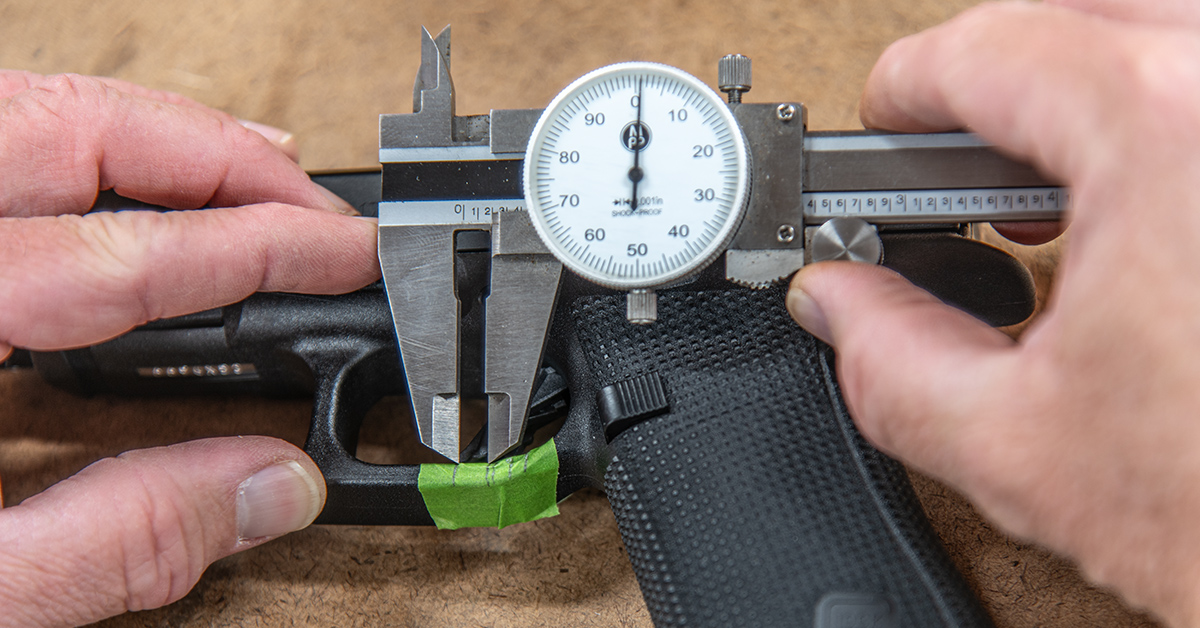
The results:
Factory Trigger Movement
- Take-Up: 0.215 inches
- Sear Travel: ≈ 0.154
- Reset: 0.192 inches
Alpha Competition Trigger Movement
- Take-Up: 0.20 inches
- Sear Travel: ≈ 0.088 inches
- Reset: 0.163 inches
As you can see from these numbers, the Alpha Competition trigger is notably shorter/faster than the factory trigger. It takes less distance to prep the trigger, the sear travel is shorter, and the reset is quicker. For a practiced shooter who understands how small increments can translate to big gains, this is significant.
The sear travel (distance required for the trigger bar to slide off of and to disengage the firing pin) is much shorter (less creepy) and cleaner with the Alpha Competition trigger than the factory trigger — a big contributor toward improved accuracy.
The reset of the Alpha Competition is also shorter than that of the factory trigger, which enhances follow-up shot speed for the skilled shooter. Furthermore, Timney offers two different trigger return spring rates with the Alpha Competition so you can adjust the reset performance to your preference. I’ve found the snappier, more positive performance of the higher-rate (red) spring to be more to my liking.
More Objective Data
Because I’m not a skilled, high-speed target shooter, I tend to focus more on accurate placement of the first shot. In that spirit, I used the MantisX open training scenario to provide objective single-shot evaluation of each trigger system.
Starting with the factory trigger, I shot three strings of 10 rounds each to obtain average scores. The results were as follows:
Factory Trigger via MantisX (10-round series)
- Series 1: 93.8
- Series 2: 91.7
- Series 3: 91.5
My most consistent problem I had with this trigger was “too little trigger finger,” which means I had uneven pressure being applied to the trigger shoe, resulting in an uneven trigger press.
Alpha Competition via MantisX (10-round series)
- Series 1: 96.0
- Series 2: 94.4
- Series 3: 94.6
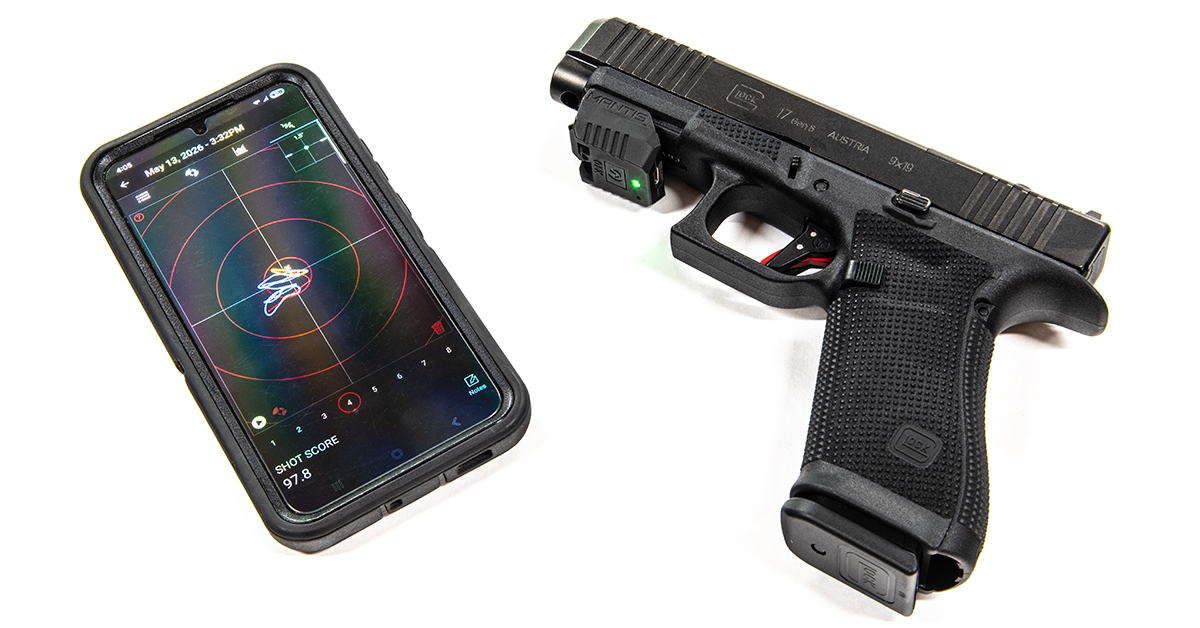
Moving to the Alpha Competition, my scores showed a noticeable improvement, with my worst score being higher than my best score with the factory trigger. I had only one round out of 30 flagged as “too little trigger finger.”
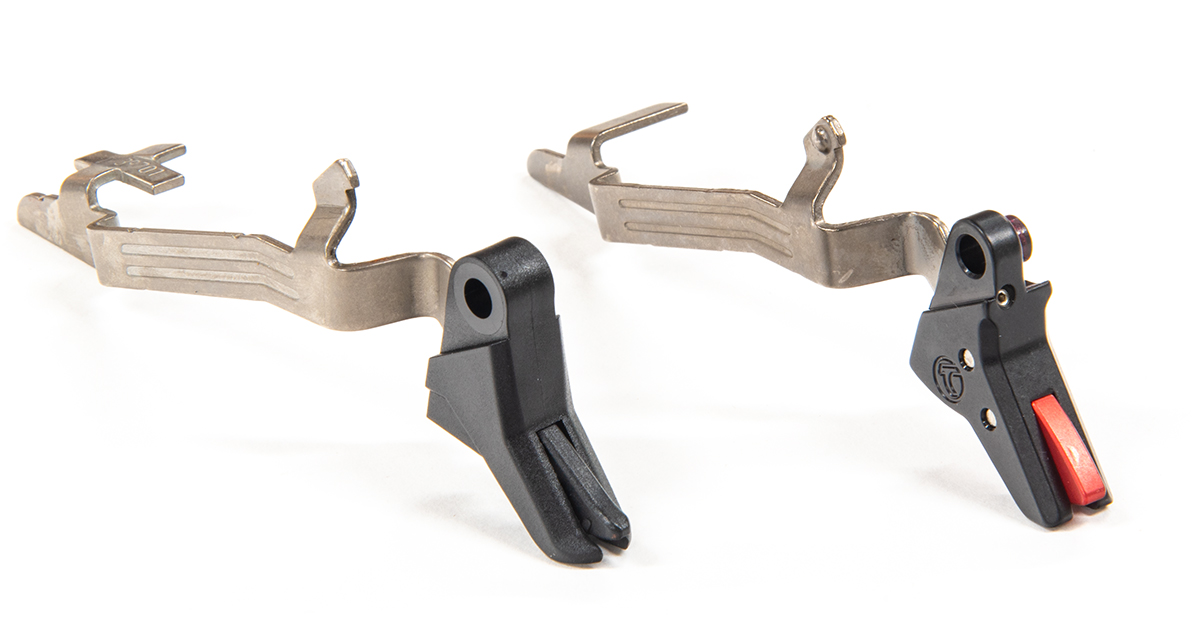
By this measure, and by my subjective feel, the Alpha Competition trigger shoe design is more compatible with my biomechanics and shooting style. You’ll note from the above photo that the Alpha Competition (right) has a straighter trigger shoe than the factory model (left). And I do seem to shoot better whenever I’m working with a flatter trigger face.
Subjective Evaluation
Overall, while the Glock trigger is a solid performer, the Alpha Competition absolutely gets the nod in terms of feel and function. The predominantly straight and flat trigger face provides excellent engagement with the finger, allowing for more even and consistent pressure. Furthermore, the clean sweep during initial take-up along with the short and crisp sear break and short reset validates the trigger’s competition-grade performance credentials.
But Competition Use Only?
This, though, brings us back to what I mentioned earlier about the Alpha Competition being “intended for competition use only.”
Four pounds of trigger pull (the average weight of the Glock factory trigger) is a good weight for a defensive handgun. It provides enough resistance to check the trained shooter in a high-adrenaline, defensive scenario. The same holds true for the engineered linear performance of the trigger.
By contrast, a trigger that is easier to pull through to the sear break and to do so quicker and in a shorter distance than a standard factory trigger could lead to problems in a high-stress defensive engagement for the poorly trained and unpracticed.
The decision is yours, of course, but there’s your caution flag. If you carry a firearm for personal defense, though, you should be adequately trained and well-practiced with your firearm of choice no matter its configuration.
Bottom line…if you’ve jumped on board with the latest and greatest pistol iteration from Glock, Timney’s new Alpha Competition for the Gen 6 models is a certifiable performance upgrade.
Installing the Alpha Competition Trigger for Glock G6
You’ll be pleased to learn that upgrading your G6 to an Alpha Competition trigger is an easy DIY project — easier even than it is to do so on the G3 and G4 series Glocks. All you need are a couple of punches (or Glock tool) to move out the trigger and spring receiver.
As always, ensure the firearm is clear of all ammunition before disassembling the gun.
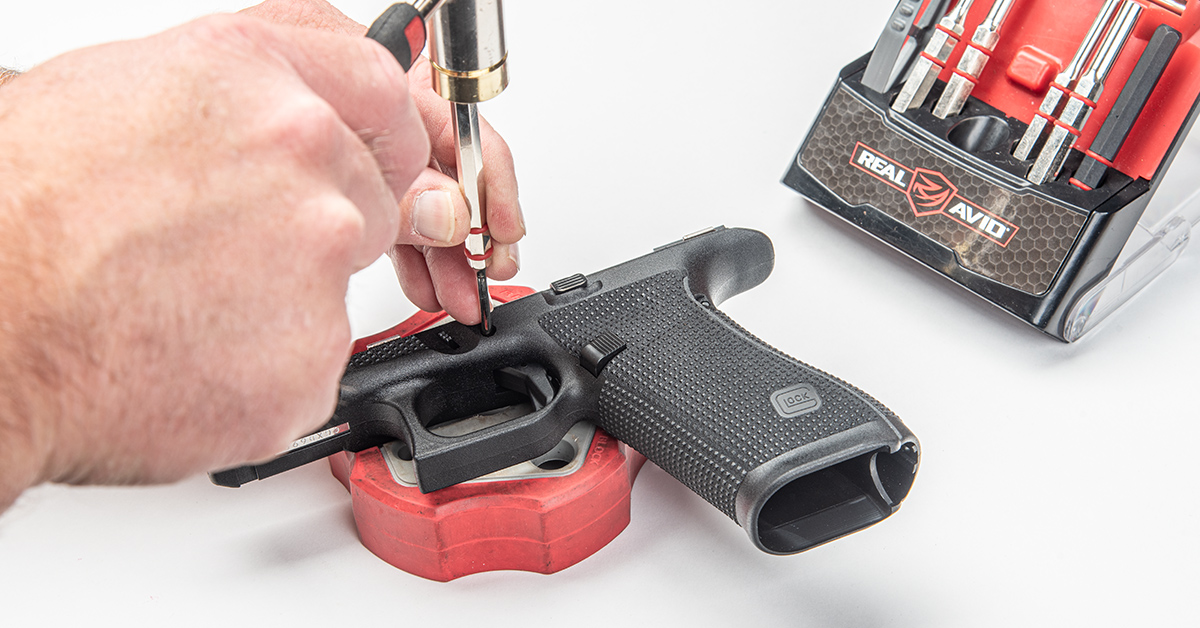
Place the frame on a bench block and push out the trigger pin from left to right. Here, we’re using Real Avid’s Smart Bench Block and Accu-Punch hammer and punch set.
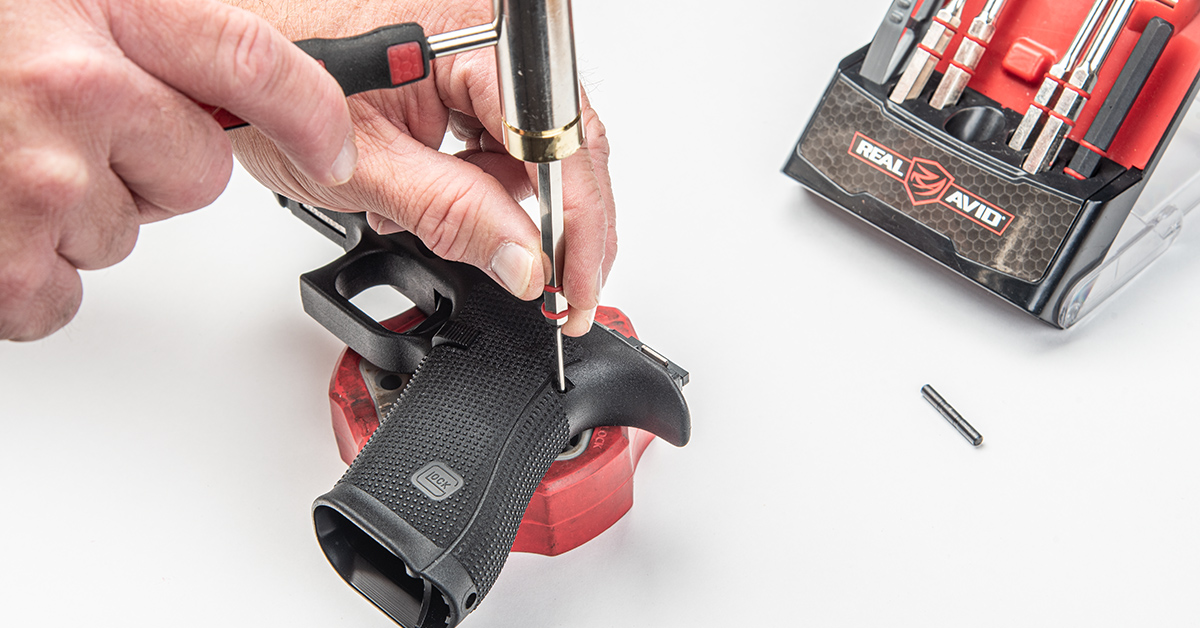
Do the same for the trigger mechanism housing pin.
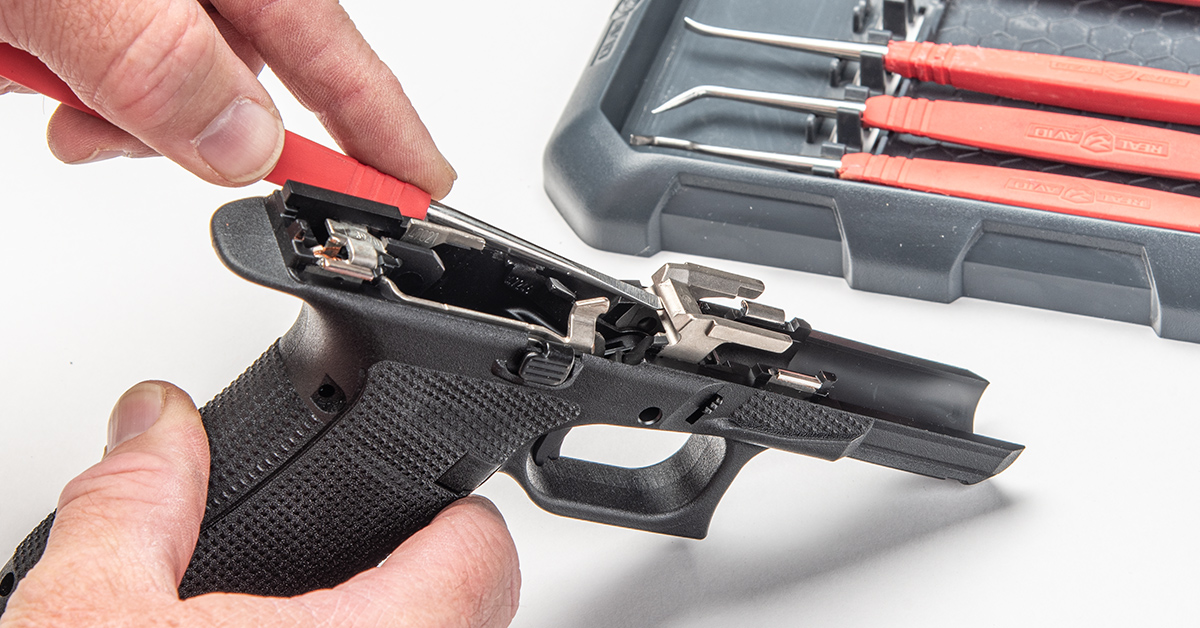
The locking block fits snugly in the frame. I used a flat Accu-Grip pick to gently lift the block out of the frame.
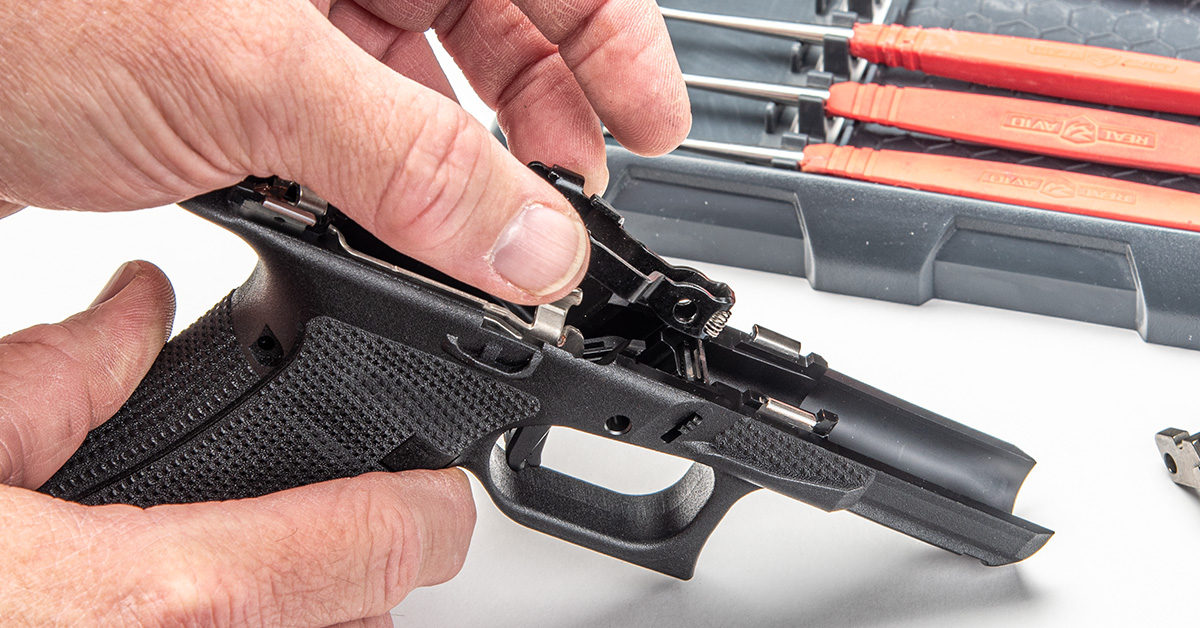
Lift the slide stop assembly out of the receiver.
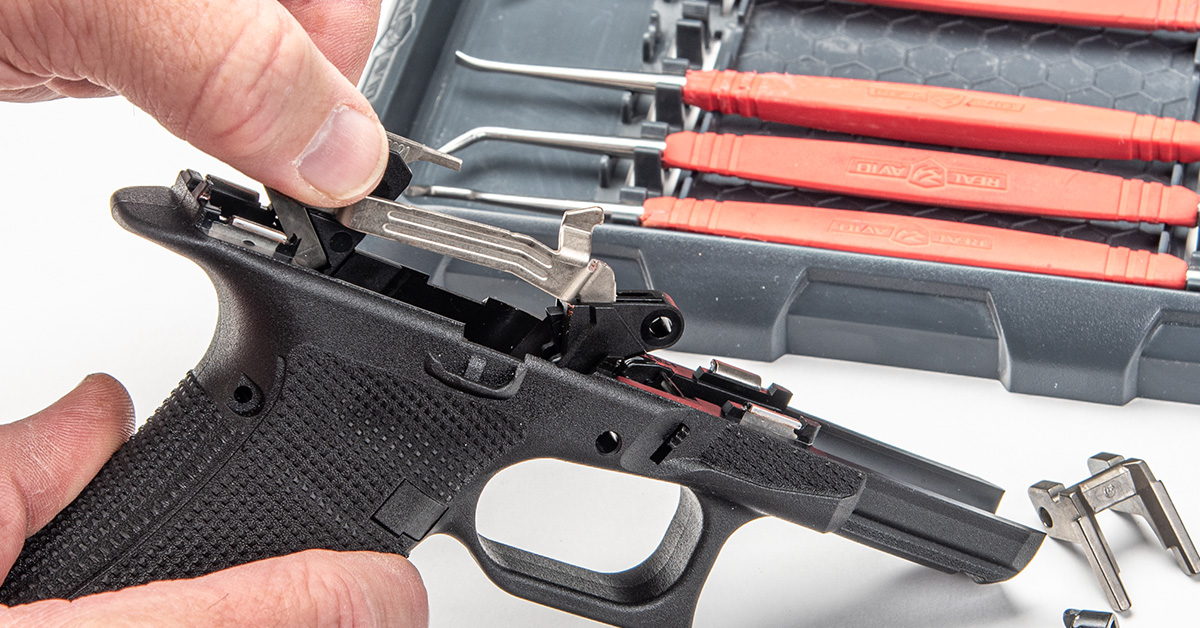
You can now remove the trigger, trigger bar, and trigger mechanism housing assembly as a unit from the frame.
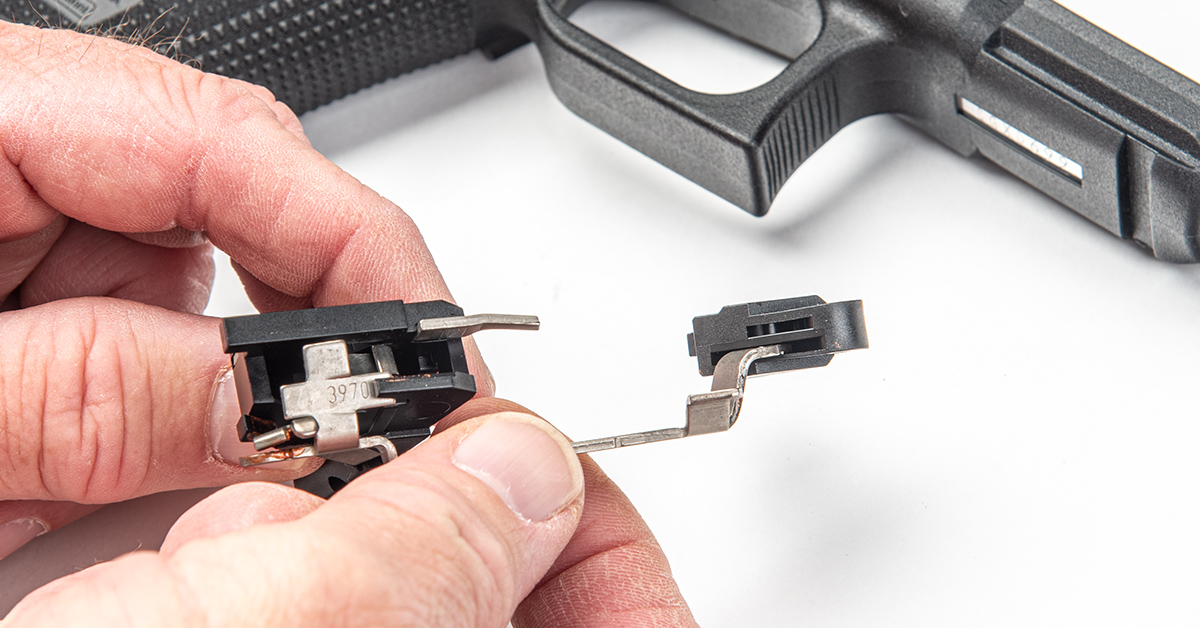
To disassemble the trigger bar from the mechanism housing, just rotate the trigger bar out of its slot in the housing.
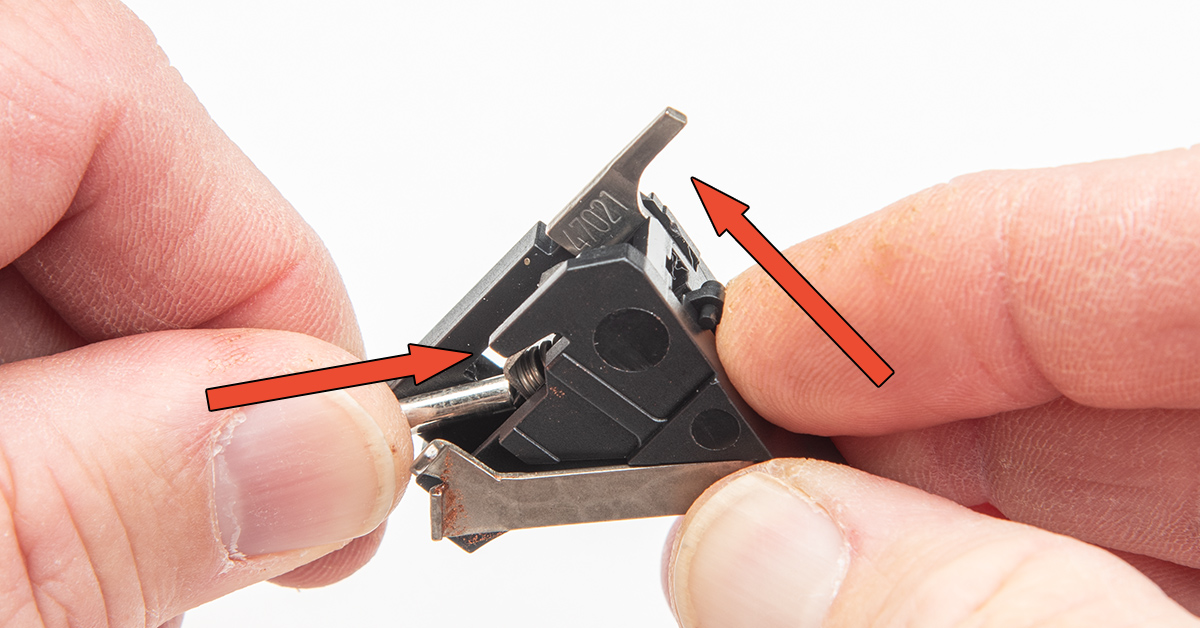
As with its previous iterations, the Alpha Competition sear module inserts into the factory trigger mechanism housing. This means removing the return spring assembly from the housing. To do this, use a punch or similar tool to push the spring strut until the back of the strut protrudes from the housing. Next, push the back of the strut all the way up.
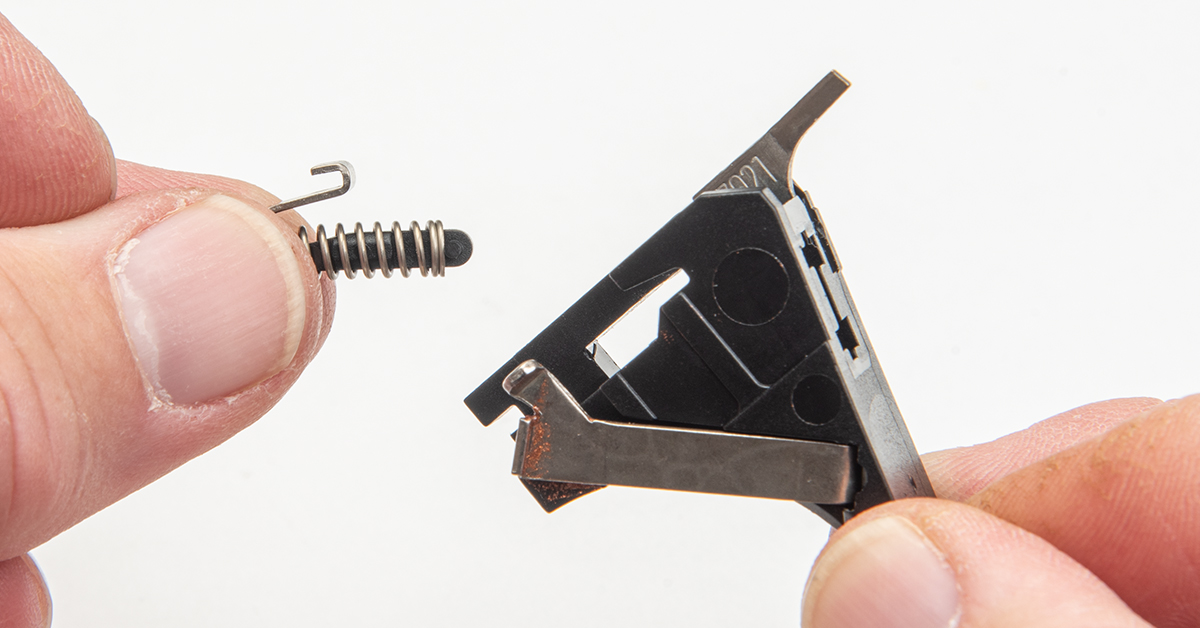
Relax the spring and the assembly can be removed from the housing.
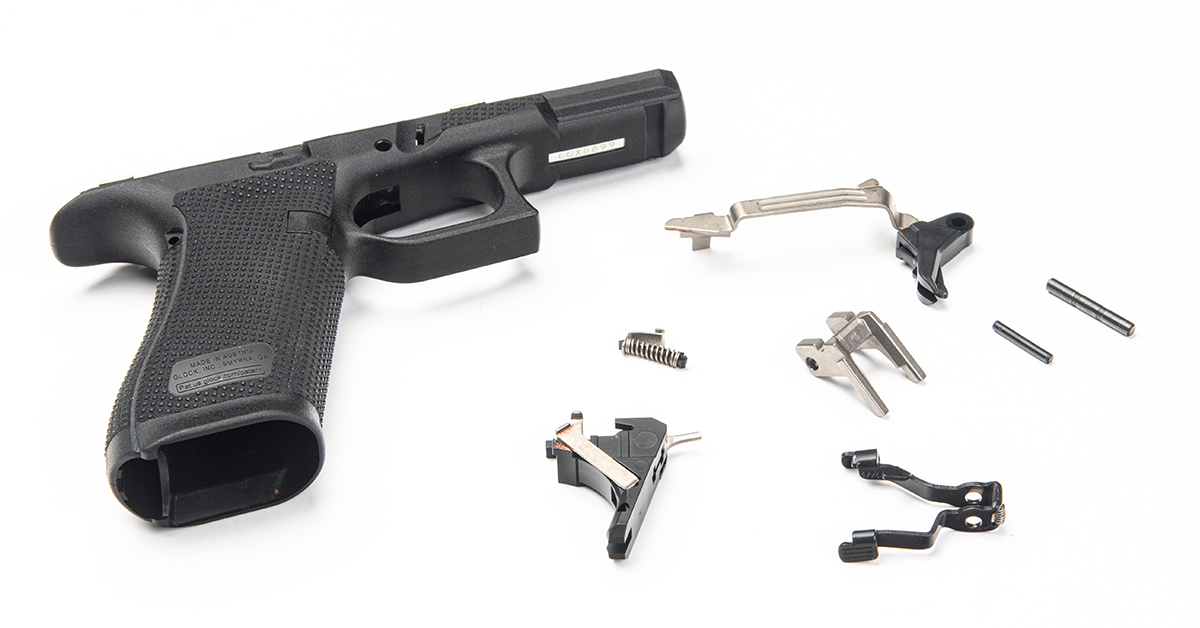
This completes the required disassembly.
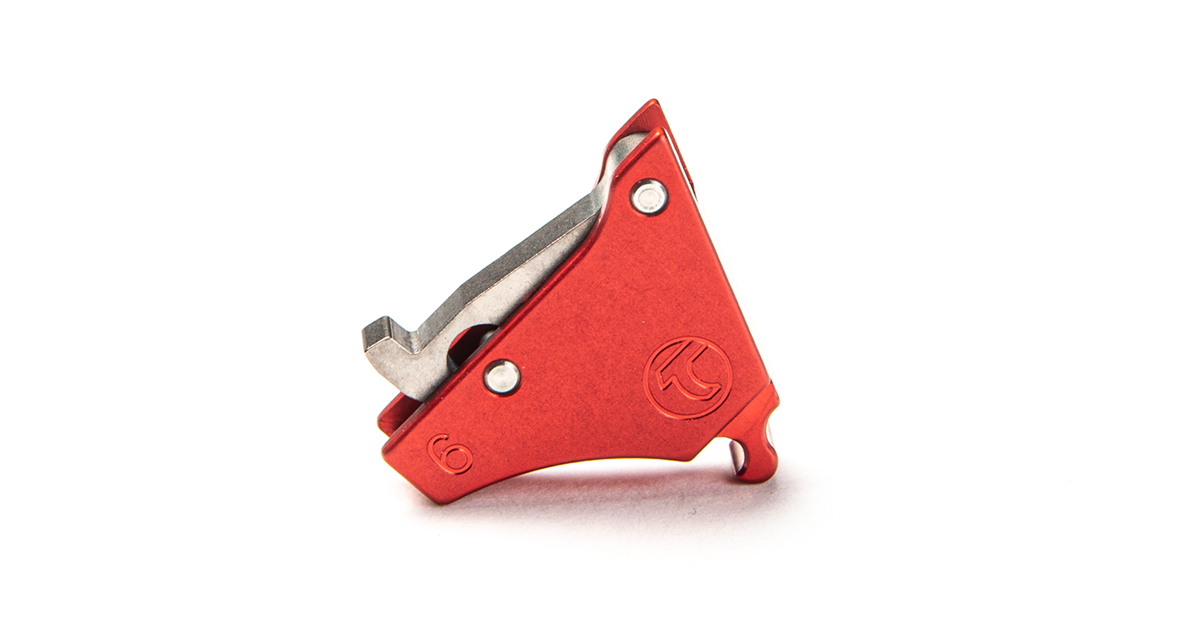
Timney’s engineers redesigned the drop-in sear module to eliminate the need for a “C” washer and button-head screw. The curved protrusion at the bottom of the module allows the unit to simply snap into place inside factory trigger mechanism housing.
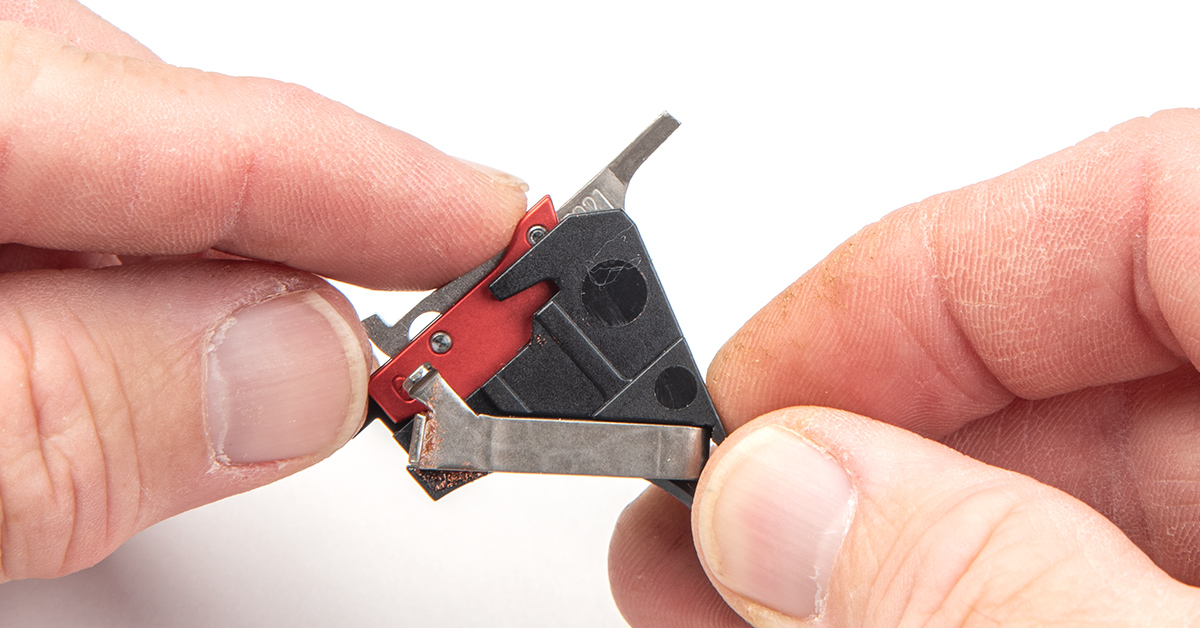
Installation of the sear module is no more complicated than pushing the module into the housing until it snaps into place.
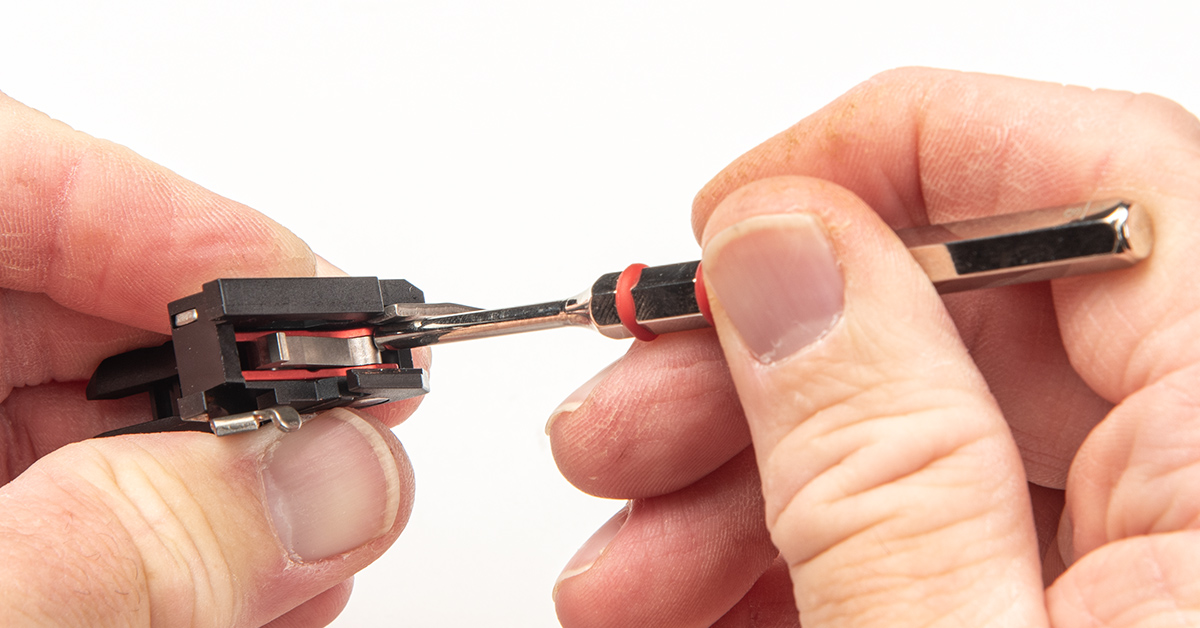
I used a punch to push on the back of the module until it clicked into position.
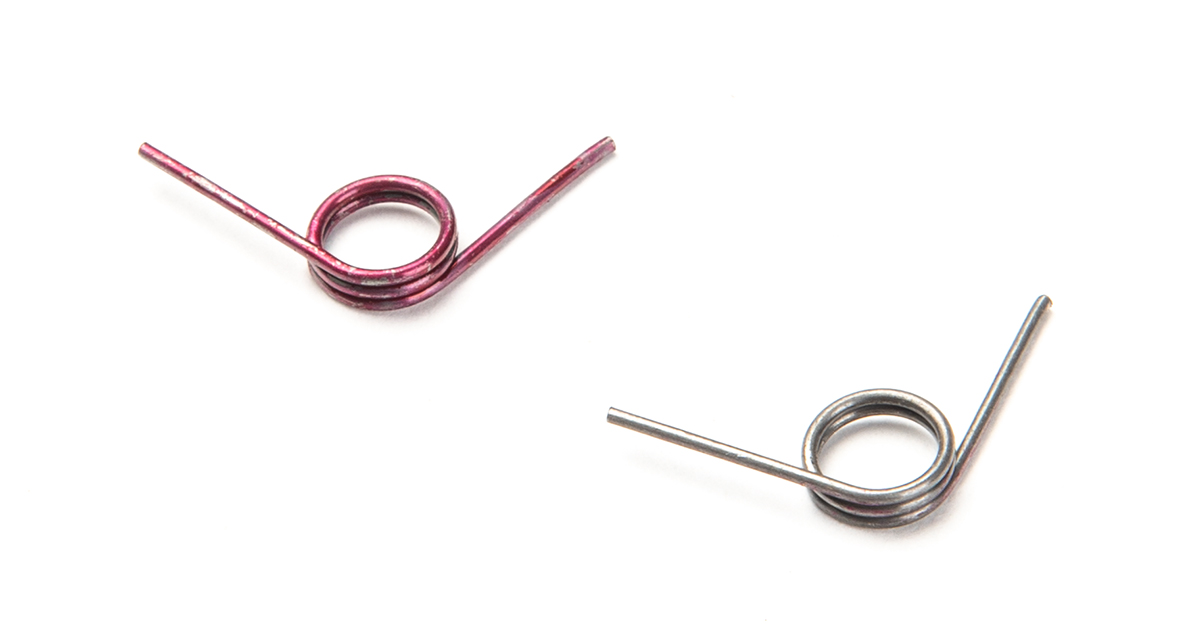
Two trigger return springs are included in the Alpha Competition kit. The red spring is stronger than the natural-colored spring and offers a more positive reset. Most shooters will trend toward the heavier red spring.
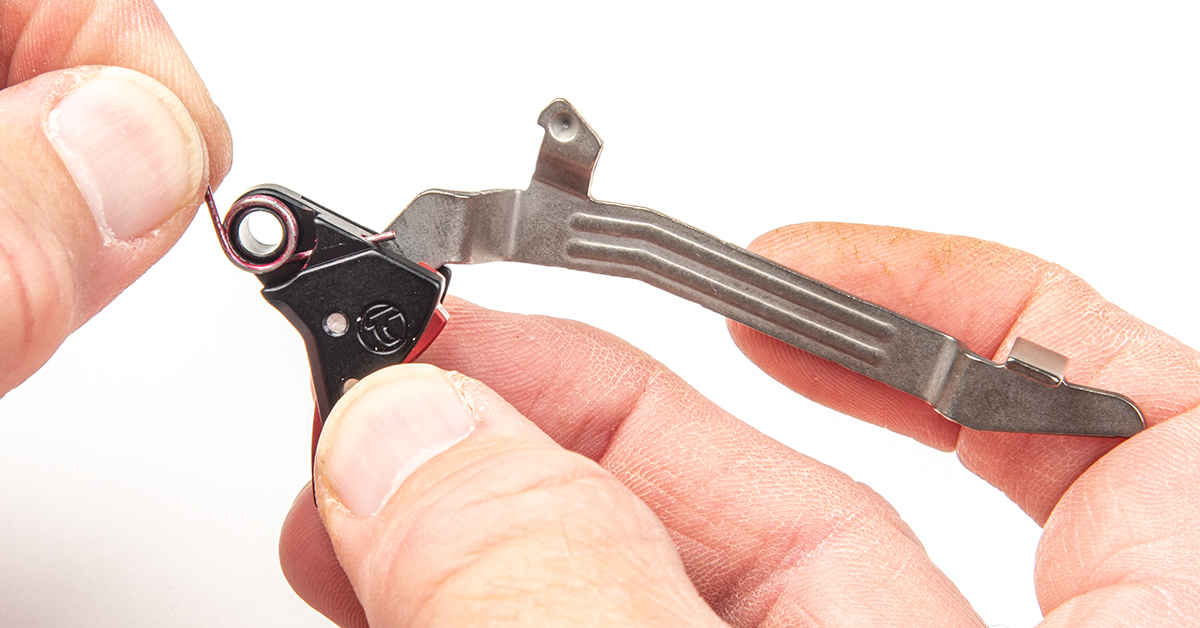
Install the selected spring onto the trigger. Insert one end of the spring through the hole in the trigger and then rotate the coil over the trigger pin hole as shown.
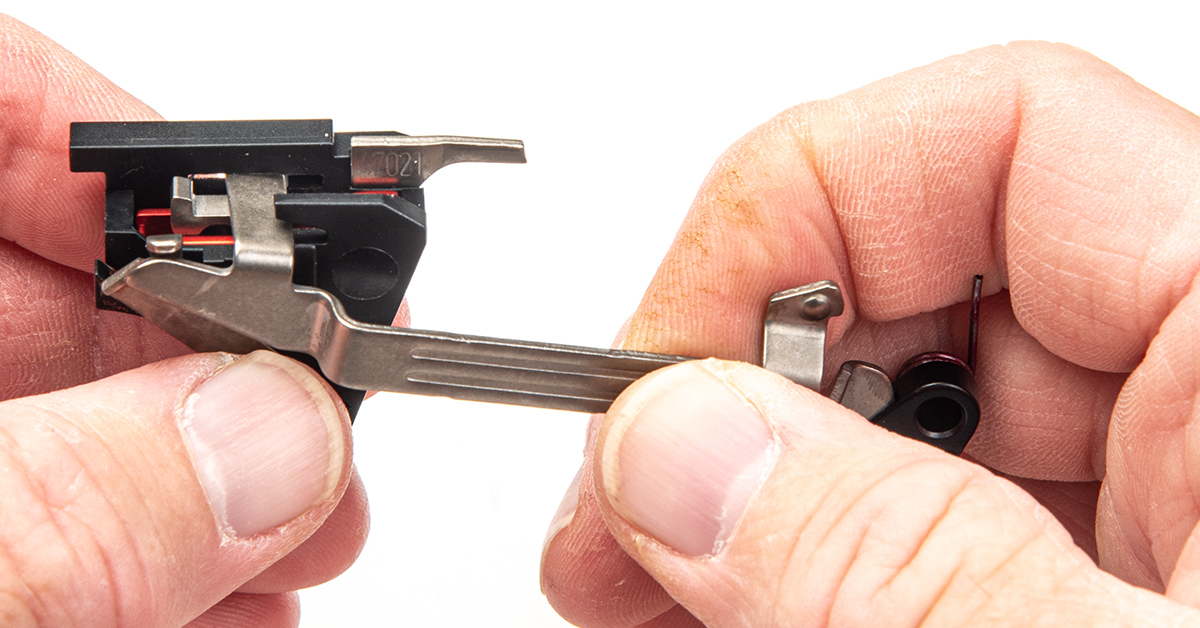
Reinstall the trigger bar in the mechanism housing in the same manner in which it was removed.
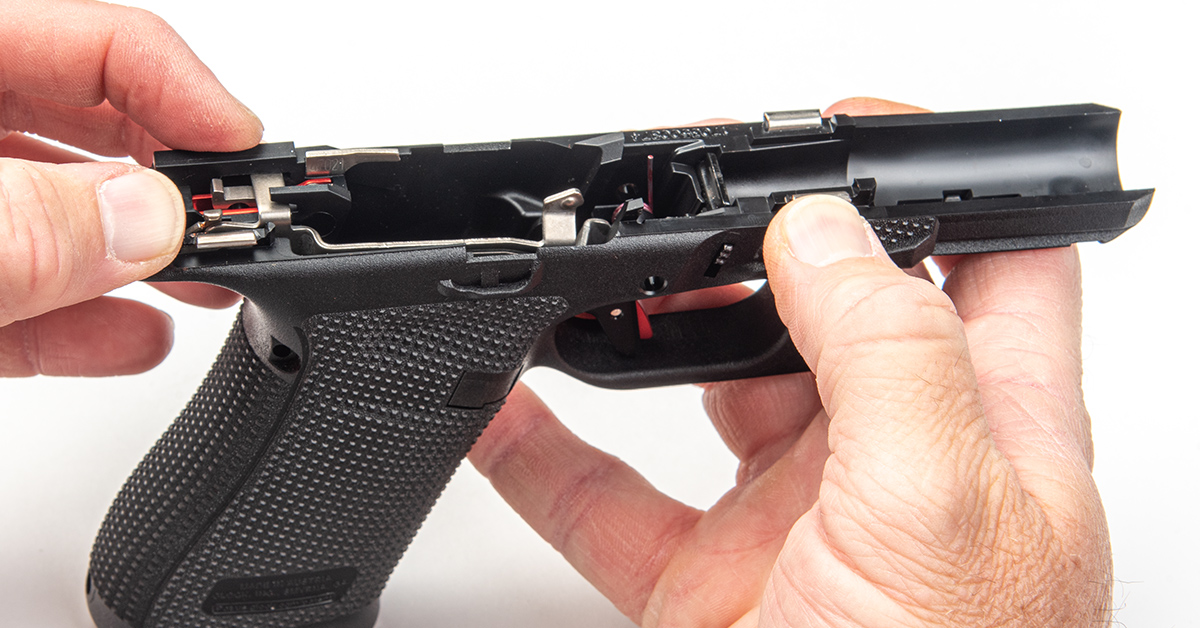
Reinstall the trigger, trigger bar, and mechanism housing as a unit into the frame. Make sure the housing is fully seated in the frame.
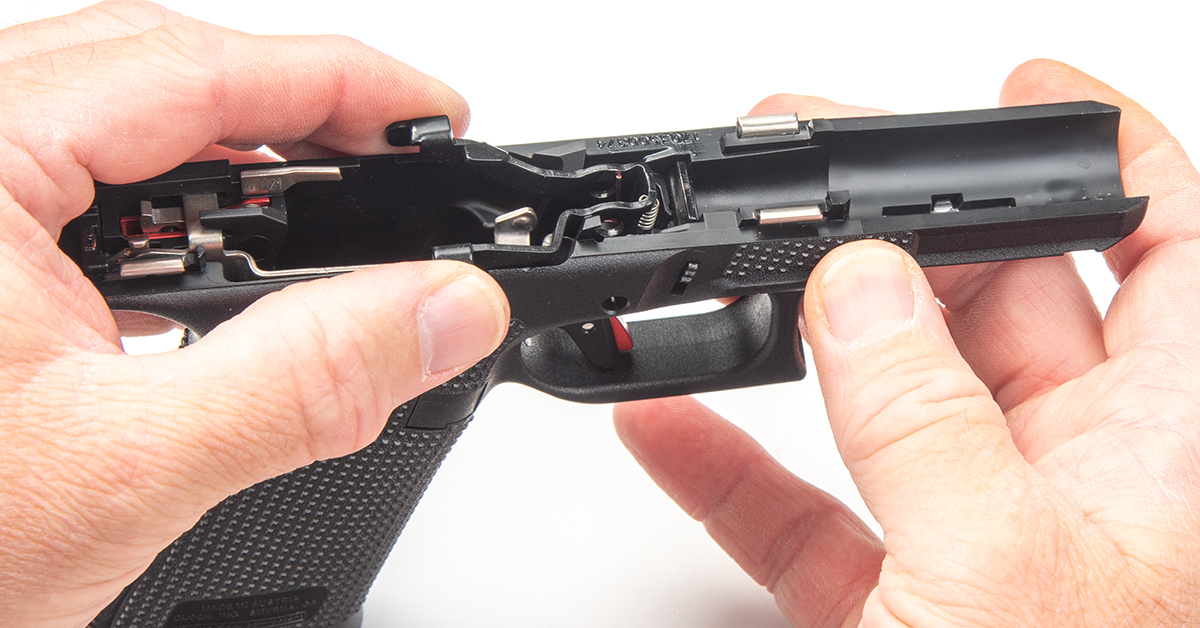
Reinstall the slide stop lever assembly.
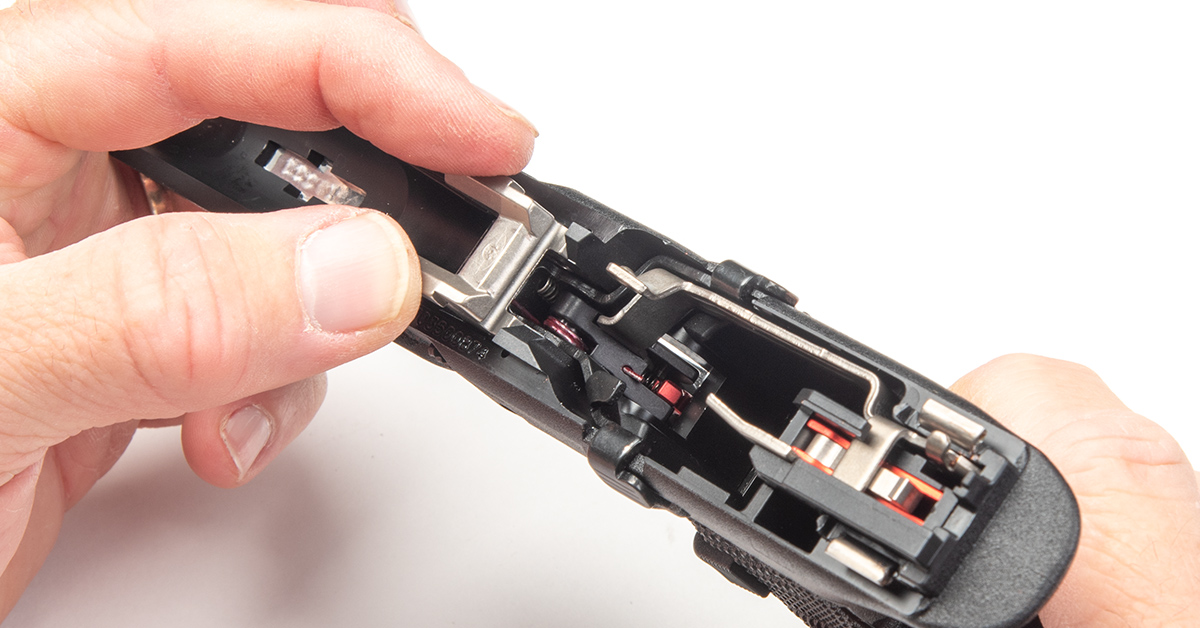
Reinstall the locking block partway into the frame. This will allow room for correct positioning of the trigger return spring.
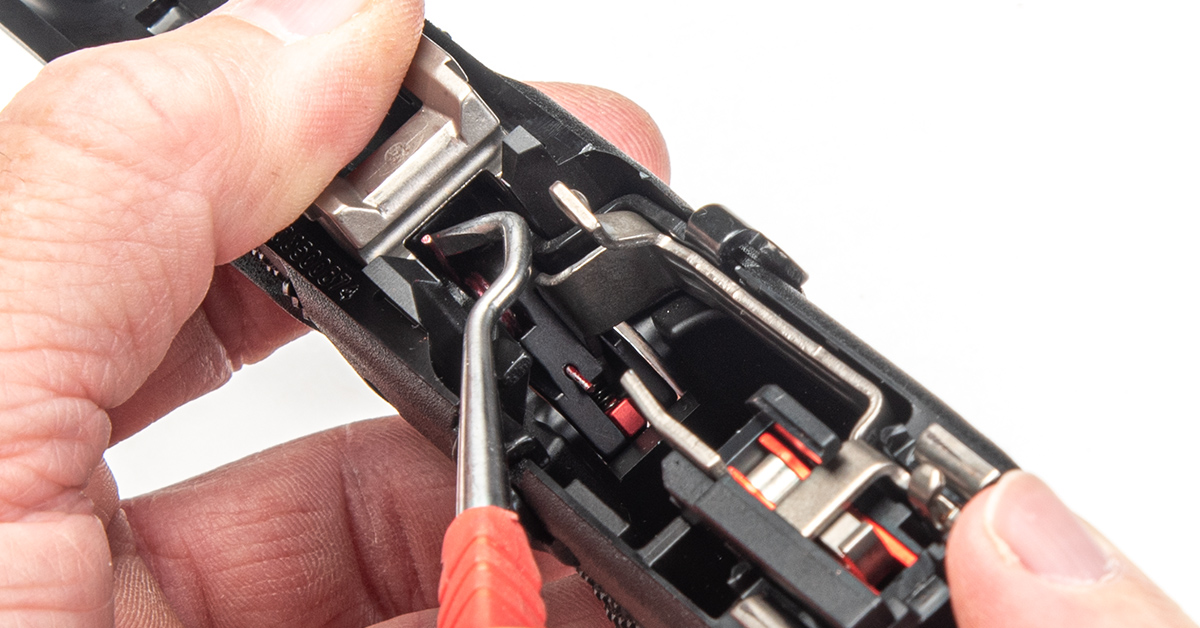
Simultaneously pull back on the free end of the trigger return spring and push the locking block the rest of the way into the frame. When properly installed, the return spring tail will lie against the locking block.
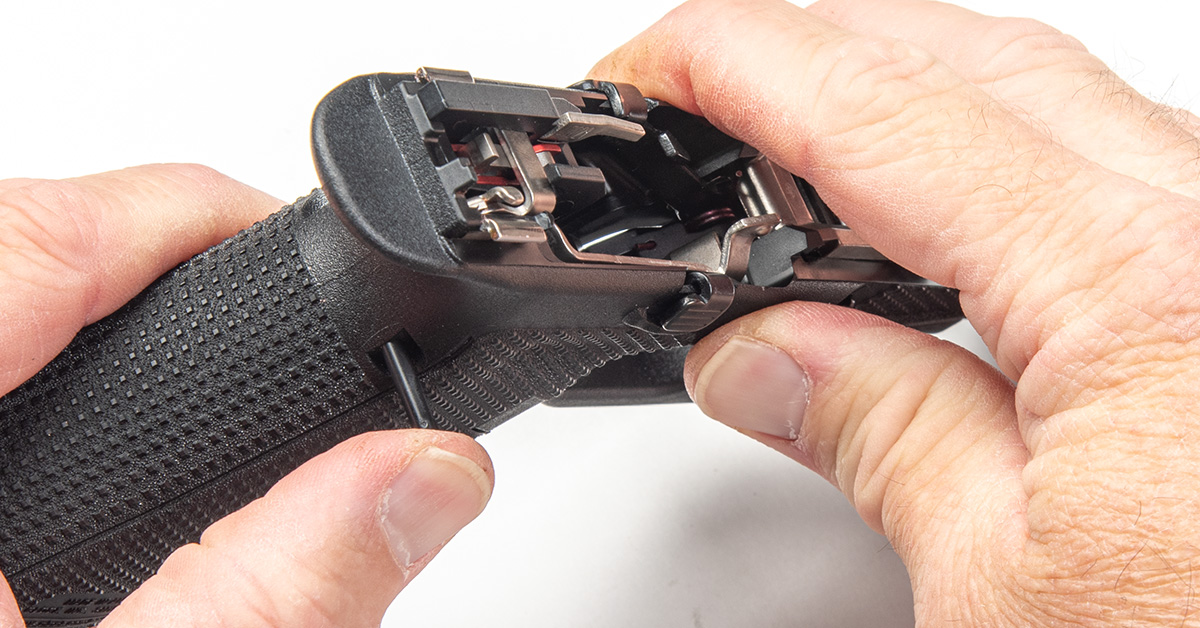
Reinstall the trigger mechanism housing pin.
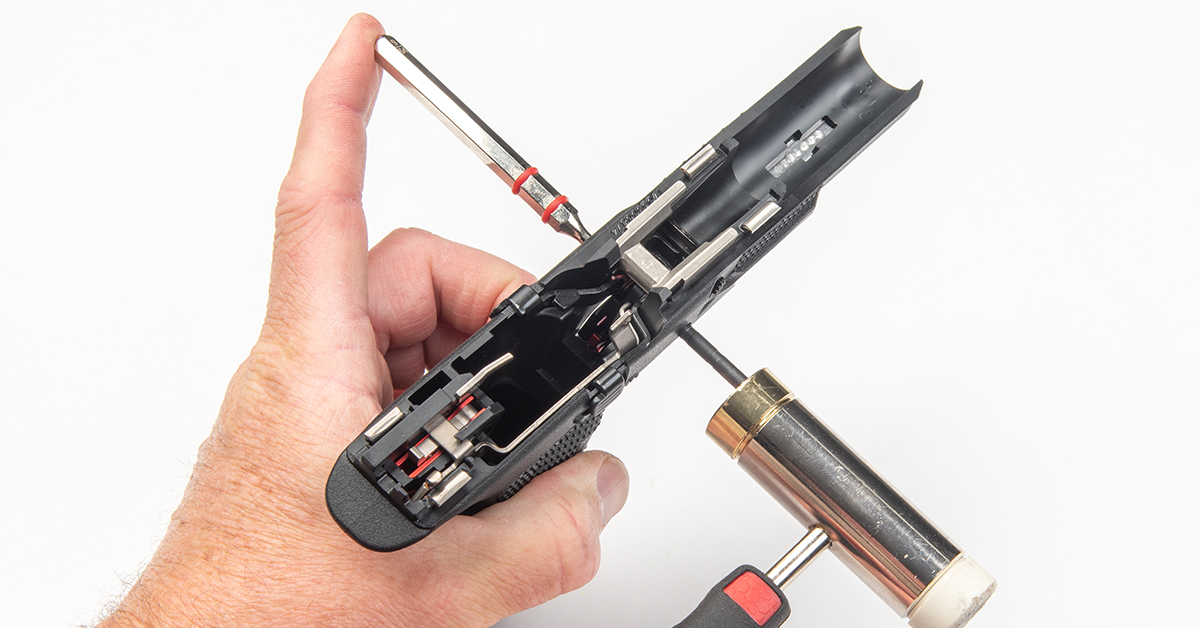
Reinstall the trigger pin from right to left. This task is easier to accomplish if you use a punch to serve as a slave pin.
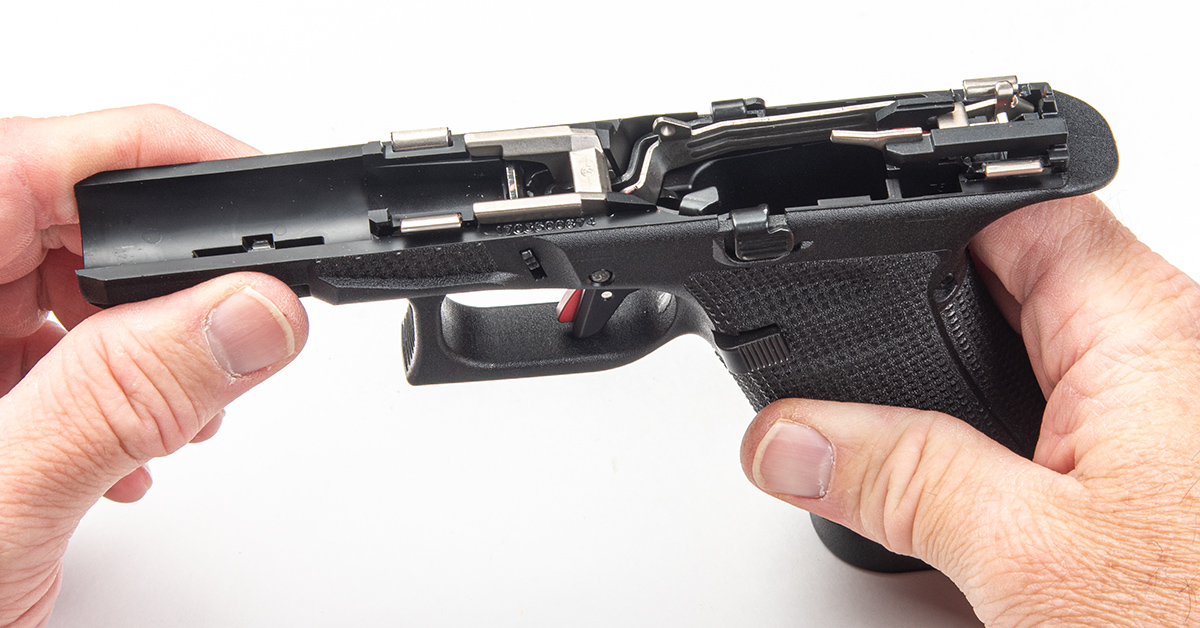
This completes the Alpha Competition trigger installation.
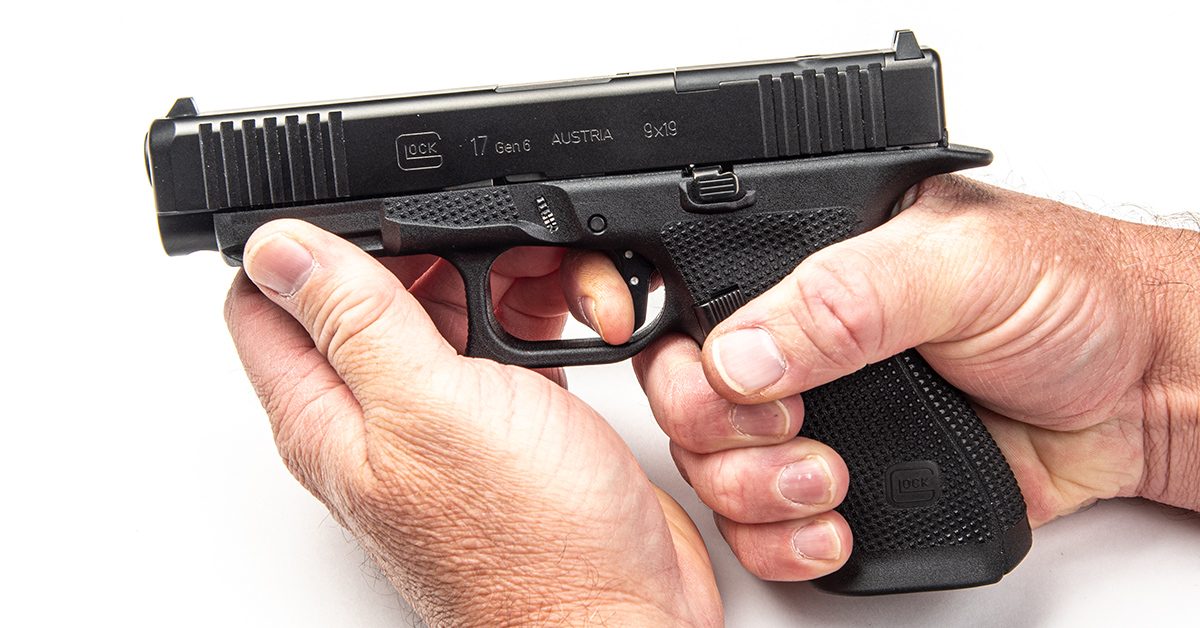
Reinstall the slide assembly and perform a function check, making sure the safety and reset functions are working properly. We also recommend purchasing a half-slide cover plate to check for proper sear engagement between the firing pin lug and the trigger bar. This check is explained at the end of this article.