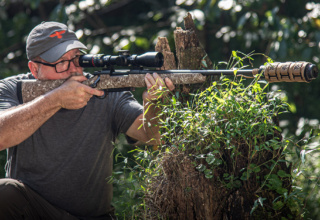
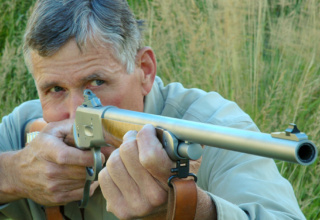
Tract Optics’ 22 Fire-series riflescopes are an overlooked option for anyone who is serious about shooting a rimfire rifle
by Richard Mann
Tract Optics has been around for more than a decade. Many shooters have never heard of them because they’ve probably never seen Tract Optics at their favorite firearms emporium. This is because Tract Optics products are sold direct to consumers. It became apparent to John LaCorte that, with the rise of the Internet, the market was evolving, and it led him to start Tract Optics.
Sure, anyone can start an optics company, but not everyone has LaCorte’s background. John spent more than 15 years with Nikon, working in product development, sales, and press relations. John knows a thing or two about optics and Tract’s rimfire line represents his understanding of what most rimfire shooters are looking for.
Essentially, what John LaCorte did was eliminate the middleman. There are no distributors or dealers between the manufacture and the customer. Tract can provide high-quality optics with features and benefits found in competitive products costing hundreds of dollars more. By cutting out the retail markup — which can be 40-50% these days — Tract is able to build a product that is unequalled in terms of price for the features they provide.
But back to Tract’s rimfire riflescopes that they offer in two magnification ranges.
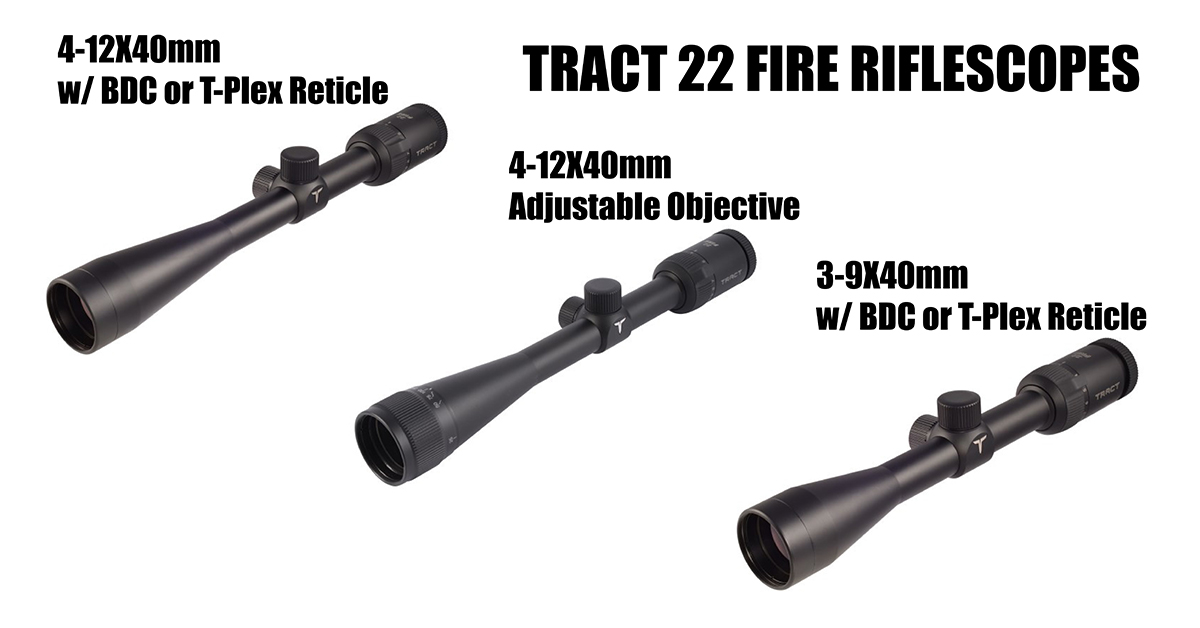
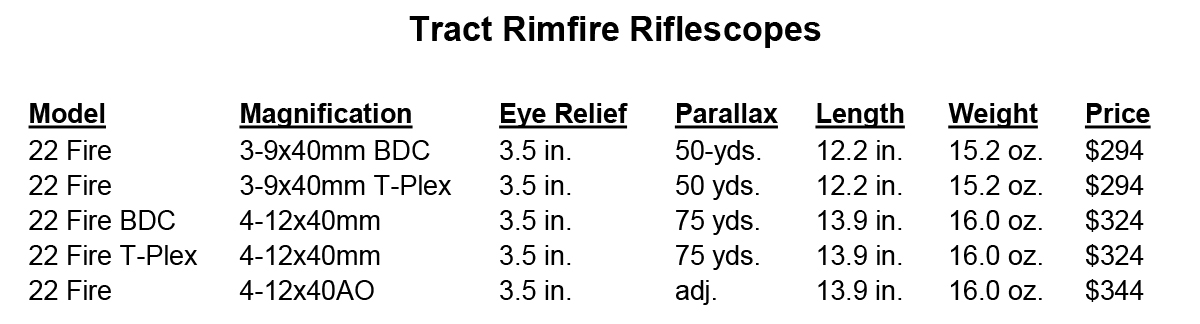
For general plinking or small game hunting, there’s the 3-9x40mm versions, and for those who want to reach out a bit further with maybe a 22 Magnum or a 17 HMR, there are the three 4-12x40mm options. Magnification range matters with riflescopes but so, too, do other things, like the fully multi-coated lenses, with every glass-to-air surface receiving four layers of anti-reflective coating to provide good light transmission and image crispness and brightness in any lighting situation.
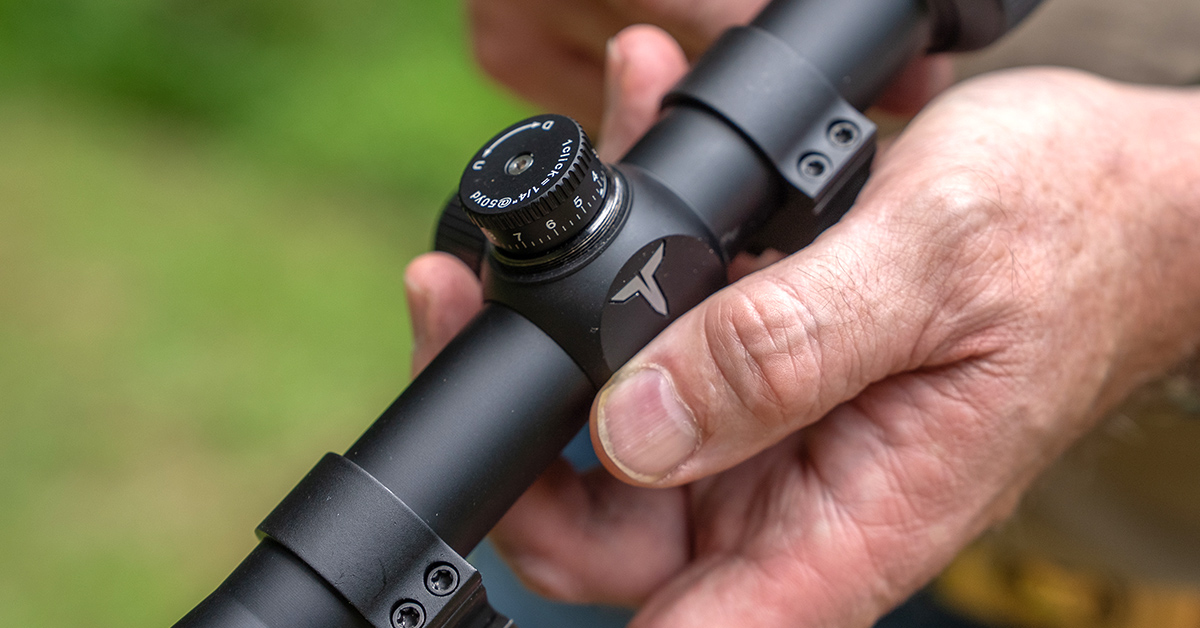
A unique feature of the 22 Fire riflescopes is the turret adjustments. Most centerfire riflescopes today adjust with either 1/10 MIL or ¼ MOA clicks. This is ideal for shooting at longer ranges. Yes, you can shoot a rimfire at extreme range, but most shooters use them inside 200 and most often inside 100 yards. All the adjustments on the 22 Fire riflescopes provide 1/4-inch per click of adjustment at 50 yards. And let’s be honest: most rimfire shooting is conducted very close to that distance. The 1/4-inch click at 50 yards on the 22 Fire riflescopes translates to a 1/8-inch click at 25 yards and a 1/2-inch click at 100 yards. When talking about distance, there’s something else that is also important, and that’s parallax.
You need to understand how parallax works for you to understand how critical it is. Let’s say you have a riflescope with the parallax set at 50 yards and you are shooting at 100 yards. If you move your eye as far as possible off the centerline of the scope but where you can still see the reticle, the maximum parallax you can experience at 100 yards is equal to the diameter of the riflescope’s objective lens. If that objective lens is 40mm, the maximum difference in your point of aim/point of impact would be 40mm or 1.5 inches. It’s unlikely you would ever shoot with your eye that far off the riflescope’s centerline, but now you can see why parallax matters, especially with rimfires shooting at small targets. Shooting at a target 25 yards away with a centerfire riflescope that has a 150-yard parallax setting can be problematic.
The 3-9x 22 Fire riflescopes have the parallax set at what is arguably the most common rimfire range of 50 yards. With the thought that a shooter who choses one of the 4-12x models might be shooting a bit further, the parallax on all but the adjustable objective (AO) 4-12x 22 Fire is set at 75 yards. With these two parallax setting options with the 22 Fire riflescopes, they are ideal for most rimfire shooting — especially for hunters and plinkers. If you want to be able to adjust your parallax, the adjustable objective (AO) model is the best choice.
Tract has a video page on their website fully describing their 22 Fire riflescopes, which are also waterproof and come with a no-time-limit, no-paperwork lifetime warranty. These riflescopes also work with the Tract Impact Ballistics program.
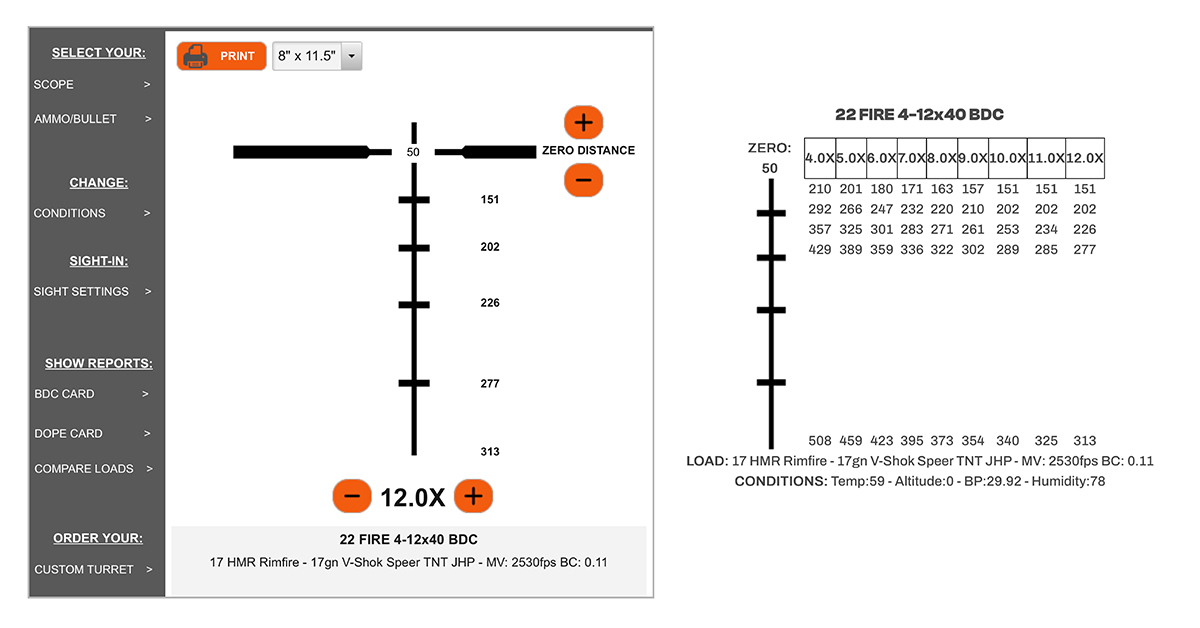
The Tract Impact Ballistics Program is a web- and app-based calculator. You simply pick your Tract riflescope and the load you are shooting, input the actual velocity from your rifle, and then set the zero distance. The program will tell you the exact corresponding distance for every aiming point on the BDC reticle.
For example, I’ve been using their 22 Fire 4-12X riflescope with the BDC reticle for the last two years and I frequently use their ballistics program when switching loads. With CCI’s Velocitor load that has a muzzle velocity of 1400 fps out of my rifle (zeroed at 50 yards), the program tells me that the first aiming point below reticle center will correspond to 77 yards, the second to 101 yards, the third to 123 yards, and the fourth to 150 yards. This is almost ideal for trajectory reference at 75, 100, 125, and 150 yards.
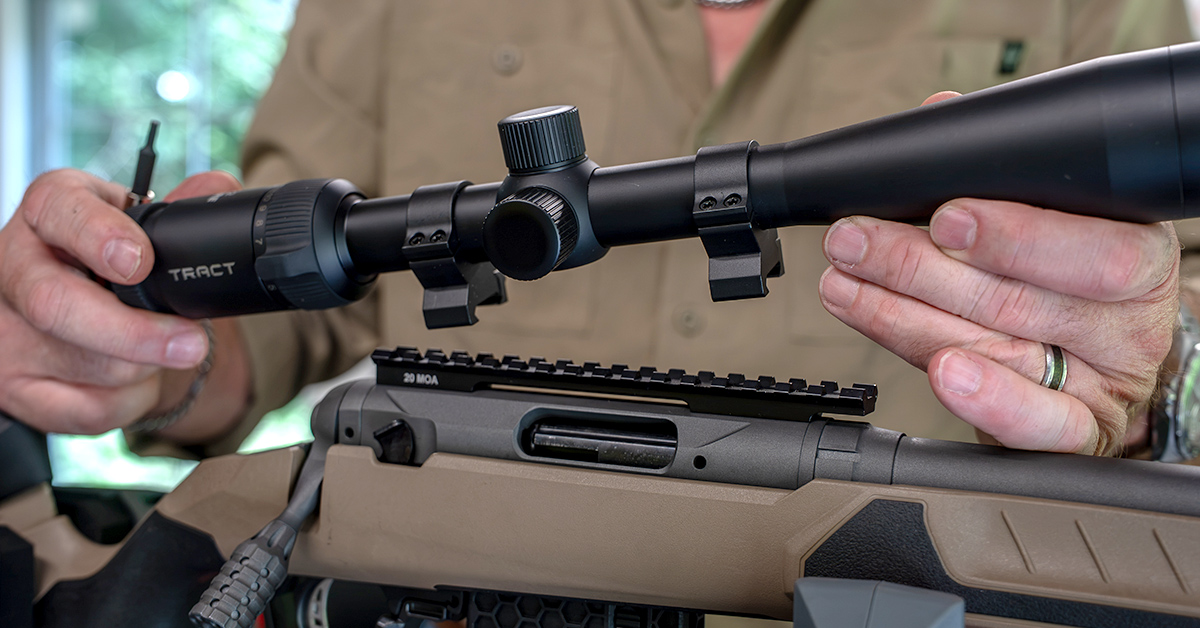
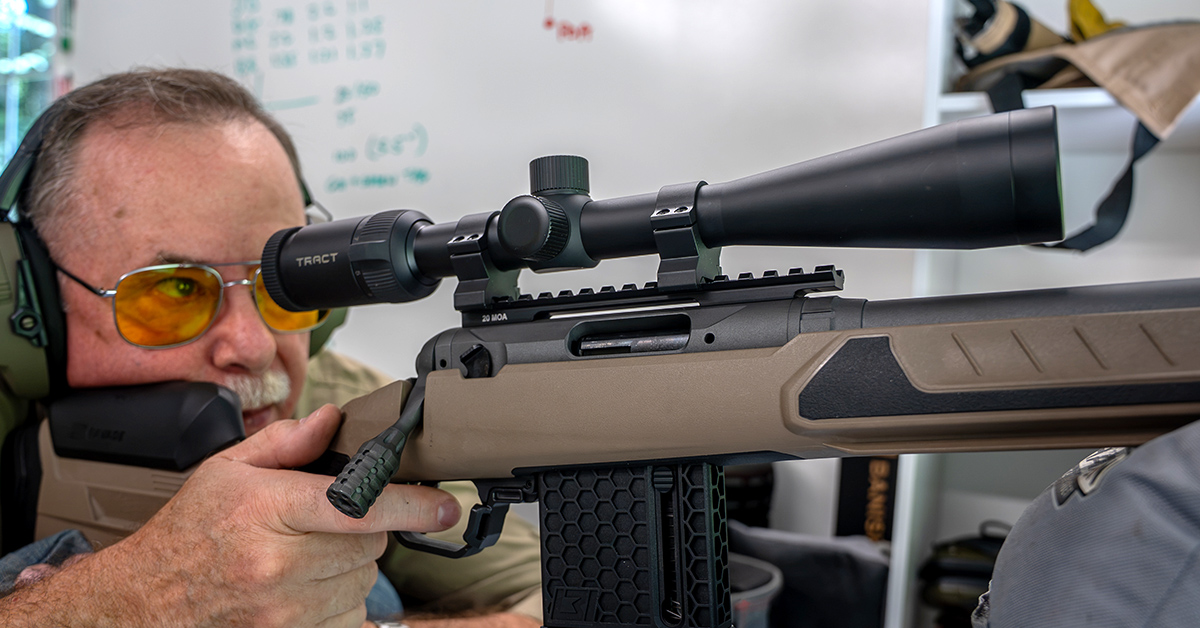
I’ve had this riflescope mounted on several different rifles and a feature I really appreciate is one that many shooters overlook when selecting a riflescope for any rifle. The 4-12X 22 Fire has 5.9 inches of mounting space. This allows for much more versatility when mounting due to ring spacing and when setting proper eye relief. The 3-9X 22 Fire riflescopes — even though they are an inch shorter — still have 5.4 inches of mounting space. You should be able to mount both just about any way you want on just about any rimfire rifle. And, too, at a pound or less, these riflescopes will not unnecessarily weigh down your rifle.
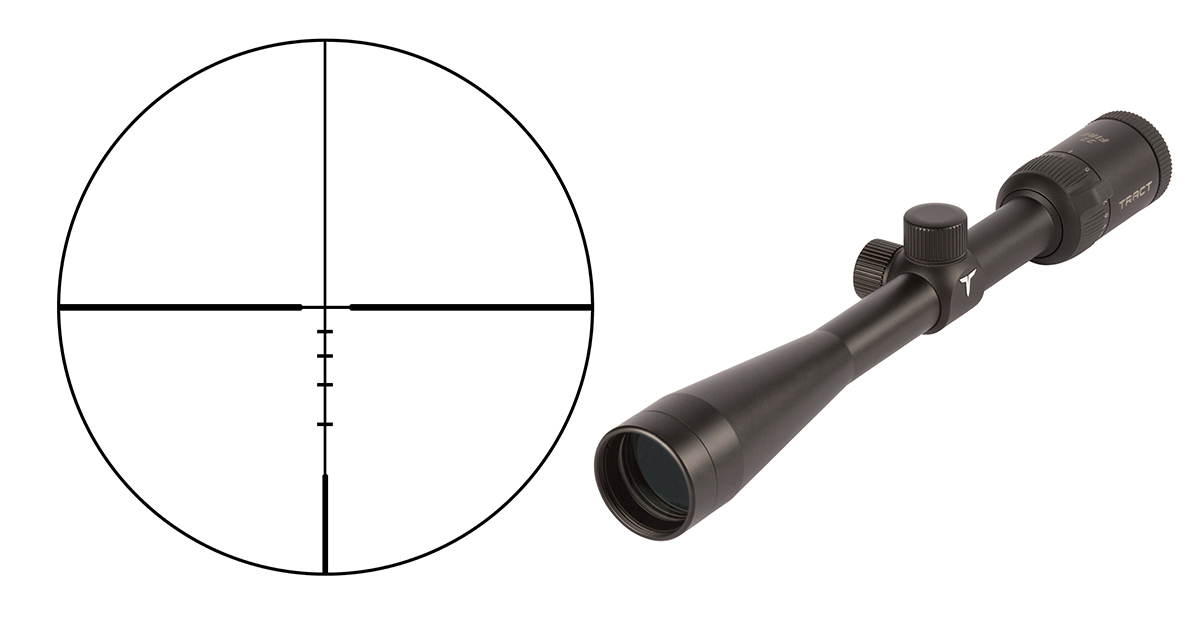
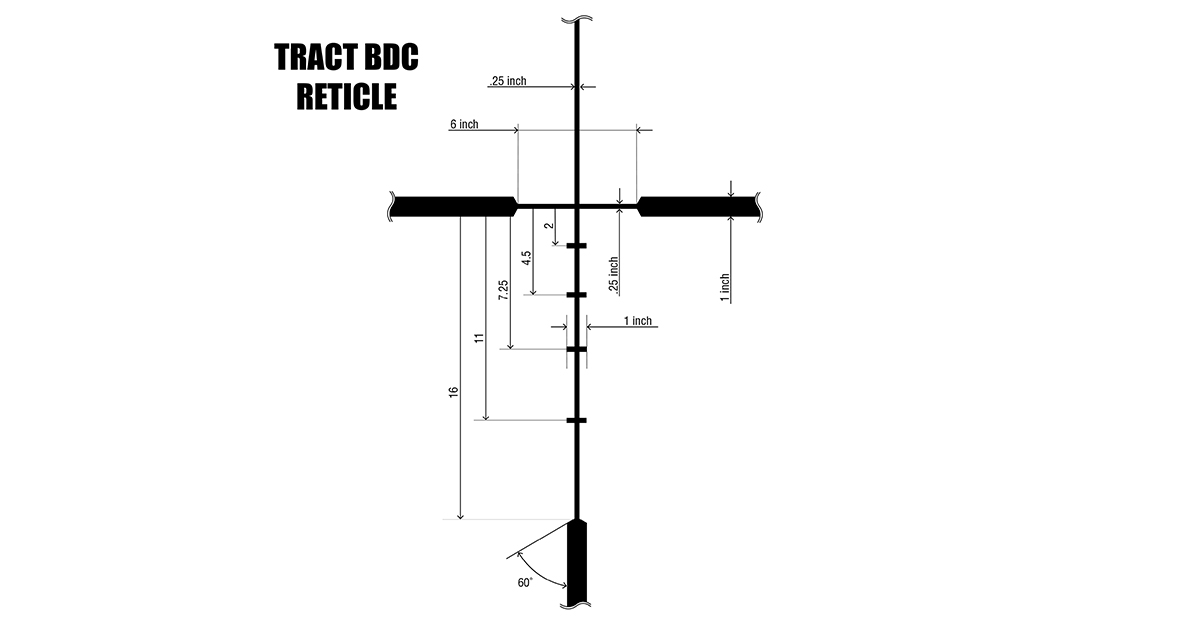
Tract 22 Fire riflescopes are constructed on a one-piece aluminum tube, and they are made in the Philippines. With either magnification range, you have the option of Tract’s T-Plex reticle, which is similar to what is commonly known as a 4a reticle, or Tract’s BDC reticle. The 4-12x adjustable objective (AO) model has a fine reticle with a 0.25-inch dot — at 50 yards — at its center. Currently, an illuminated reticle on a 22 Fire riflescope is not an option.
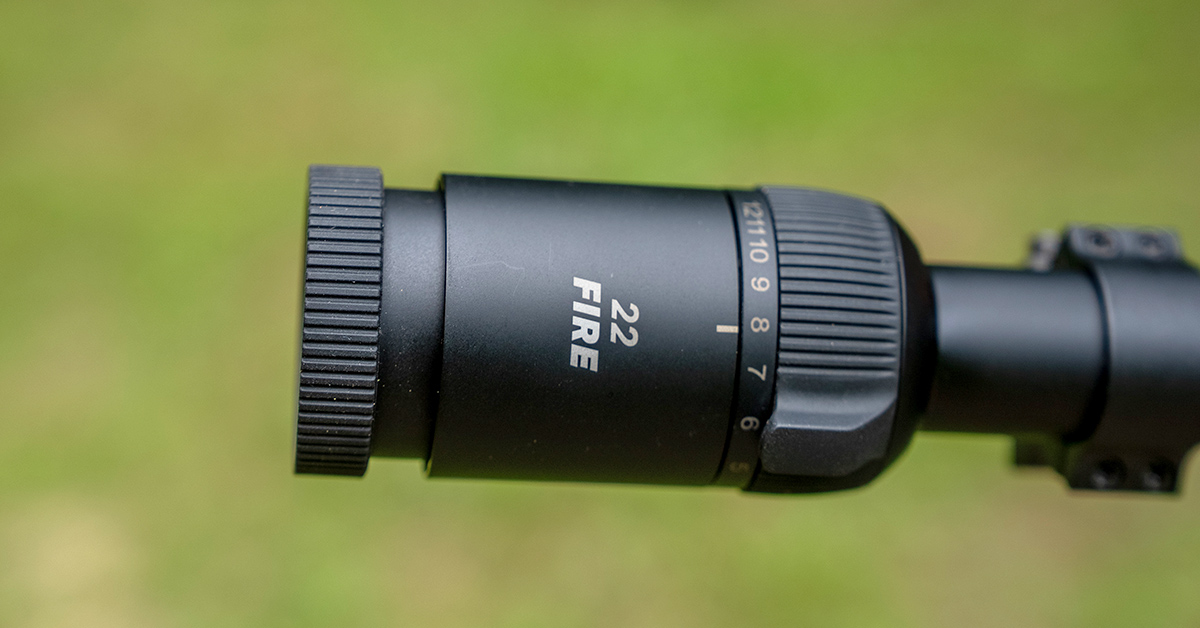
The magnification adjustment ring is covered in rubber and is easy to turn, but it has a raised bump at maximum power that extends nearly a quarter inch beyond the eyepiece diameter. It’s a nice reference but it could interfere with bolt operation if you mount your riflescope seriously low. All the reticles, regardless of style, are second focal plane reticles, and every 22 Fire riflescope has a fast-focus eyepiece. Both the windage and elevation knobs have 60 MOA of adjustment and a fast zero-reset feature.
Tract does not have the historic legacy of brands like Leupold, Burris, Bushnell, and Swarovski, but that does not mean they are not quality riflescopes. In addition to the Tract 22 Fire riflescope, I have worked with several other Tract riflescopes and have always found them to perform as well as riflescopes from other brands costing substantially more, and I would not hesitate to recommend them.
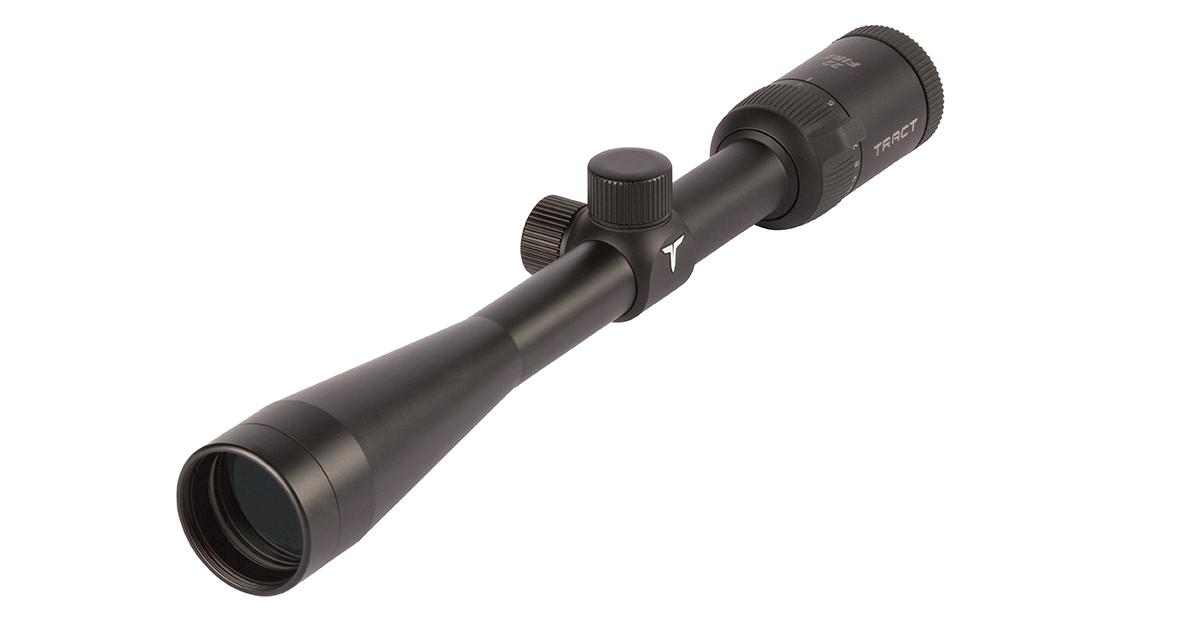
Granted, when it comes to a dedicated rimfire riflescope, you can find them out there for less than $100. But with optical sights — maybe more than anything else — in terms of features and performance, you tend to get what you pay for. Also, Tract wants to offer rimfire riflescopes that deliver performance comparable to their centerfire riflescopes. So, while they might cost a bit more than the bargain basement rimfire scopes, they are going to perform better and be more durable.
I recently talked with John LaCorte about Tract Optics and asked him what the future holds. John said, “We will continue to innovate and provide exciting new products based upon the feedback from our customers. The TORIC 4-25×50 has been a great addition to the line for precision PRS and NRL22 shooters because it features a best-in-class 160 MOA/47 MRAD of adjustment, allowing rimfire shooters to dial further than they ever have before.”
So, the next time you’re in one of your favorite gun stores looking at riflescopes, take a few minutes to go online and compare the features and prices of those scopes to what Tract has to offer. You might find that the riflescope you really want and need is less expensive and just a few clicks away.
Tract 22 Fire 4-12x40mm BDC Specifications
- Magnification: 4-12x
- Objective Lens Diameter: 40mm
- Eye Relief: 3.5 constant
- Exit Pupil: 10 at 4x/3.3 at 12x
- Field of View: 34 feet at 100 yards (4x)
- Length: 13.9 in.
- Weight: 16 oz.
- Adjustment Range: 60 MOA
- Click Diameter: ¼ in. at 50 yards
- Tube Diameter: 1 in.
- Parallax: 75 yards
- Reticle Plane: second
- Mounting Space: 5.9 in.
- Cost: $324.00

- TESTED: Tract Optics Rimfire Riflescopes - October 2, 2026
- TESTED: Dan Wesson Kodiak 10mm Auto - August 19, 2026
- The 25 RPM: Weatherby’s New Quarter-Bore - June 22, 2026