Irish Setter’s VaprTrek hunting boots may be the ultimate stalker with its extremely light weight and moccasin-like feel
by Rob Reaser
I’ve been hunting since I was in early grade school. For my cousins and me, the highlight of our “outdoor apparel” consisted of those white, pretty much worthless long johns that have, thankfully, largely disappeared from the shelves plus uncomfortable, unlined, cold-as-ice rubber boots that froze your toes within five minutes of leaving the cabin.
Around the 4th or 5th grade, I came across a pair of my grandma’s old (probably 1940s-era) unlined leather lace-up boots with flat soles that I used for a couple of years and thought I was rolling in high cotton. It wasn’t until 7th grade that I got my first pair of new, genuine leather hunting boots, and I ran those hard — from bow season, through the winter months, and all summer while traipsing behind my grandpas in search of wild ginseng.
Since then, I’ve acquired more sensible footwear over the decades — from the so-so box brand types to the high-end Italian imports. None of them, though, have elicited a, “WOW…these are different,” response until I slipped on Irish Setter’s new VaprTrek hunting boots a couple months ago.

What first struck me was how light the boots are. I’m talking true featherweight.
I had chosen the leather insulated (400 grams PrimaLoft) model #3944, which registered 1 lb. 7.4 ounces (one boot) on my scale. For comparison, I weighed one of my primary hunting boots — Kenetrek’s Mountain Extreme 400. Those weigh 2 lbs. 7.7 ounces each. That’s a significant disparity that you certainly will feel after a hard day of hill-climbing and holler-hopping.

The other “holy smokes” observation came when I slipped the boots on for the test fit and took a couple of steps across my shop floor. The sole and footbed were remarkably pliable and soft, unlike most boots that have a firm, almost plank-like feel to them. In that moment, I thought, “These are modern-day hunting moccasins!” And that reminded me of a passage from a book I had been reading about the first pioneers to settle the western Appalachians in the mid- to late-1700s. The book provides some anecdotal descriptions of these mountain men precursors — how they lived, the challenges they faced in the unspoiled wilderness, and their everyday lives, such as how they dressed.
“On the frontier, and particularly among those who were much in the habit of hunting, and going on scouts and campaigns, the dress of the men was partly Indian and partly that of civilized nations…
A pair of drawers, or breeches and leggins were the dress of the thighs and legs, a pair of moccasins answered for their feet much better than shoes. These were made of dressed deerskins. They were mostly of a single piece, with a gathering seam along the top of the foot, and another from the bottom of the heel, without gathers, as high or a little higher than the ankle joint. Flaps were left on each side, to reach some distance up the legs. These were nicely adapted to the ankles and lower part of the leg by thongs of deer-skin, so that no dust, gravel, or snow could get within the moccasin.
In cold weather the moccasins were well stuffed with deers’ hair or dry leaves, so as to keep the feet comfortably warm; but in wet weather it was usually said, that wearing them was a ‘a decent way of going barefooted;’ and such was the fact, owing to the spongy texture of the leather of which they were made.” – History of the Early Settlement and Indian Wars of West Virginia, Wills De Hass, 1851.
I believe I would take today’s advanced insulating fibers over stuffing my boots with deer hair and leaves in order to keep warm, but the pliable nature of moccasins have much to their credit in terms of allowing the hunter soft, quiet passage through brush and woodland environments. The Irish Setter VaprTrek boots, I anticipated, would certainly be the next best thing to moccasins in terms of stealth performance.

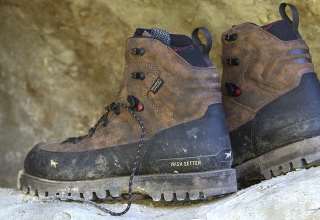
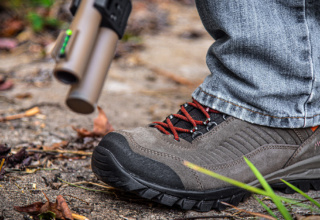
As you can see, the outsoles of the VaprTreks are a hybrid of sorts. Constructed of tan rubber Hex Lite that supports an EVA footbed, the outsole features tread blocks that are generously spaced, with high void areas forward of the heel. This combination of high pliability and ample flat sole surface really lets you feel the ground beneath your feet. For those of you who apply a lot of stalking or still hunting to your outdoor pursuits, this is a huge bonus because you can “feel the ground.” This lets you avoid stepping on downed limbs, sticks, and other noise makers so as to reduce the chance of spooking your quarry.
The potential downside to this soft and pliable outsole construction is that it does demand more foot muscle to maintain stability in some terrain compared to boots with a more conventional, hard-type sole. Irish Setter does mitigate this somewhat by including EnerG technology in the mid-sole construction, which helps with rebound (think “spring in your step”).

The VaprTrek’s outsole wraps high onto the toe box. This protective covering not only adds scuff protection to this critical location, but it also extends traction. You’ll note the traction lugs extend across the toe box and the sides of the boot forward of the heel. Good stuff if climbing steep grades is part of your game.
The upper construction is also less rigid than most all-leather hunting boots I’ve worn. If you are one who demands a high degree of ankle support, this may not be the boot for you. Again, this pliable construction is part of what gives the VaprTrek that moccasin-like feel and performance.

ArmaTec covering wrapping around the heel adds some stability to the heel pocket area, which is important. Another benefit is that it protects the leather from abrasion. The scallop design serves as a heel kick when you’re ready to take the boots off.
You’ll also note the padded chevrons located on either side of the ankle areas. This offers a minor stabilizing influence, but I find the greater value in the protective cushioning they offer.

Irish Setter offers all VaprTrek models with its UltraDry waterproofing system. I crossed several creeks and had a not-so-fun day hunting in a cold and miserable rain during the second day of our rifle season, and never did the boots leak nor did moisture wick through to the inside. The 400 grams of PrimaLoft (not offered on all VaprTrek models) did a surprisingly good job of keeping my feet warm in mid-20- and mid-30-degree temperatures.

While Irish Setter offers the VaprTrek in Mossy Oak and Realtree camo patterns, I’ve developed a fondness for the company’s own mottled camo design featured on the Trout Brook Nubuck leather upper. It just looks cool and doesn’t clash with other camo patterns I’m wearing (as if critters give a flip about that!).

As of this writing in early December, the VaprTreks are the only boots I have worn since hunting season started in late September. Their deliciously light weight was a blessing when climbing hills during the warm, early bow season, their waterproof construction was proven through creek crossings and foul-weather downpours, and the boots’ insulating properties worked with my poly liners and merino wool socks to keep cold at bay during frigid sits in the hunting blind.
Overall, the light weight and pliable, feel-the-ground-beneath-you outsole is what really won me over. As I mentioned at the beginning of this review, the VaprTrek is a modern-day moccasin, in my estimation — ideal for stalking or still hunting. That easy-going sole, though does require a caveat that my colleague Jace Bauserman at our sister site Born Hunting noted during his testing of the VaprTrek in the western states. Jace had a cactus thorn to pierce the boot and enter his ankle on a hunt, so this might not be the footwear for you if you intend to hunt in areas where the flora bites back (or just be careful where you tread).

Irish Setter is currently offering the VaprTrek tested here for $179.99 (regular price is $239.99). If you like the idea of a 21st century hunting moccasin, you need to check it out. As for me, I can say that this is the most comfortable, out-of-the-box hunting boot I’ve ever worn…and that inherent comfort adds practical function.
Our pioneering forebears would have been jealous.