Whaler, then hunter and explorer, he survived sharks, bandits, and an execution order to unearth history.
by Wayne van Zwoll
A Mongol, Tserin should have known better. The Russians who had sneaked onto Bogdo-ol and shot a bear had been caught. In a rage, the lamas who protected The Sacred Mountain above Mongolia’s capital, Urga, beat the poachers brutally and led them out in chains.
But Tserin was a hunter, too, and a stag he’d seen from afar had taken his breath. Two days after entering Bogdo-ol under cover of night, he downed the beast. But lamas had heard the shot and homed in. Tserin was clubbed unconscious, hauled to Urga, and thrown into a “prison coffin.” He’d have died there had not a hunting partner of high station interceded.
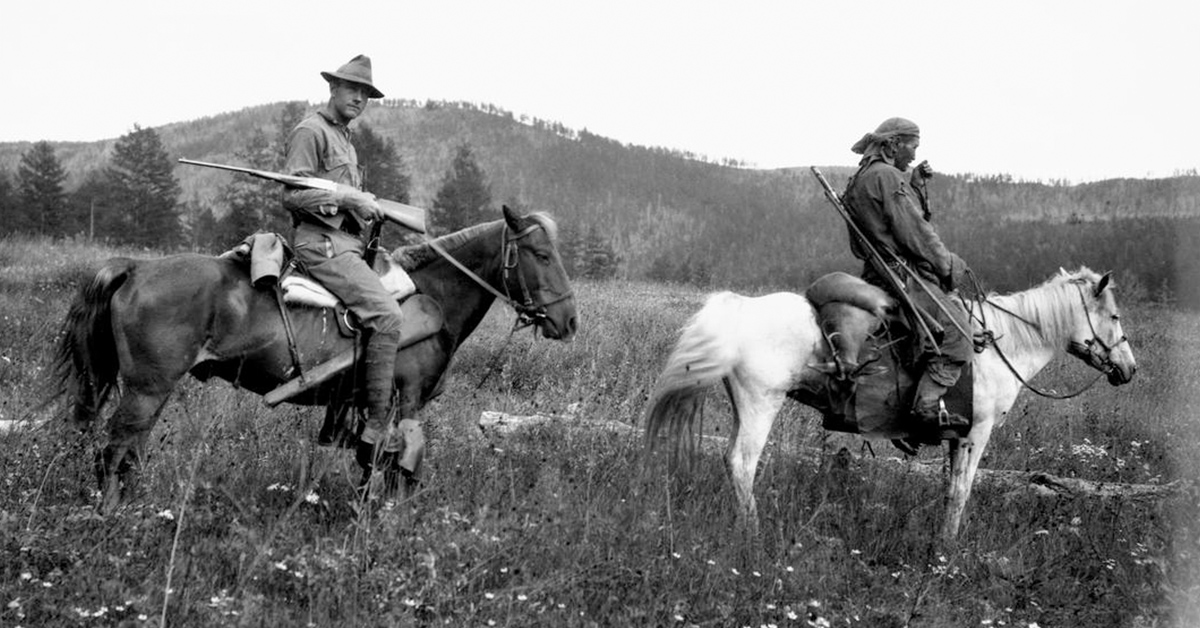
Roy Chapman Andrews met him later in the Terelche Valley, where the Siberian life zone meets northern Mongolia. At camp, they shared tsamba, finely ground meal and a lump of rancid butter in black tea. In the forest the next morning, Andrews surprised a big roebuck. It fell to a quick shot. “He was the finest buck I had ever seen,” he exulted. “Gold [in] sunlight was never more beautiful than his spotless summer coat.” He reflected on his good fortune of that moment — and on a career that had given him many. “How fortunate I was to have been born a naturalist! A sportsman shoots a deer and takes its head. [A museum’s naturalist] can reproduce with fidelity [the animal in its habitat].”
Roy Chapman Andrews was born in 1884 in Beloit, Wisconsin, a young manufacturing center on bluffs above the Rock River. He grew up prowling woods and wetlands, a student of wildlife. He pestered waterfowl with a shotgun gifted him at age nine. Once he fired at six geese, neatly clumped in a flotilla. But instead of death throes and feathers, he saw the birds deflate. The hunter behind them wasn’t amused.
In March 1905, his junior year at Beloit College, Andrews and a pal were crossing a swollen river when the canoe capsized. Muscled by swift, icy current, Roy caught a snag. His friend drowned. That loss brought home “the frailty of my own existence” and drove Andrews to exploit every chance.
In February 1907, he helped salvage the skeleton of a whale half buried by roiling seas in Long Island Sound. Anchoring the 54-foot carcass against a vicious storm, the team excised 50 tons of stinking flesh. A driftwood fire warmed hands in sub-zero wind. Oddly, that week pushed Andrews to enhance the museum’s cetacean display. At West Coast ports north to Alaska, he photographed and mined data from 106 whales. In 1908, he began a doctoral program at Columbia. By then he’d met renowned paleontologist and railroad heir Henry Osborn, who would fund the Asiatic Expeditions he was to lead 14 years later.
In 1909, Andrews sailed to the Orient on a research ship, Albatross. Ports offered opium dens. He tried cocaine, heroin, morphine, and hashish, too — and swore off all of them. Whales brought real thrills.
Japanese whaling boats then were typically fitted with a swivel-mounted gun on the bow. Its 52-inch barrel had a 3-inch bore that accepted a 375-dram charge of coarse black powder in a cheese-cloth sack loaded from the front. Wads of okum, cork, and wool preceded a 76-inch double-shafted “iron.” Four-foot flukes seized the beast on impact. A time fuse lit a powder charge in the nose after a four-second delay. A ring sliding in the shaft’s double walls held 3-inch rope 40 fathoms long, spliced to a 5-inch rope at least a mile long. A winch “played” the whale and pulled it in.
His work on the huge mammals and a lust for hunting drove Andrews to ask for a chance to shoot a whale. Like most gunners, Erik was Scandinavian. “Harpoons don’t fly like bullets,” he replied, “and in tall seas a boat is an unstable platform. A whale’s meat and oil can bring 3,000 yen. So, a miss could cost the crew $2,000 in U.S. gold. You wouldn’t be popular.”
“I’ve saved $3,500,” blurted Andrews. “You’ll get it all if I miss!”
The gunner roared with laughter. “You Americans! To gamble all your savings on one shot!” But the deal was struck. During a day at port, Andrews saw his mentor in action. After killing 200 whales on dancing seas without a miss, he swiveled the cannon as if it were a grouse gun and hurled three irons pell mell into a barrel floated as a target. Given three charges, Andrews threaded the barrel with one harpoon.
The ocean denied him an early chance; slim 50-foot sei whales rolled and reversed like dolphins. Then the bo’sun cried “Kujira! Shironagasu!” Sulphur bottom whale. Much bigger. A 6,000-yen prize and, unspoken, double the loss if missed. At 50 fathoms the beast sounded. “It’s yours, Roy,” said Erik. “Aim two feet high; wait till his back clears. To the swivel! He’s rising!” Ninety tons of whale suddenly erased all else below the waves. The great head rent them; a cloud of stinking vapor blinded Andrews. Instinct or accident nudged the trigger. The iron struck behind the blowhole, glanced off bone, and fell into the sea.
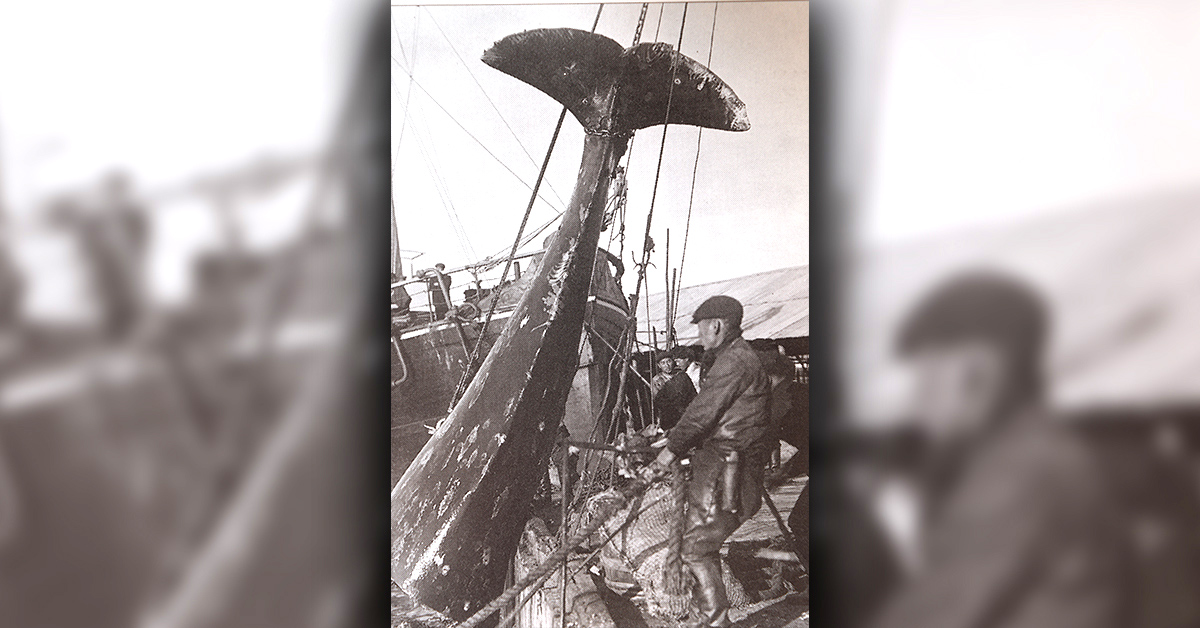
Grabbing the gun, Erik swung it in as the crew ran up to reload. The whale lay stunned for a long three minutes before the harpoon was rammed home. “Aim lower!” Andrews muscled the cannon; again, it belched. The harpoon buried itself behind a flipper; then came the dull thud.
The young zoologist had taken the world’s biggest game.
He spent a summer in the fishing village of Aikawa, Japan. There, the Oriental Whaling Co. had 14 “chasers” supplying meat to Tokyo and Yokohama markets. A Swede, Johnson had proven himself an expert sailor and deadly gunner. He knew whale habit, too. With uncanny accuracy he foretold where the creatures would be and how they’d run. He braved rough seas and routinely logged the biggest hauls.
One day Johnson invited Andrews aboard. The morning brought heavy swells under wet skies. A finback whale spouted. Fast, agile, and strong, finbacks weren’t easy marks. Bigger than most, this one would tape 70 feet. An hour’s chase yielded no shot. Then the beast ran straight off. Inexplicably, Johnson yelled “hard starboard!” The ship keeled sharply. On the bridge Andrews saw the nearby surface become a slick. Then the sea gaped. He was peering down the blowholes as they opened to spout. Over the gun, Johnson fired as the nose submerged, the body rolling behind it. The harpoon embedded half its length.
But there was no detonation. The winch shrieked; the engineer yelled for water to cool its brake. Three hundred fathoms of rope spooled out before the chaos stopped and the ship slid quietly into a swell. Twenty minutes later the line rose slowly. Engines stopped, the 100-ton boat crept ahead, then gathered speed. Fifteen knots! The finback sounded, then burst from the waves like a tarpon. Johnson ordered more rope spliced to the mile already out.
After four hours, the whale was weakening. Then a swell lifted the ship sharply. The line parted. Johnson, still on the gun, sent a harpoon as the whale’s back winked above the sea. A muffled blast came on its heels. The shaft fell free, releasing the whale. Near evening, another harpoon held. The beast lay in a wide red stain on the surface. With the mate and another sailor, Andrews rowed out to finish it.
“Suddenly,” he wrote, “I did not want the animal to die. It had been…a wild thing to be chased and caught. [But] it had fought so gallantly for life that I would have liked to see it swim away. [To] other men it [was] meat and oil and fertilizer and money.”
Mere feet from the whale, the mate plunged his lance into the lungs, Andrews heaved mightily on the oars. One snapped. The pram bumped the finback. A fluke scaling a ton splintered the craft. Weighted by oilskins, Andrews clutched its husk as his crewmates splashed toward it. Sharks, few at the outset, now swarmed the whale “in a maelstrom of crimson froth.” Twice Roy kicked toothy maws away. Another got his boot. A Japanese lost part of a leg before the ship sent a pram. It might have come sooner, Roy wrote bitterly, had not Johnson turned the ship to secure the whale with another harpoon.
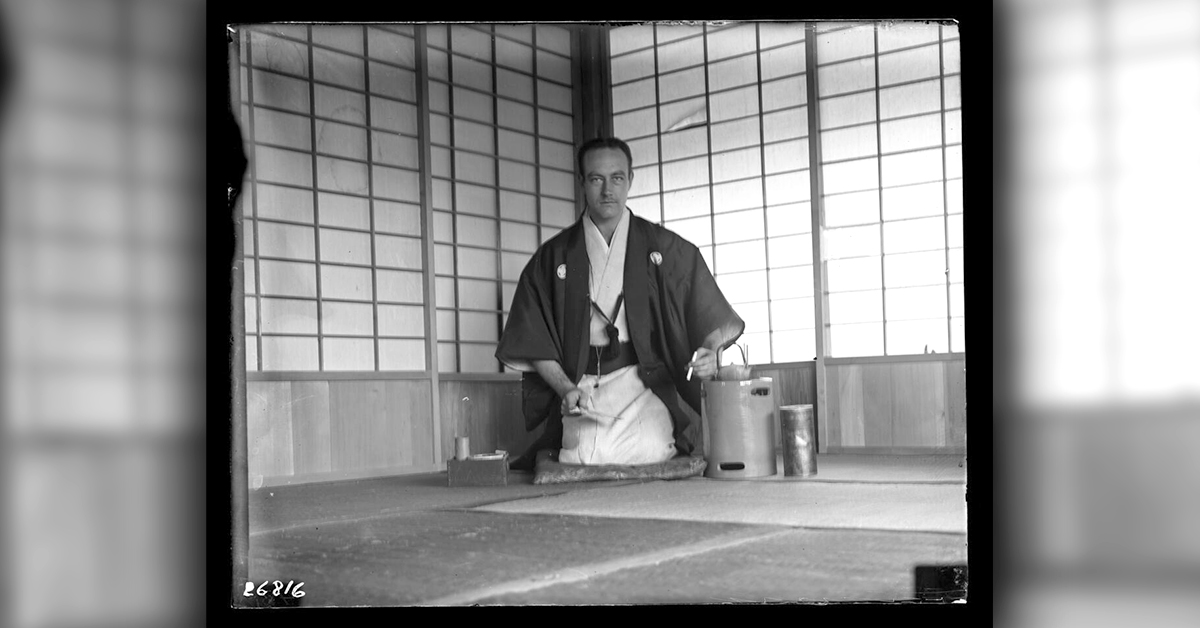
A hillside house, rented for $15 a month (with three servants and an ocean view) held Andrews in Japan for much of 1910. The next year, after writing one of three National Geographic article on whales, he left New York for work in Korea and a week’s trek to fabled peak Paik-tu-san. Pressing on to the Yalu River, he rafted 375 miles to its mouth and rode Trans-Siberian rails to a six-week sojourn in Moscow.
In 1913 Andrews earned an M.S. degree from Columbia. The next fall, he wed spirited Yvette Borup. She had 18 months stateside before their first trip to China and Mongolia. But she adapted quickly to life in the rough. A fine horsewoman, she proved an able photographer, too. Her images of the Second Asiatic Expedition in 1918 brought Andrews’ adventures to a receptive public. His focus had swung from Pacific cetaceans to secrets of the Orient. “The desire to see new places,” he said, “[is] a resistless driving force.”
His travels drew an invitation from Ohio-born Harry Caldwell, a missionary in southeast China’s Fukien Province since 1900. Andrews obliged in spring, 1916. In Shanghai, he loaded a motor launch with 1600 pounds of baggage and 33 coolies. After more than a week on the water, he reached the mission. The two men got on well. Harry’s knowledge of China’s people and politics proved invaluable to Andrews.
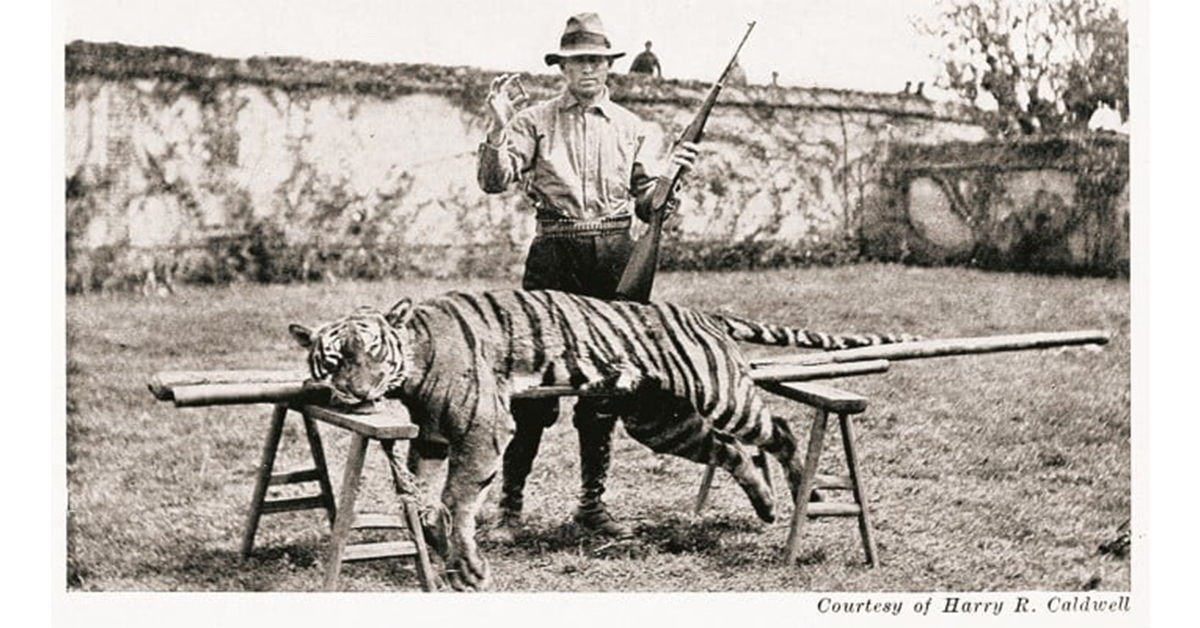
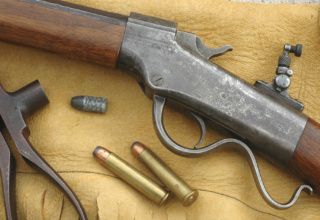
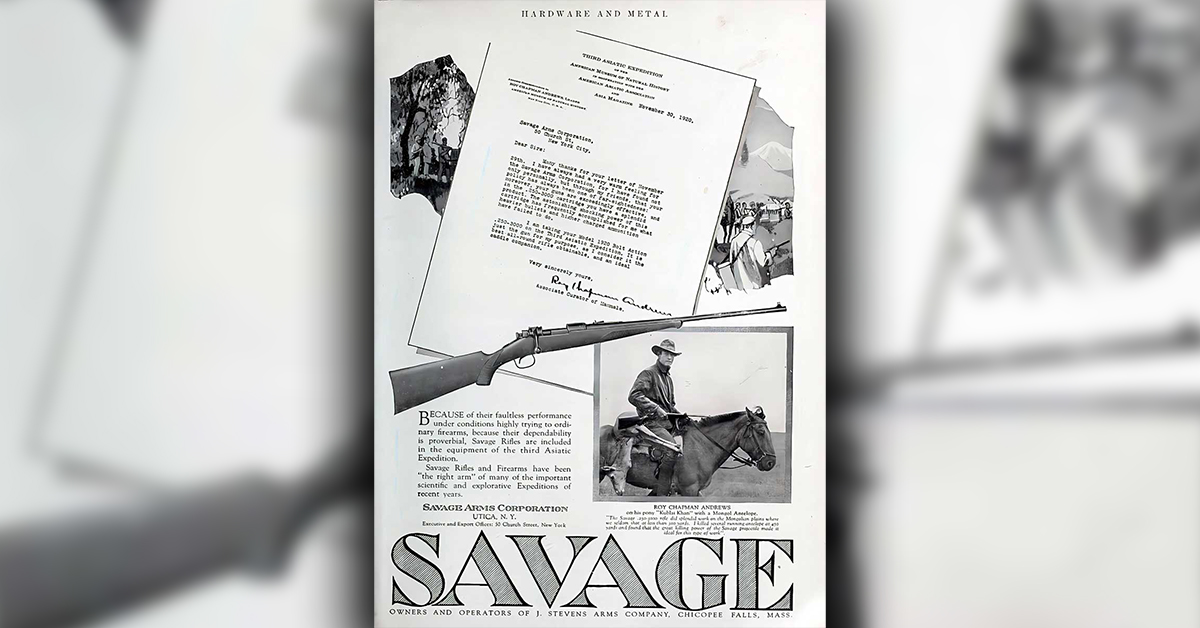
Impressed by Caldwell’s use of a Savage 1899 rifle to shoot tigers, the company had offered him new rifles and cartridges if it could feature him in Savage ads. When a Model 1899 in .22 Hi-Power came, he shelved his .303 and, without checking zero, upended a big tiger with the tiny bullet.
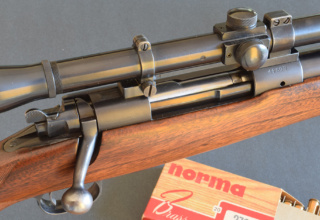
After visiting Caldwell, Andrews favored a Savage-supplied 1899. He called the .250-3000 “the most wonderful cartridge ever developed.” On his Third Asiatic Expedition, he would use Savage’s bolt-action Model 1920. Rifles not only brought meat and specimens, they warned off brigands. Once, their escape blocked, Andrews and a colleague felled two of a gang of bandits. The rest fled. Mastiff-size feral dogs were also a threat. Mongol nomads left their dead on the desert or bore them at speed on carts over rough ground, the driver staring ahead. Dogs feeding on corpses came to regard humans as food. A pack circling Andrews’ team at a campfire lost two of its members to his rifle. The rest quickly devoured them.
While most travel across the Gobi Desert then was still by camel caravans, its hard surfaces also conducted automobiles. Leading the Museum’s Second Asiatic Expedition, Andrews hired cars for the trip’s first leg. One day, a herd of antelope appeared 500 yards off. “I shall never forget the sight of those magnificent animals streaming across the desert!” he wrote. The driver throttled up in a wide arc to close the gap and at 200 yards hammered the brakes. Both men piled out, rifles popping.
Weeks into the expedition, Mongol ponies replaced automobiles, adding challenge and thrills to the chase. When he “shook the reins over Kublai Khan’s neck,” the stallion was off like a rocket. Yvette kept pace, “hat gone, hair streaming, light as a butterfly” in the saddle. He later climbed after wild sheep and wapiti in Mongolia’s highlands, sharing those hunts with Harry Caldwell.
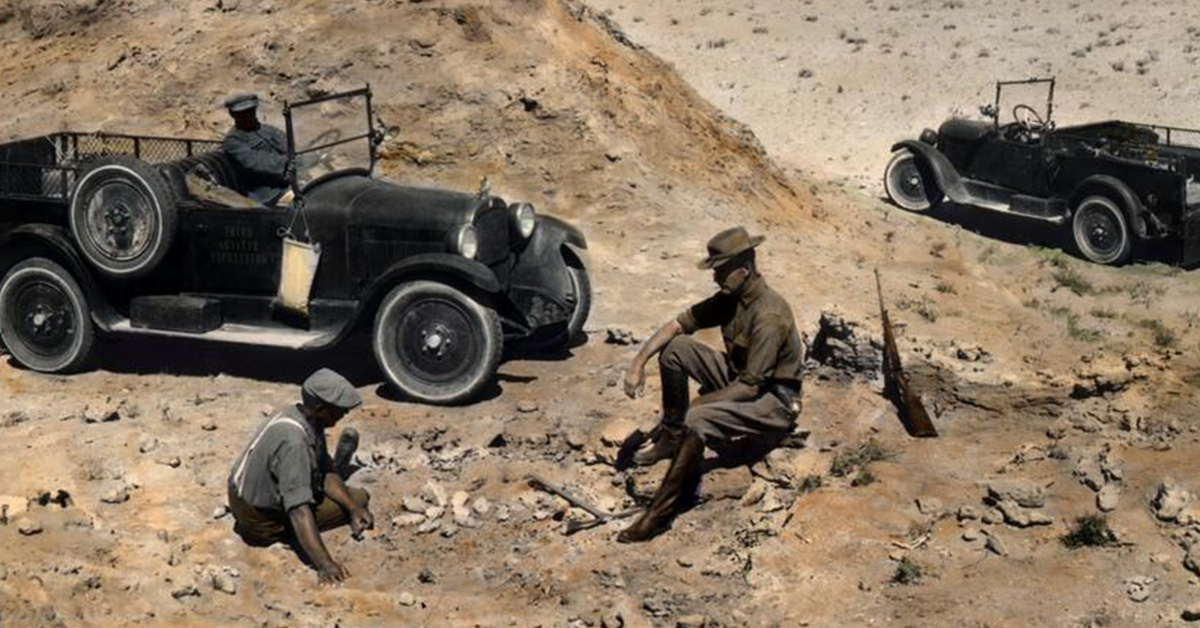
His exploring brought Andrews to paleontology. Once an inland sea, the Gobi Desert held great treasure. The remote Flaming Cliffs his team discovered yielded the first remains of Velociraptor, the fierce predator in the film, Jurassic Park. A nest of fossilized dinosaur eggs and embryos proved that at least some of these beasts did not give live birth.
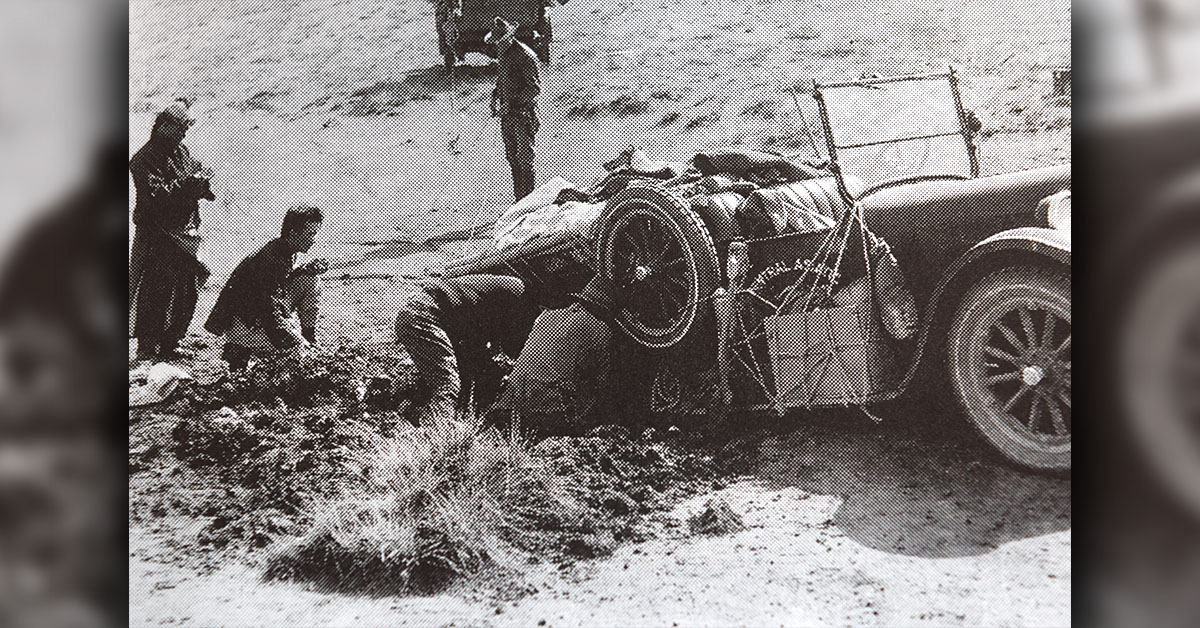
Civil unrest in China during the 1920s interrupted work at the “digs.” Passing troops with a show of credentials, Andrews and a car full of colleagues were fired upon by another. As bullets tore into the steering wheel and windscreen, he spun the vehicle around. But hearing the shots, and seeing the car now racing toward them, soldiers who’d waved them on thought them hostiles and added volleys. The riddled car was dragged to a stop by crazed Chinese piling on the bonnet and screaming, “Kill the foreign dogs!” An officer rode up as the Americans were stood against the sedan to be shot. Andrews’ fluent Mandarin secured his team’s release. He minded the major’s advice to “drive fast and far.”
Mongolia’s closed doors frustrated Roy. The stock market crash of 1929 and divorce from Yvette added pain. But in 1934, he was appointed Director of the Museum whose floors he had once swept.
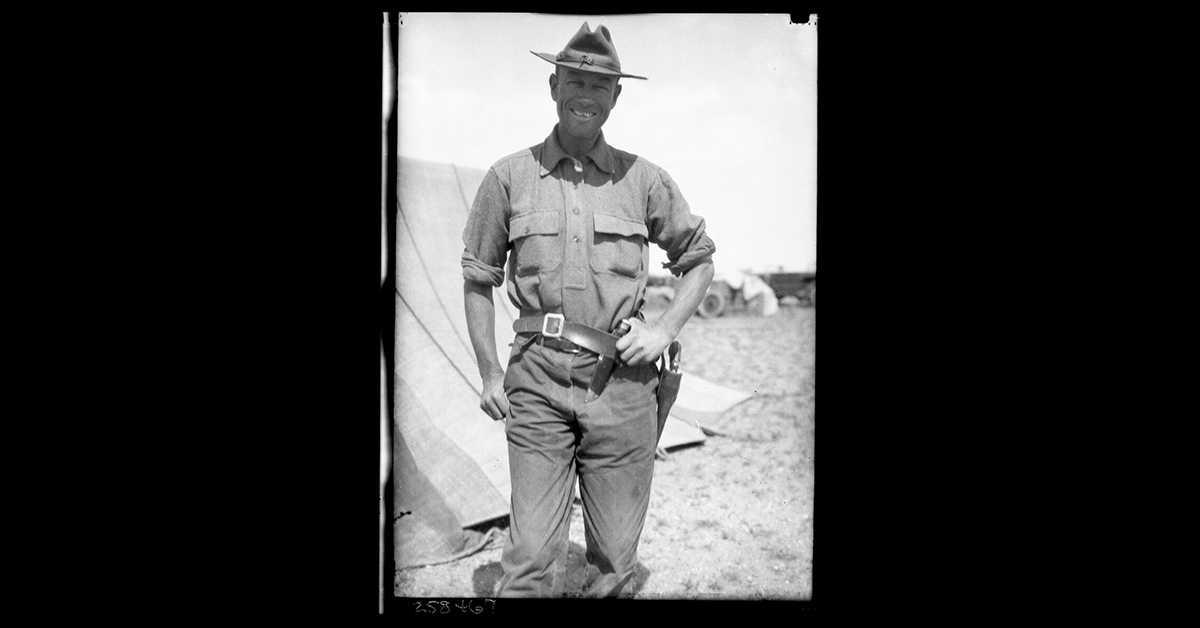
Decades later, George Lucas would bring to new generations a vivid image of the famous hunter, adventurer, and paleontologist. Minding what is known of Roy Chapman Andrews, he gave Indiana Jones a revolver, a bull whip, U.S. Intelligence credentials, and a campaign hat. Also, a distaste for snakes.